

238
8. Complex Geometries
- - old
F:
r e s e ($) ., + [(g) - ( z ) ~ , ]
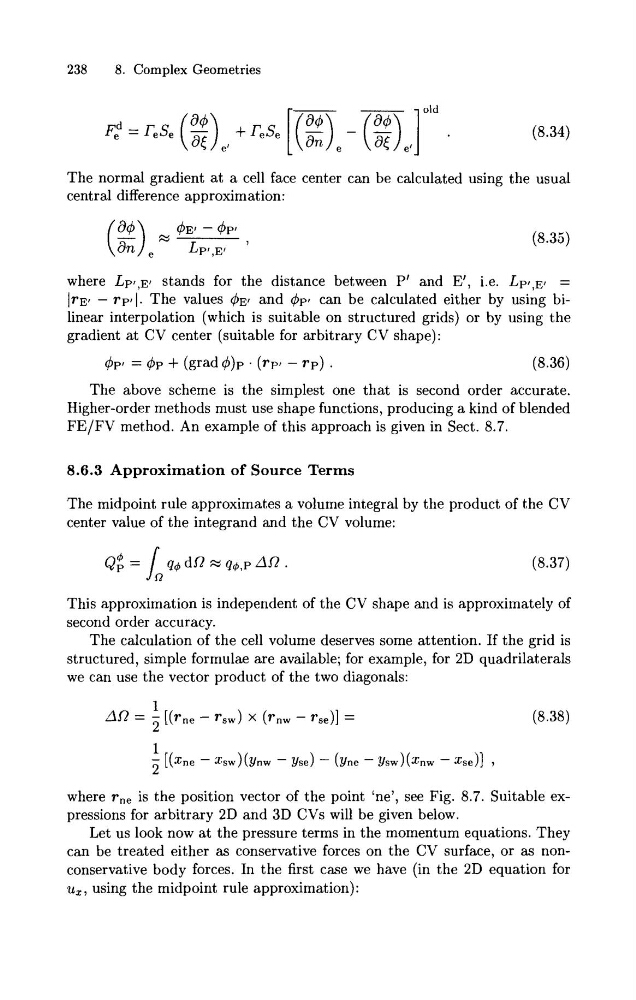
The normal gradient a t a cell face center can be calculated using the usual
central difference approximation:
where L p r , ~ ) stands for the distance between P' and E', i.e. L P , , ~ ,
=
IrE1 - r p ~
1. The values 4 ~ 1 and
can be calculated either by using bilinear interpolation (which is suitable on structured grids) or by using the
gradient at CV center (suitable for arbitrary CV shape):
The above scheme is the simplest one that is second order accurate.
Higher-order methods must use shape functions, producing a kind of blended
FE/FV method. An example of this approach is given in Sect. 8.7.
8.6.3 Approximation of Source Terms
The midpoint rule approximates a volume integral by the product of the CV
center value of the integrand and the CV volume:
This approximation is independent of the CV shape and is approximately of
second order accuracy.
The calculation of the cell volume deserves some attention. If the grid is
structured, simple formulae are available; for example, for 2D quadrilaterals
we can use the vector product of the two diagonals:
where rne is the position vector of the point he1, see Fig. 8.7. Suitable expressions for arbitrary 2D and 3D CVs will be given below.
Let us look now at the pressure terms in the momentum equations. They
can be treated either as conservative forces on the CV surface, or as nonconservative body forces. In the first case we have (in the 2D equation for
u,, using the midpoint rule approximation):
8. Complex Geometries
- - old
F:
r e s e ($) ., + [(g) - ( z ) ~ , ]
The normal gradient a t a cell face center can be calculated using the usual
central difference approximation:
where L p r , ~ ) stands for the distance between P' and E', i.e. L P , , ~ ,
=
IrE1 - r p ~
1. The values 4 ~ 1 and
can be calculated either by using bilinear interpolation (which is suitable on structured grids) or by using the
gradient at CV center (suitable for arbitrary CV shape):
The above scheme is the simplest one that is second order accurate.
Higher-order methods must use shape functions, producing a kind of blended
FE/FV method. An example of this approach is given in Sect. 8.7.
8.6.3 Approximation of Source Terms
The midpoint rule approximates a volume integral by the product of the CV
center value of the integrand and the CV volume:
This approximation is independent of the CV shape and is approximately of
second order accuracy.
The calculation of the cell volume deserves some attention. If the grid is
structured, simple formulae are available; for example, for 2D quadrilaterals
we can use the vector product of the two diagonals:
where rne is the position vector of the point he1, see Fig. 8.7. Suitable expressions for arbitrary 2D and 3D CVs will be given below.
Let us look now at the pressure terms in the momentum equations. They
can be treated either as conservative forces on the CV surface, or as nonconservative body forces. In the first case we have (in the 2D equation for
u,, using the midpoint rule approximation):