

8.6 Finite Volume Methods
235
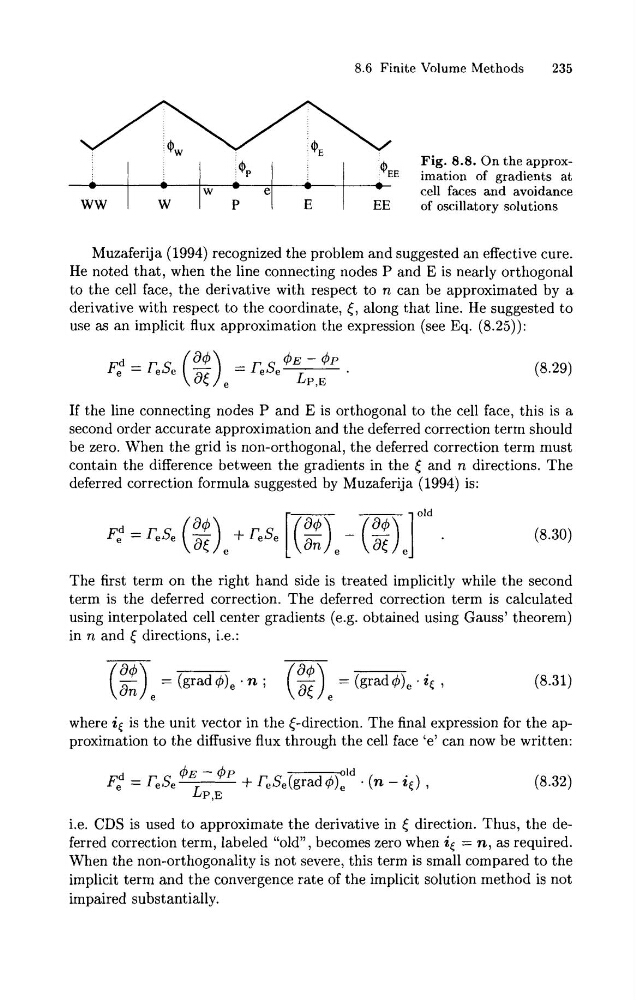
Fig. 8.8. On the approxE E
imation of gradients at
A
A
*
- I -
- I - cell faces and avoidance
WW I
W
I
P
I
E
1 EE
of oscillatory solutions
Muzaferija (1994) recognized the problem and suggested an effective cure.
He noted that, when the line connecting nodes P and E is nearly orthogonal
to the cell face, the derivative with respect to n can be approximated by a
derivative with respect to the coordinate, (, along that line. He suggested to
use as an implicit flux approximation the expression (see Eq. (8.25)):
If the line connecting nodes P and E is orthogonal to the cell face, this is a
second order accurate approximation and the deferred correction term should
be zero. When the grid is non-orthogonal, the deferred correction term must
contain the difference between the gradients in the ( and n directions. The
deferred correction formula suggested by Muzaferija (1994) is:
The first term on the right hand side is treated implicitly while the second
term is the deferred correction. The deferred correction term is calculated
using interpolated cell center gradients (e.g. obtained using Gauss' theorem)
in n and ( directions, i.e.:
where it is the unit vector in the (-direction. The final expression for the approximation to the diffusive flux through the cell face 'e' can now be written:
i.e. CDS is used to approximate the derivative in ( direction. Thus, the deferred correction term, labeled "old", becomes zero when it = n, as required.
When the non-orthogonality is not severe, this term is small compared to the
implicit term and the convergence rate of the implicit solution method is not
impaired substantially.
235
Fig. 8.8. On the approxE E
imation of gradients at
A
A
*
- I -
- I - cell faces and avoidance
WW I
W
I
P
I
E
1 EE
of oscillatory solutions
Muzaferija (1994) recognized the problem and suggested an effective cure.
He noted that, when the line connecting nodes P and E is nearly orthogonal
to the cell face, the derivative with respect to n can be approximated by a
derivative with respect to the coordinate, (, along that line. He suggested to
use as an implicit flux approximation the expression (see Eq. (8.25)):
If the line connecting nodes P and E is orthogonal to the cell face, this is a
second order accurate approximation and the deferred correction term should
be zero. When the grid is non-orthogonal, the deferred correction term must
contain the difference between the gradients in the ( and n directions. The
deferred correction formula suggested by Muzaferija (1994) is:
The first term on the right hand side is treated implicitly while the second
term is the deferred correction. The deferred correction term is calculated
using interpolated cell center gradients (e.g. obtained using Gauss' theorem)
in n and ( directions, i.e.:
where it is the unit vector in the (-direction. The final expression for the approximation to the diffusive flux through the cell face 'e' can now be written:
i.e. CDS is used to approximate the derivative in ( direction. Thus, the deferred correction term, labeled "old", becomes zero when it = n, as required.
When the non-orthogonality is not severe, this term is small compared to the
implicit term and the convergence rate of the implicit solution method is not
impaired substantially.