

10
1. Basic Concepts of Fluid Flow
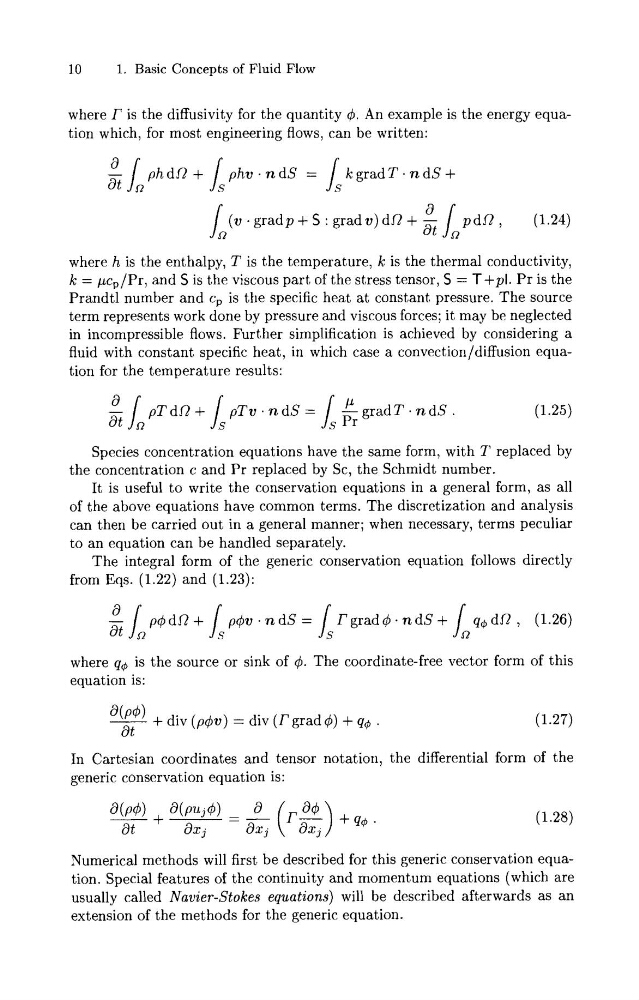
where r is the diffusivity for the quantity 4. An example is the energy equation which, for most engineering flows, can be written:
where h is the enthalpy, T is the temperature, k is the thermal conductivity,
k = pc,/Pr, and S is the viscous part of the stress tensor, S = T+pl. P r is the
Prandtl number and c, is the specific heat at constant pressure. The source
term represents work done by pressure and viscous forces; it may be neglected
in incompressible flows. Further simplification is achieved by considering a
fluid with constant specific heat, in which case a convection/diffusion equation for the temperature results:
Species concentration equations have the same form, with T replaced by
the concentration c and Pr replaced by Sc, the Schmidt number.
It is useful to write the conservation equations in a general form, as all
of the above equations have common terms. The discretization and analysis
can then be carried out in a general manner; when necessary, terms peculiar
to an equation can be handled separately.
The integral form of the generic conservation equation follows directly
from Eqs. (1.22) and (1.23):
where q$ is the source or sink of 4. The coordinate-free vector form of this
equation is:
a(p4) + div (pdv) = div ( T grad 4) + q$ .
a t
In Cartesian coordinates and tensor notation, the differential form of the
generic conservation equation is:
Numerical methods will first be described for this generic conservation equation. Special features of the continuity and momentum equations (which are
usually called Navier-Stokes equations) will be described afterwards as an
extension of the methods for the generic equation.
1. Basic Concepts of Fluid Flow
where r is the diffusivity for the quantity 4. An example is the energy equation which, for most engineering flows, can be written:
where h is the enthalpy, T is the temperature, k is the thermal conductivity,
k = pc,/Pr, and S is the viscous part of the stress tensor, S = T+pl. P r is the
Prandtl number and c, is the specific heat at constant pressure. The source
term represents work done by pressure and viscous forces; it may be neglected
in incompressible flows. Further simplification is achieved by considering a
fluid with constant specific heat, in which case a convection/diffusion equation for the temperature results:
Species concentration equations have the same form, with T replaced by
the concentration c and Pr replaced by Sc, the Schmidt number.
It is useful to write the conservation equations in a general form, as all
of the above equations have common terms. The discretization and analysis
can then be carried out in a general manner; when necessary, terms peculiar
to an equation can be handled separately.
The integral form of the generic conservation equation follows directly
from Eqs. (1.22) and (1.23):
where q$ is the source or sink of 4. The coordinate-free vector form of this
equation is:
a(p4) + div (pdv) = div ( T grad 4) + q$ .
a t
In Cartesian coordinates and tensor notation, the differential form of the
generic conservation equation is:
Numerical methods will first be described for this generic conservation equation. Special features of the continuity and momentum equations (which are
usually called Navier-Stokes equations) will be described afterwards as an
extension of the methods for the generic equation.