

218
8. Complex Geometries
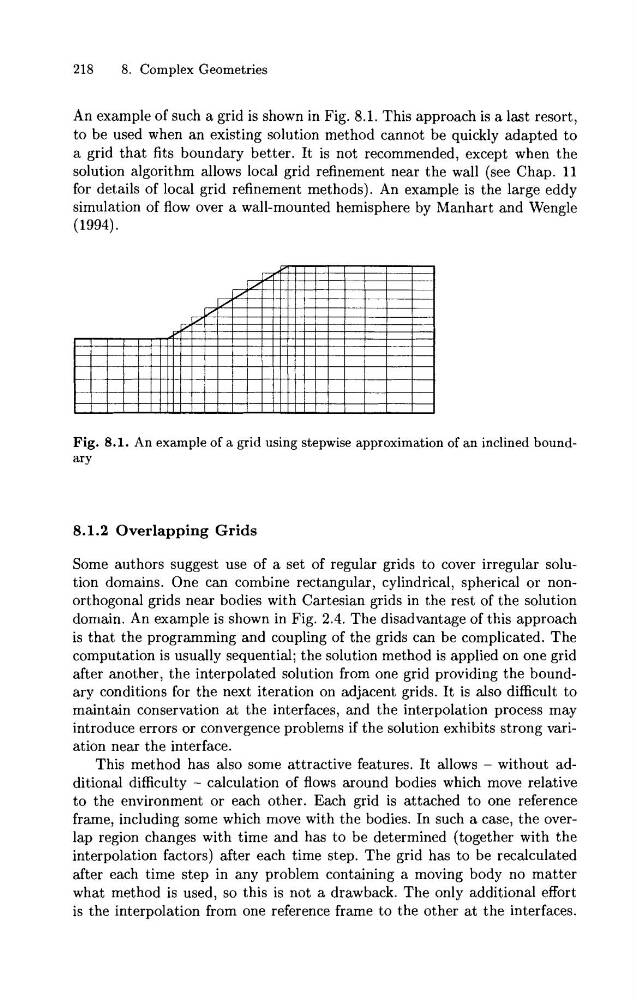
An example of such a grid is shown in Fig. 8.1. This approach is a last resort,
to be used when an existing solution method cannot be quickly adapted t o
a grid that fits boundary better. It is not recommended, except when the
solution algorithm allows local grid refinement near the wall (see Chap. 11
for details of local grid refinement methods). An example is the large eddy
simulation of flow over a wall-mounted hemisphere by Manhart and Wengle
(1994).
Fig. 8.1. An example of a grid using stepwise approximation of an inclined boundary
8.1.2 Overlapping Grids
Some authors suggest use of a set of regular grids to cover irregular solution domains. One can combine rectangular, cylindrical, spherical or nonorthogonal grids near bodies with Cartesian grids in the rest of the solution
domain. An example is shown in Fig. 2.4. The disadvantage of this approach
is that the programming and coupling of the grids can be complicated. The
computation is usually sequential; the solution method is applied on one grid
after another, the interpolated solution from one grid providing the boundary conditions for the next iteration on adjacent grids. It is also difficult to
maintain conservation at the interfaces, and the interpolation process may
introduce errors or convergence problems if the solution exhibits strong variation near the interface.
This method has also some attractive features. It allows - without additional difficulty - calculation of flows around bodies which move relative
to the environment or each other. Each grid is attached to one reference
frame, including some which move with the bodies. In such a case, the overlap region changes with time and has to be determined (together with the
interpolation factors) after each time step. The grid has to be recalculated
after each time step in any problem containing a moving body no matter
what method is used, so this is not a drawback. The only additional effort
is the interpolation from one reference frame to the other at the interfaces.
8. Complex Geometries
An example of such a grid is shown in Fig. 8.1. This approach is a last resort,
to be used when an existing solution method cannot be quickly adapted t o
a grid that fits boundary better. It is not recommended, except when the
solution algorithm allows local grid refinement near the wall (see Chap. 11
for details of local grid refinement methods). An example is the large eddy
simulation of flow over a wall-mounted hemisphere by Manhart and Wengle
(1994).
Fig. 8.1. An example of a grid using stepwise approximation of an inclined boundary
8.1.2 Overlapping Grids
Some authors suggest use of a set of regular grids to cover irregular solution domains. One can combine rectangular, cylindrical, spherical or nonorthogonal grids near bodies with Cartesian grids in the rest of the solution
domain. An example is shown in Fig. 2.4. The disadvantage of this approach
is that the programming and coupling of the grids can be complicated. The
computation is usually sequential; the solution method is applied on one grid
after another, the interpolated solution from one grid providing the boundary conditions for the next iteration on adjacent grids. It is also difficult to
maintain conservation at the interfaces, and the interpolation process may
introduce errors or convergence problems if the solution exhibits strong variation near the interface.
This method has also some attractive features. It allows - without additional difficulty - calculation of flows around bodies which move relative
to the environment or each other. Each grid is attached to one reference
frame, including some which move with the bodies. In such a case, the overlap region changes with time and has to be determined (together with the
interpolation factors) after each time step. The grid has to be recalculated
after each time step in any problem containing a moving body no matter
what method is used, so this is not a drawback. The only additional effort
is the interpolation from one reference frame to the other at the interfaces.