

7.8 Examples
215
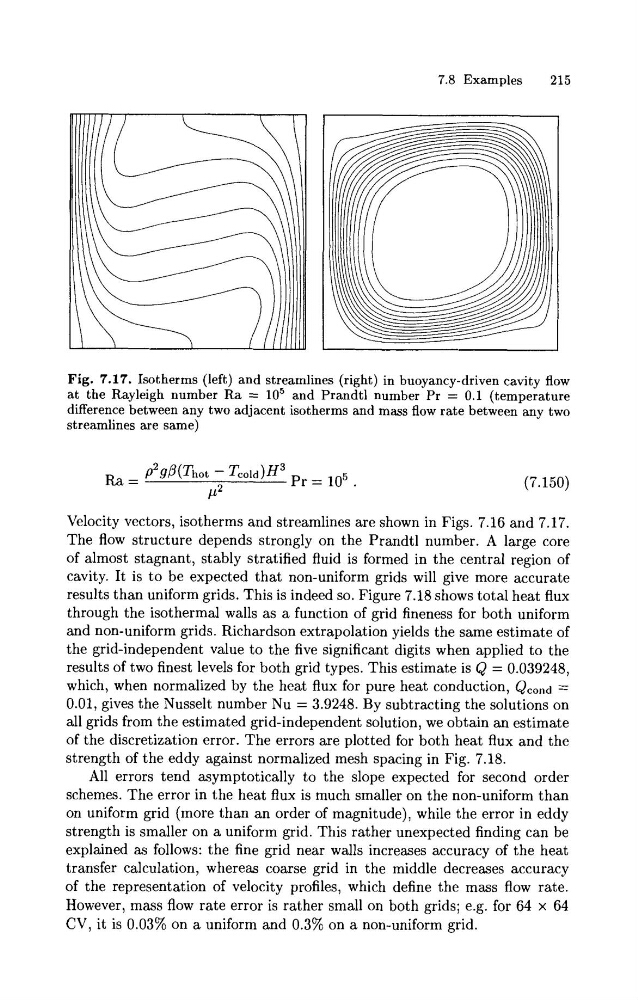
Fig. 7.17. Isotherms (left) and streamlines (right) in buoyancy-driven cavity flow
at the Rayleigh number Ra = lo5 and Prandtl number Pr = 0.1 (temperature
difference between any two adjacent isotherms and mass flow rate between any two
streamlines are same)
Velocity vectors, isotherms and streamlines are shown in Figs. 7.16 and 7.17.
The flow structure depends strongly on the Prandtl number. A large core
of almost stagnant, stably stratified fluid is formed in the central region of
cavity. It is t o be expected that non-uniform grids will give more accurate
results than uniform grids. This is indeed so. Figure 7.18 shows total heat flux
through the isothermal walls as a function of grid fineness for both uniform
and non-uniform grids. Richardson extrapolation yields the same estimate of
the grid-independent value to the five significant digits when applied to the
results of two finest levels for both grid types. This estimate is Q = 0.039248,
which, when normalized by the heat flux for pure heat conduction, Qcond =
0.01, gives the Nusselt number Nu = 3.9248. By subtracting the solutions on
all grids from the estimated grid-independent solution, we obtain an estimate
of the discretization error. The errors are plotted for both heat flux and the
strength of the eddy against normalized mesh spacing in Fig. 7.18.
All errors tend asymptotically to the slope expected for second order
schemes. The error in the heat flux is much smaller on the non-uniform than
on uniform grid (more than an order of magnitude), while the error in eddy
strength is smaller on a uniform grid. This rather unexpected finding can be
explained as follows: the fine grid near walls increases accuracy of the heat
transfer calculation, whereas coarse grid in the middle decreases accuracy
of the representation of velocity profiles, which define the mass flow rate.
However, mass flow rate error is rather small on both grids; e.g. for 64 x 64
CV, it is 0.03% on a uniform and 0.3% on a non-uniform grid.
215
Fig. 7.17. Isotherms (left) and streamlines (right) in buoyancy-driven cavity flow
at the Rayleigh number Ra = lo5 and Prandtl number Pr = 0.1 (temperature
difference between any two adjacent isotherms and mass flow rate between any two
streamlines are same)
Velocity vectors, isotherms and streamlines are shown in Figs. 7.16 and 7.17.
The flow structure depends strongly on the Prandtl number. A large core
of almost stagnant, stably stratified fluid is formed in the central region of
cavity. It is t o be expected that non-uniform grids will give more accurate
results than uniform grids. This is indeed so. Figure 7.18 shows total heat flux
through the isothermal walls as a function of grid fineness for both uniform
and non-uniform grids. Richardson extrapolation yields the same estimate of
the grid-independent value to the five significant digits when applied to the
results of two finest levels for both grid types. This estimate is Q = 0.039248,
which, when normalized by the heat flux for pure heat conduction, Qcond =
0.01, gives the Nusselt number Nu = 3.9248. By subtracting the solutions on
all grids from the estimated grid-independent solution, we obtain an estimate
of the discretization error. The errors are plotted for both heat flux and the
strength of the eddy against normalized mesh spacing in Fig. 7.18.
All errors tend asymptotically to the slope expected for second order
schemes. The error in the heat flux is much smaller on the non-uniform than
on uniform grid (more than an order of magnitude), while the error in eddy
strength is smaller on a uniform grid. This rather unexpected finding can be
explained as follows: the fine grid near walls increases accuracy of the heat
transfer calculation, whereas coarse grid in the middle decreases accuracy
of the representation of velocity profiles, which define the mass flow rate.
However, mass flow rate error is rather small on both grids; e.g. for 64 x 64
CV, it is 0.03% on a uniform and 0.3% on a non-uniform grid.