

212
7. Solution of the Navier-Stokes Equations
4th Order CDS
Mixed 2nd/4th
2nd Order CDS
\,
1st Order UDS
\.\Exact
'\
100
1000
10000
N u m b e r of CV
4th Order CDS
Mixed 2nd/4tk
2nd Order CDS
1st Order UDS
Ideal
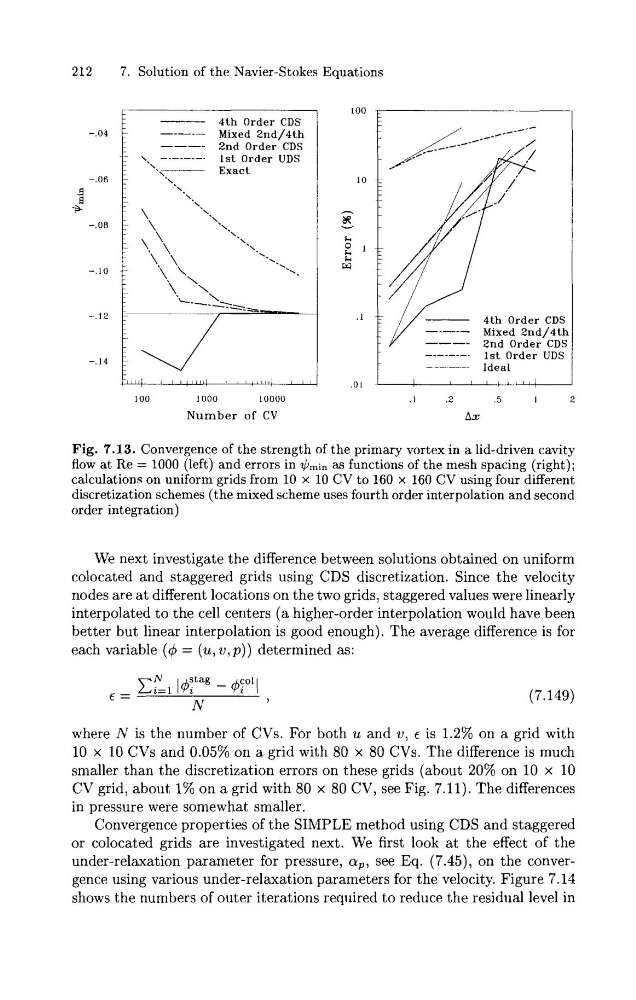
Fig. 7.13. Convergence of the strength of the primary vortex in a lid-driven cavity
flow at Re = 1000 (left) and errors in +,in as functions of the mesh spacing (right);
calculations on uniform grids from 10 x 10 CV to 160 x 160 CV using four different
discretization schemes (the mixed scheme uses fourth order interpolation and second
order integration)
We next investigate the difference between solutions obtained on uniform
colocated and staggered grids using CDS discretization. Since the velocity
nodes are a t different locations on the two grids, staggered values were linearly
interpolated to the cell centers ( a higher-order interpolation would have been
better but linear interpolation is good enough). The average difference is for
each variable ( 4 = (u, v,p)) determined as:
where N is the number of CVs. For both u and v, E is 1.2% on a grid with
10 x 10 CVs and 0.05% on a grid with 80 x 80 CVs. The difference is much
smaller than the discretization errors on these grids (about 20% on 10 x 10
CV grid, about 1% on a grid with 80 x 80 CV, see Fig. 7.11). The differences
in pressure were somewhat smaller.
Convergence properties of the SIMPLE method using CDS and staggered
or colocated grids are investigated next. We first look at the effect of the
under-relaxation parameter for pressure, a,, see Eq. (7.45), on the convergence using various under-relaxation parameters for the velocity. Figure 7.14
shows the numbers of outer iterations required t o reduce the residual level in
7. Solution of the Navier-Stokes Equations
4th Order CDS
Mixed 2nd/4th
2nd Order CDS
\,
1st Order UDS
\.\Exact
'\
100
1000
10000
N u m b e r of CV
4th Order CDS
Mixed 2nd/4tk
2nd Order CDS
1st Order UDS
Ideal
Fig. 7.13. Convergence of the strength of the primary vortex in a lid-driven cavity
flow at Re = 1000 (left) and errors in +,in as functions of the mesh spacing (right);
calculations on uniform grids from 10 x 10 CV to 160 x 160 CV using four different
discretization schemes (the mixed scheme uses fourth order interpolation and second
order integration)
We next investigate the difference between solutions obtained on uniform
colocated and staggered grids using CDS discretization. Since the velocity
nodes are a t different locations on the two grids, staggered values were linearly
interpolated to the cell centers ( a higher-order interpolation would have been
better but linear interpolation is good enough). The average difference is for
each variable ( 4 = (u, v,p)) determined as:
where N is the number of CVs. For both u and v, E is 1.2% on a grid with
10 x 10 CVs and 0.05% on a grid with 80 x 80 CVs. The difference is much
smaller than the discretization errors on these grids (about 20% on 10 x 10
CV grid, about 1% on a grid with 80 x 80 CV, see Fig. 7.11). The differences
in pressure were somewhat smaller.
Convergence properties of the SIMPLE method using CDS and staggered
or colocated grids are investigated next. We first look at the effect of the
under-relaxation parameter for pressure, a,, see Eq. (7.45), on the convergence using various under-relaxation parameters for the velocity. Figure 7.14
shows the numbers of outer iterations required t o reduce the residual level in