

7.8 Examples
209
if one knows roughly the order of the initial error (it is the solution itself
if one starts with a zero initial field), then a reliable criterion for stopping
the iterations is the reduction of the norm of either the difference between
two iterates or the residual by a certain factor, say three or four orders of
magnitude. Results similar to those shown in Fig. 7.10 are obtained on other
grids and for other flow problems.
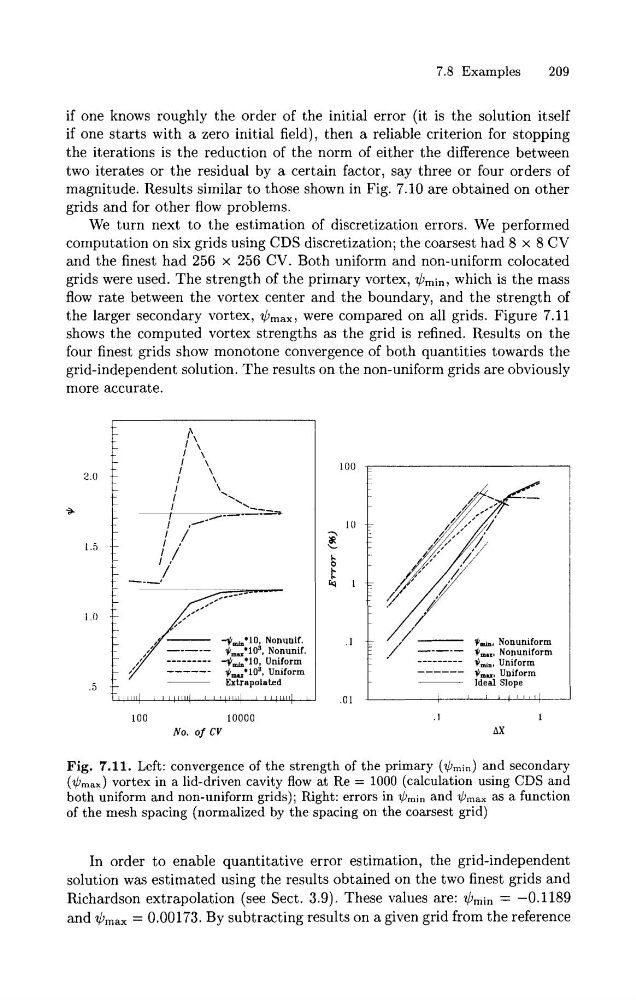
We turn next to the estimation of discretization errors. We performed
computation on six grids using CDS discretization; the coarsest had 8 x 8 CV
and the finest had 256 x 256 CV. Both uniform and non-uniform colocated
grids were used. The strength of the primary vortex, $,in, which is the mass
flow rate between the vortex center and the boundary, and the strength of
the larger secondary vortex, GmaX, were compared on all grids. Figure 7.11
shows the computed vortex strengths as the grid is refined. Results on the
four finest grids show monotone convergence of both quantities towards the
grid-independent solution. The results on the non-uniform grids are obviously
more accurate.
+,*lo.
Nonunif.
$,,*103. Nonunif.
+,*lo,
Uniform
$,,*10~, Uniform
4
Extrapolated
."
1 , 1 1 1
1 / 1 / 1 , 1 1 l
1 1 ' l 1 l I l
I
1 1 1 1 1 1 1 1
I
100
10000
No. of CV
$
,
,
Nonuniform
----- - - - - - - - -
$,,, Nonuniform
-----$mint Uniform
$,,,
Uniform
Ideal Slope
Fig. 7.11. Left: convergence of the strength of the primary (q,;,) and secondary
($,,,)
vortex in a lid-driven cavity flow at Re = 1000 (calculation using CDS and
both uniform and non-uniform grids); Right: errors in qmi, and q,,, as a function
of the mesh spacing (normalized by the spacing on the coarsest grid)
In order to enable quantitative error estimation, the grid-independent
solution was estimated using the results obtained on the two finest grids and
Richardson extrapolation (see Sect. 3.9). These values are: Gmin = -0.1189
and I), , ,
= 0.00173. By subtracting results on a given grid from the reference
209
if one knows roughly the order of the initial error (it is the solution itself
if one starts with a zero initial field), then a reliable criterion for stopping
the iterations is the reduction of the norm of either the difference between
two iterates or the residual by a certain factor, say three or four orders of
magnitude. Results similar to those shown in Fig. 7.10 are obtained on other
grids and for other flow problems.
We turn next to the estimation of discretization errors. We performed
computation on six grids using CDS discretization; the coarsest had 8 x 8 CV
and the finest had 256 x 256 CV. Both uniform and non-uniform colocated
grids were used. The strength of the primary vortex, $,in, which is the mass
flow rate between the vortex center and the boundary, and the strength of
the larger secondary vortex, GmaX, were compared on all grids. Figure 7.11
shows the computed vortex strengths as the grid is refined. Results on the
four finest grids show monotone convergence of both quantities towards the
grid-independent solution. The results on the non-uniform grids are obviously
more accurate.
+,*lo.
Nonunif.
$,,*103. Nonunif.
+,*lo,
Uniform
$,,*10~, Uniform
4
Extrapolated
."
1 , 1 1 1
1 / 1 / 1 , 1 1 l
1 1 ' l 1 l I l
I
1 1 1 1 1 1 1 1
I
100
10000
No. of CV
$
,
,
Nonuniform
----- - - - - - - - -
$,,, Nonuniform
-----$mint Uniform
$,,,
Uniform
Ideal Slope
Fig. 7.11. Left: convergence of the strength of the primary (q,;,) and secondary
($,,,)
vortex in a lid-driven cavity flow at Re = 1000 (calculation using CDS and
both uniform and non-uniform grids); Right: errors in qmi, and q,,, as a function
of the mesh spacing (normalized by the spacing on the coarsest grid)
In order to enable quantitative error estimation, the grid-independent
solution was estimated using the results obtained on the two finest grids and
Richardson extrapolation (see Sect. 3.9). These values are: Gmin = -0.1189
and I), , ,
= 0.00173. By subtracting results on a given grid from the reference