

7.3 Calculation of the Pressure
175
As noted earlier, the derivatives of the pressure inside the brackets must be
discretized in the same way they are discretized in the momentum equations;
the outer derivatives, which come from the continuity equation, must be
approximated in the way they are discretized in the continuity equation.
After solving the Poisson equation for the pressure, (7.35), the final velocity field at the new iteration, u y , is calculated from Eq. (7.34). At this
point, we have a velocity field which satisfies the continuity condition, but the
velocity and pressure fields do not satisfy the momentum equations (7.30).
We begin another outer iteration and the process is continued until a velocity field which satisfies both the momentum and continuity equations is
obtained.
This method is essentially a variation on the one presented in the preceding section. Methods of this kind, which first construct velocity field that
does not satisfy the continuity equation and then correct it by subtracting
something (usually a pressure gradient) are known as projection methods.
The name is derived from the concept that the divergence-producing part of
the field is projected out.
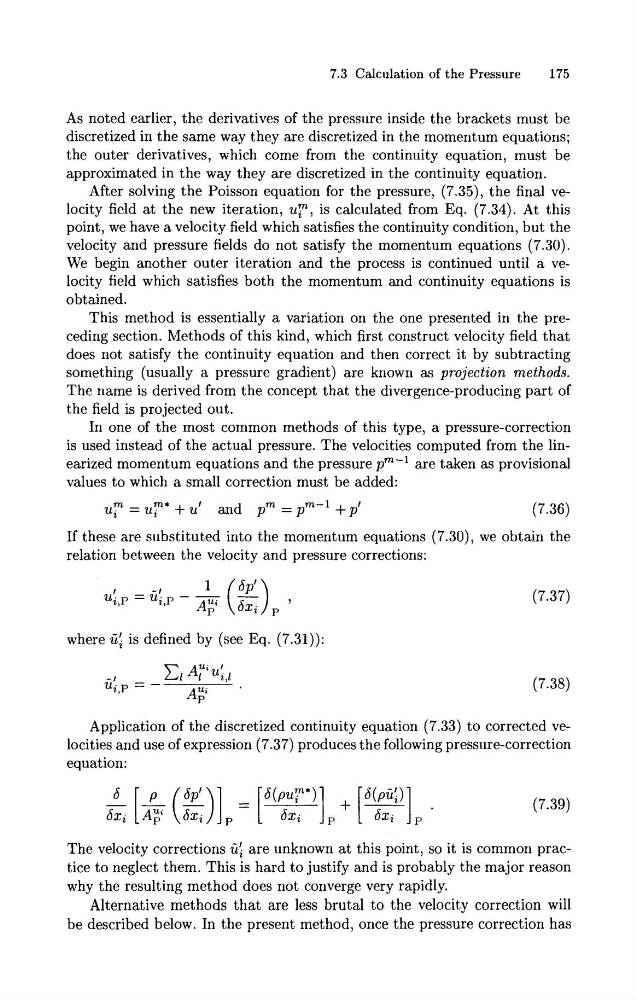
In one of the most common methods of this type, a pressure-correction
is used instead of the actual pressure. The velocities computed from the linearized momentum equations and the pressure pm-' are taken as provisional
values to which a small correction must be added:
If these are substituted into the momentum equations (7.30), we obtain the
relation between the velocity and pressure corrections:
where GI is defined by (see Eq. (7.31)):
Application of the discretized continuity equation (7.33) to corrected velocities and use of expression (7.37) produces the following pressure-correction
equation:
The velocity corrections 12: are unknown at this point, so it is common practice to neglect them. This is hard to justify and is probably the major reason
why the resulting method does not converge very rapidly.
Alternative methods that are less brutal to the velocity correction will
be described below. In the present method, once the pressure correction has
175
As noted earlier, the derivatives of the pressure inside the brackets must be
discretized in the same way they are discretized in the momentum equations;
the outer derivatives, which come from the continuity equation, must be
approximated in the way they are discretized in the continuity equation.
After solving the Poisson equation for the pressure, (7.35), the final velocity field at the new iteration, u y , is calculated from Eq. (7.34). At this
point, we have a velocity field which satisfies the continuity condition, but the
velocity and pressure fields do not satisfy the momentum equations (7.30).
We begin another outer iteration and the process is continued until a velocity field which satisfies both the momentum and continuity equations is
obtained.
This method is essentially a variation on the one presented in the preceding section. Methods of this kind, which first construct velocity field that
does not satisfy the continuity equation and then correct it by subtracting
something (usually a pressure gradient) are known as projection methods.
The name is derived from the concept that the divergence-producing part of
the field is projected out.
In one of the most common methods of this type, a pressure-correction
is used instead of the actual pressure. The velocities computed from the linearized momentum equations and the pressure pm-' are taken as provisional
values to which a small correction must be added:
If these are substituted into the momentum equations (7.30), we obtain the
relation between the velocity and pressure corrections:
where GI is defined by (see Eq. (7.31)):
Application of the discretized continuity equation (7.33) to corrected velocities and use of expression (7.37) produces the following pressure-correction
equation:
The velocity corrections 12: are unknown at this point, so it is common practice to neglect them. This is hard to justify and is probably the major reason
why the resulting method does not converge very rapidly.
Alternative methods that are less brutal to the velocity correction will
be described below. In the present method, once the pressure correction has