

7.3 Calculation of the Pressure
167
Other staggering methods have been suggested, for example, the partially
staggered ALE (Arbitrary Lagrangian-Eulerian) method (Hirt et al., 1974),
in which both velocity components are stored at the corners of the pressure
CVs, see Fig. 7.2. This variant has some advantages when the grid is nonorthogonal, an important one being that the pressure at the boundary need
not be specified. However, it also has drawbacks, notably the possibility of
producing oscillatory pressure or velocity fields.
Other arrangements have not gained wide popularity and will not be
further discussed here.
7.3 Calculation of the Pressure
Solution of the Navier-Stokes equations is complicated by the lack of an independent equation for the pressure, whose gradient contributes to each of
the three momentum equations. Furthermore, the continuity equation does
not have a dominant variable in incompressible flows. Mass conservation is
a kinematic constraint on the velocity field rather than a dynamic equation.
One way out of this difficulty is to construct the pressure field so as to guarantee satisfaction of the continuity equation. This may seem a bit strange
at first, but we shall show below that it is possible. Note that the absolute
pressure is of no significance in an incompressible flow; only the gradient of
the pressure (pressure difference) affects the flow.
In compressible flows the continuity equation can be used to determine
the density and the pressure is calculated from an equation of state. This
approach is not appropriate for incompressible or low Mach number flows.
Within this section we present the basic philosophy behind some of the
most popular methods of pressure-velocity coupling. Section 7.5 presents a
full set of discretized equations which form the basis for writing a computer
code.
7.3.1 The Pressure Equation and its Solution
The momentum equations clearly determine the respective velocity components so their roles are clearly defined. This leaves the continuity equation,
which does not contain the pressure, to determine the pressure. How can this
be done? The most common method is based on combining the two equations.
The form of the continuity equation suggests that we take the divergence
of the momentum equation (1.15). The continuity equation can be used to
simplify the resulting equation, leaving a Poisson equation for the pressure:
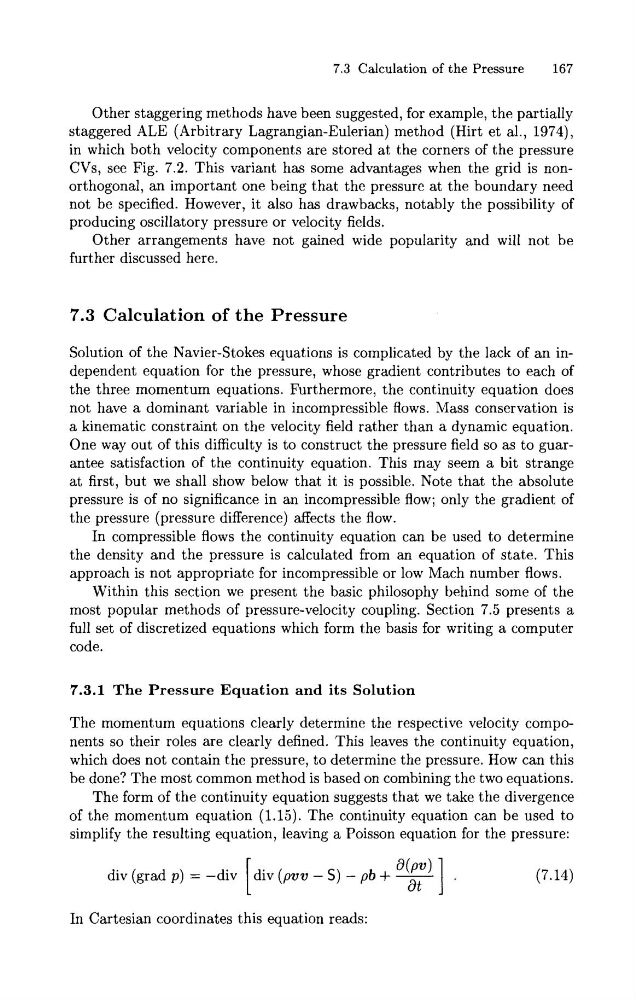
div (grad p) = -div div (pvv - S) - pb + - at
In Cartesian coordinates this equation reads:
167
Other staggering methods have been suggested, for example, the partially
staggered ALE (Arbitrary Lagrangian-Eulerian) method (Hirt et al., 1974),
in which both velocity components are stored at the corners of the pressure
CVs, see Fig. 7.2. This variant has some advantages when the grid is nonorthogonal, an important one being that the pressure at the boundary need
not be specified. However, it also has drawbacks, notably the possibility of
producing oscillatory pressure or velocity fields.
Other arrangements have not gained wide popularity and will not be
further discussed here.
7.3 Calculation of the Pressure
Solution of the Navier-Stokes equations is complicated by the lack of an independent equation for the pressure, whose gradient contributes to each of
the three momentum equations. Furthermore, the continuity equation does
not have a dominant variable in incompressible flows. Mass conservation is
a kinematic constraint on the velocity field rather than a dynamic equation.
One way out of this difficulty is to construct the pressure field so as to guarantee satisfaction of the continuity equation. This may seem a bit strange
at first, but we shall show below that it is possible. Note that the absolute
pressure is of no significance in an incompressible flow; only the gradient of
the pressure (pressure difference) affects the flow.
In compressible flows the continuity equation can be used to determine
the density and the pressure is calculated from an equation of state. This
approach is not appropriate for incompressible or low Mach number flows.
Within this section we present the basic philosophy behind some of the
most popular methods of pressure-velocity coupling. Section 7.5 presents a
full set of discretized equations which form the basis for writing a computer
code.
7.3.1 The Pressure Equation and its Solution
The momentum equations clearly determine the respective velocity components so their roles are clearly defined. This leaves the continuity equation,
which does not contain the pressure, to determine the pressure. How can this
be done? The most common method is based on combining the two equations.
The form of the continuity equation suggests that we take the divergence
of the momentum equation (1.15). The continuity equation can be used to
simplify the resulting equation, leaving a Poisson equation for the pressure:
div (grad p) = -div div (pvv - S) - pb + - at
In Cartesian coordinates this equation reads: