

6.2 Methods for Initial Value Problems in ODES
141
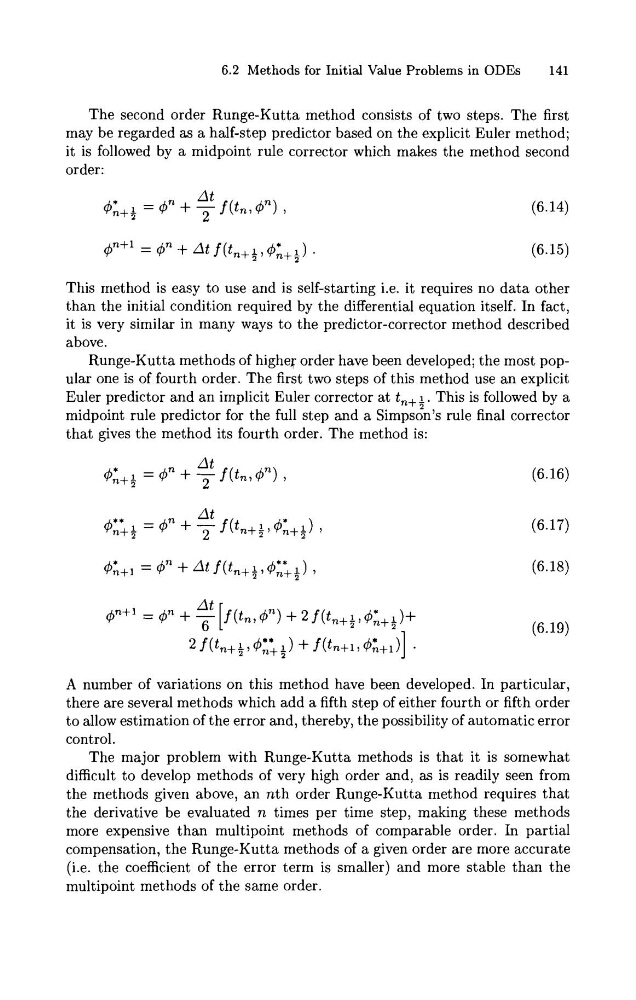
The second order Runge-Kutta method consists of two steps. The first
may be regarded as a half-step predictor based on the explicit Euler method;
it is followed by a midpoint rule corrector which makes the method second
order :
This method is easy to use and is self-starting i.e. it requires no data other
than the initial condition required by the differential equation itself. In fact,
it is very similar in many ways to the predictor-corrector method described
above.
Runge-Kutta methods of higher order have been developed; the most popular one is of fourth order. The first two steps of this method use an explicit
Euler predictor and an implicit Euler corrector at tn+;. This is followed by a
midpoint rule predictor for the full step and a Simpson's rule final corrector
that gives the method its fourth order. The method is:
A number of variations on this method have been developed. In particular,
there are several methods which add a fifth step of either fourth or fifth order
to allow estimation of the error and, thereby, the possibility of automatic error
control.
The major problem with Runge-Kutta methods is that it is somewhat
difficult to develop methods of very high order and, as is readily seen from
the methods given above, an nth order Runge-Kutta method requires that
the derivative be evaluated n times per time step, making these methods
more expensive than multipoint methods of comparable order. In partial
compensation, the Runge-Kutta methods of a given order are more accurate
(i.e. the coefficient of the error term is smaller) and more stable than the
multipoint methods of the same order.
141
The second order Runge-Kutta method consists of two steps. The first
may be regarded as a half-step predictor based on the explicit Euler method;
it is followed by a midpoint rule corrector which makes the method second
order :
This method is easy to use and is self-starting i.e. it requires no data other
than the initial condition required by the differential equation itself. In fact,
it is very similar in many ways to the predictor-corrector method described
above.
Runge-Kutta methods of higher order have been developed; the most popular one is of fourth order. The first two steps of this method use an explicit
Euler predictor and an implicit Euler corrector at tn+;. This is followed by a
midpoint rule predictor for the full step and a Simpson's rule final corrector
that gives the method its fourth order. The method is:
A number of variations on this method have been developed. In particular,
there are several methods which add a fifth step of either fourth or fifth order
to allow estimation of the error and, thereby, the possibility of automatic error
control.
The major problem with Runge-Kutta methods is that it is somewhat
difficult to develop methods of very high order and, as is readily seen from
the methods given above, an nth order Runge-Kutta method requires that
the derivative be evaluated n times per time step, making these methods
more expensive than multipoint methods of comparable order. In partial
compensation, the Runge-Kutta methods of a given order are more accurate
(i.e. the coefficient of the error term is smaller) and more stable than the
multipoint methods of the same order.