

5.7 Convergence Criteria and Iteration Errors
125
This error estimate can be computed from the two successive iterates of the
solution. Although the method is designed for linear systems, all systems are
essentially linear near convergence; as this is the time when error estimates
are most needed, the method can be applied to nonlinear systems as well.
Unfortunately, iterative methods often have complex eigenvalues. When
this is the case, the error reduction is not exponential and may not be monotonic. Since the equations are real, complex eigenvalues must occur as conjugate pairs. Their estimation requires an extension of the above procedure.
In particular, data from more iterates are required. Some of the ideas used
below are found in Golub and van Loan (1990).
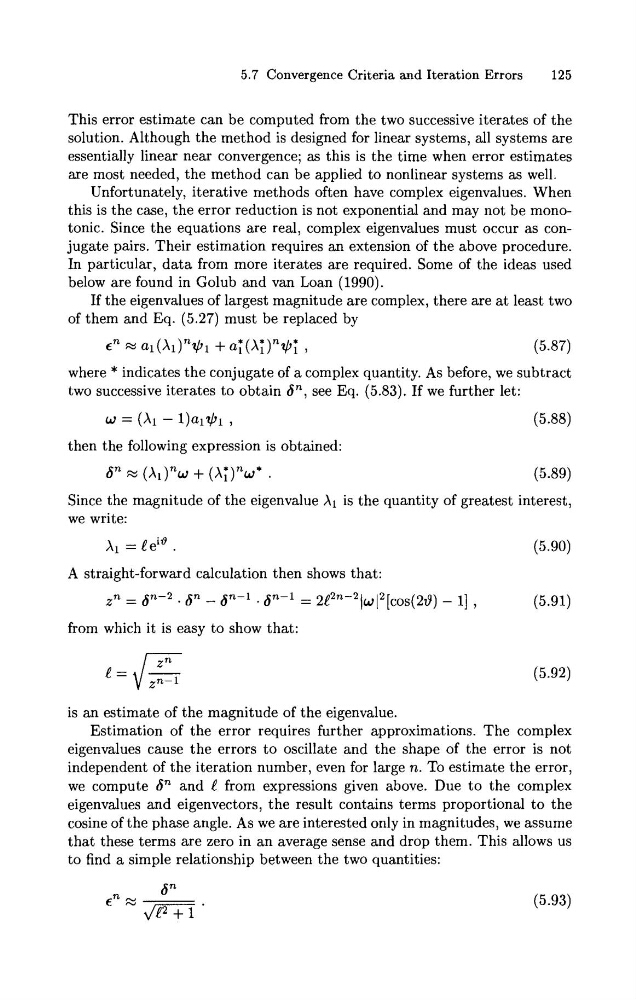
If the eigenvalues of largest magnitude are complex, there are a t least two
of them and Eq. (5.27) must be replaced by
where * indicates the conjugate of a complex quantity. As before, we subtract
two successive iterates to obtain hn, see Eq. (5.83). If we further let:
then the following expression is obtained:
Since the magnitude of the eigenvalue X1 is the quantity of greatest interest,
we write:
X1 = lei* .
(5.90)
A straight-forward calculation then shows that:
from which it is easy to show that:
is an estimate of the magnitude of the eigenvalue.
Estimation of the error requires further approximations. The complex
eigenvalues cause the errors t o oscillate and the shape of the error is not
independent of the iteration number, even for large n. To estimate the error,
we compute bn and e from expressions given above. Due t o the complex
eigenvalues and eigenvectors, the result contains terms proportional t o the
cosine of the phase angle. As we are interested only in magnitudes, we assume
that these terms are zero in an average sense and drop them. This allows us
to find a simple relationship between the two quantities:
125
This error estimate can be computed from the two successive iterates of the
solution. Although the method is designed for linear systems, all systems are
essentially linear near convergence; as this is the time when error estimates
are most needed, the method can be applied to nonlinear systems as well.
Unfortunately, iterative methods often have complex eigenvalues. When
this is the case, the error reduction is not exponential and may not be monotonic. Since the equations are real, complex eigenvalues must occur as conjugate pairs. Their estimation requires an extension of the above procedure.
In particular, data from more iterates are required. Some of the ideas used
below are found in Golub and van Loan (1990).
If the eigenvalues of largest magnitude are complex, there are a t least two
of them and Eq. (5.27) must be replaced by
where * indicates the conjugate of a complex quantity. As before, we subtract
two successive iterates to obtain hn, see Eq. (5.83). If we further let:
then the following expression is obtained:
Since the magnitude of the eigenvalue X1 is the quantity of greatest interest,
we write:
X1 = lei* .
(5.90)
A straight-forward calculation then shows that:
from which it is easy to show that:
is an estimate of the magnitude of the eigenvalue.
Estimation of the error requires further approximations. The complex
eigenvalues cause the errors t o oscillate and the shape of the error is not
independent of the iteration number, even for large n. To estimate the error,
we compute bn and e from expressions given above. Due t o the complex
eigenvalues and eigenvectors, the result contains terms proportional t o the
cosine of the phase angle. As we are interested only in magnitudes, we assume
that these terms are zero in an average sense and drop them. This allows us
to find a simple relationship between the two quantities: