

5.6 Deferred-Correction Approaches
123
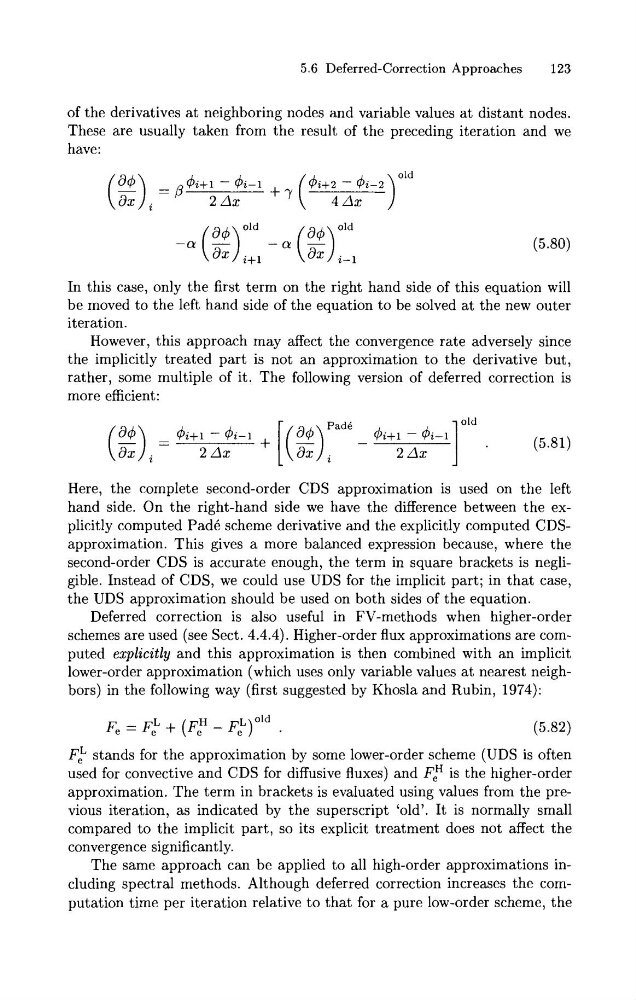
of the derivatives a t neighboring nodes and variable values a t distant nodes.
These are usually taken from the result of the preceding iteration and we
have:
old
old
(2)i+l - (2) i-1
In this case, only the first term on the right hand side of this equation will
be moved to the left hand side of the equation to be solved at the new outer
iteration.
However, this approach may affect the convergence rate adversely since
the implicitly treated part is not an approximation to the derivative but,
rather, some multiple of it. The following version of deferred correction is
more efficient:
Here, the complete second-order CDS approximation is used on the left
hand side. On the right-hand side we have the difference between the explicitly computed Pad6 scheme derivative and the explicitly computed CDSapproximation. This gives a more balanced expression because, where the
second-order CDS is accurate enough, the term in square brackets is negligible. Instead of CDS, we could use UDS for the implicit part; in that case,
the UDS approximation should be used on both sides of the equation.
Deferred correction is also useful in FV-methods when higher-order
schemes are used (see Sect. 4.4.4). Higher-order flux approximations are computed explicitly and this approximation is then combined with an implicit
lower-order approximation (which uses only variable values a t nearest neighbors) in the following way (first suggested by Khosla and Rubin, 1974):
F: stands for the approximation by some lower-order scheme (UDS is often
used for convective and CDS for diffusive fluxes) and F: is the higher-order
approximation. The term in brackets is evaluated using values from the previous iteration, as indicated by the superscript 'old'. It is normally small
compared to the implicit part, so its explicit treatment does not affect the
convergence significantly.
The same approach can be applied to all high-order approximations including spectral methods. Although deferred correction increases the computation time per iteration relative t o that for a pure low-order scheme, the
123
of the derivatives a t neighboring nodes and variable values a t distant nodes.
These are usually taken from the result of the preceding iteration and we
have:
old
old
(2)i+l - (2) i-1
In this case, only the first term on the right hand side of this equation will
be moved to the left hand side of the equation to be solved at the new outer
iteration.
However, this approach may affect the convergence rate adversely since
the implicitly treated part is not an approximation to the derivative but,
rather, some multiple of it. The following version of deferred correction is
more efficient:
Here, the complete second-order CDS approximation is used on the left
hand side. On the right-hand side we have the difference between the explicitly computed Pad6 scheme derivative and the explicitly computed CDSapproximation. This gives a more balanced expression because, where the
second-order CDS is accurate enough, the term in square brackets is negligible. Instead of CDS, we could use UDS for the implicit part; in that case,
the UDS approximation should be used on both sides of the equation.
Deferred correction is also useful in FV-methods when higher-order
schemes are used (see Sect. 4.4.4). Higher-order flux approximations are computed explicitly and this approximation is then combined with an implicit
lower-order approximation (which uses only variable values a t nearest neighbors) in the following way (first suggested by Khosla and Rubin, 1974):
F: stands for the approximation by some lower-order scheme (UDS is often
used for convective and CDS for diffusive fluxes) and F: is the higher-order
approximation. The term in brackets is evaluated using values from the previous iteration, as indicated by the superscript 'old'. It is normally small
compared to the implicit part, so its explicit treatment does not affect the
convergence significantly.
The same approach can be applied to all high-order approximations including spectral methods. Although deferred correction increases the computation time per iteration relative t o that for a pure low-order scheme, the