

5.3 Iterative Methods
103
vector M@:
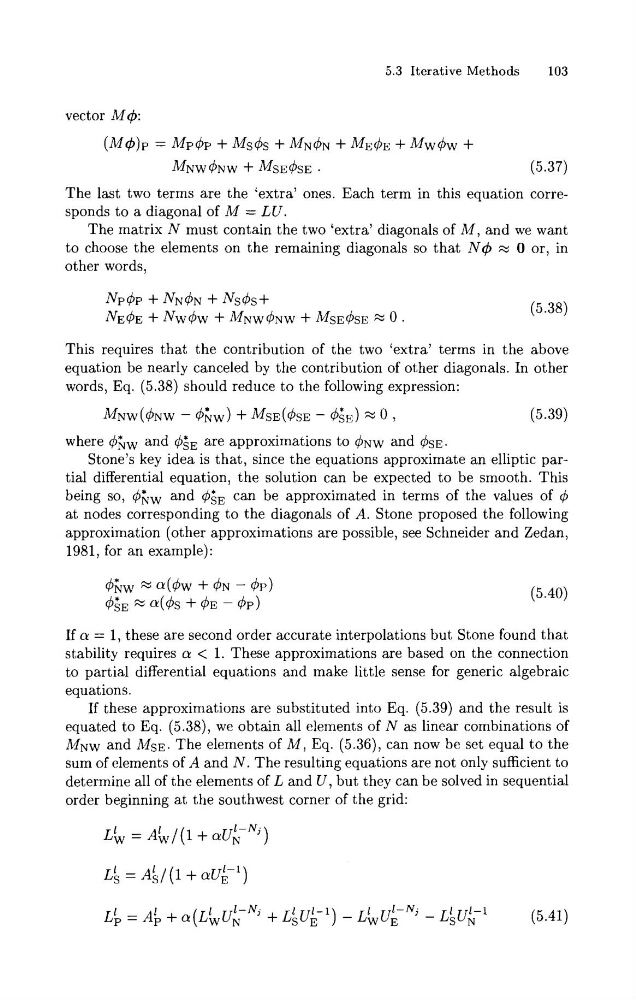
The last two terms are the 'extra' ones. Each term in this equation corresponds to a diagonal of M = LU.
The matrix N must contain the two 'extra' diagonals of M , and we want
to choose the elements on the remaining diagonals so that N 4 x 0 or, in
other words,
This requires that the contribution of the two 'extra' terms in the above
equation be nearly canceled by the contribution of other diagonals. In other
words, Eq. (5.38) should reduce to the following expression:
where 4hw and q! ~: ~ are approximations to ~ N W and 4 s ~ .
Stone's key idea is that, since the equations approximate an elliptic partial differential equation, the solution can be expected to be smooth. This
being so, 4kw and 4EE can be approximated in terms of the values of 4
at nodes corresponding to the diagonals of A. Stone proposed the following
approximation (other approximations are possible, see Schneider and Zedan,
1981, for an example):
If CY = 1, these are second order accurate interpolations but Stone found that
stability requires cr < 1. These approximations are based on the connection
to partial differential equations and make little sense for generic algebraic
equations.
If these approximations are substituted into Eq. (5.39) and the result is
equated to Eq. (5.38), we obtain all elements of N as linear combinations of
MNW and MSE The elements of M , Eq. (5.36), can now be set equal t o the
sum of elements of A and N. The resulting equations are not only sufficient to
determine all of the elements of L and U, but they can be solved in sequential
order beginning a t the southwest corner of the grid:
103
vector M@:
The last two terms are the 'extra' ones. Each term in this equation corresponds to a diagonal of M = LU.
The matrix N must contain the two 'extra' diagonals of M , and we want
to choose the elements on the remaining diagonals so that N 4 x 0 or, in
other words,
This requires that the contribution of the two 'extra' terms in the above
equation be nearly canceled by the contribution of other diagonals. In other
words, Eq. (5.38) should reduce to the following expression:
where 4hw and q! ~: ~ are approximations to ~ N W and 4 s ~ .
Stone's key idea is that, since the equations approximate an elliptic partial differential equation, the solution can be expected to be smooth. This
being so, 4kw and 4EE can be approximated in terms of the values of 4
at nodes corresponding to the diagonals of A. Stone proposed the following
approximation (other approximations are possible, see Schneider and Zedan,
1981, for an example):
If CY = 1, these are second order accurate interpolations but Stone found that
stability requires cr < 1. These approximations are based on the connection
to partial differential equations and make little sense for generic algebraic
equations.
If these approximations are substituted into Eq. (5.39) and the result is
equated to Eq. (5.38), we obtain all elements of N as linear combinations of
MNW and MSE The elements of M , Eq. (5.36), can now be set equal t o the
sum of elements of A and N. The resulting equations are not only sufficient to
determine all of the elements of L and U, but they can be solved in sequential
order beginning a t the southwest corner of the grid: