

84
3 An Introduction to Surface Waves
water at the bottom is virtually stationary whether or not the bottom is there,
as the presence or absence of a solid bottom makes little difference. On the
other hand, when the depth of the water in the basin is less than half the
wavelength, the bottom affects the flow pattern in the basin.
3.4.2 Orbital Motion of Water Particles
We earlier described wave motion as the process whereby energy is transmitted,
but material itself is not transported by wave propagation. However, it is easy
to observe that the wave form itself moves; for example, wave crests moving
on the water surface. A cork floating on propagating wave crests appears to
move 'up and down', but this is not exactly true. The cork in fact moves in
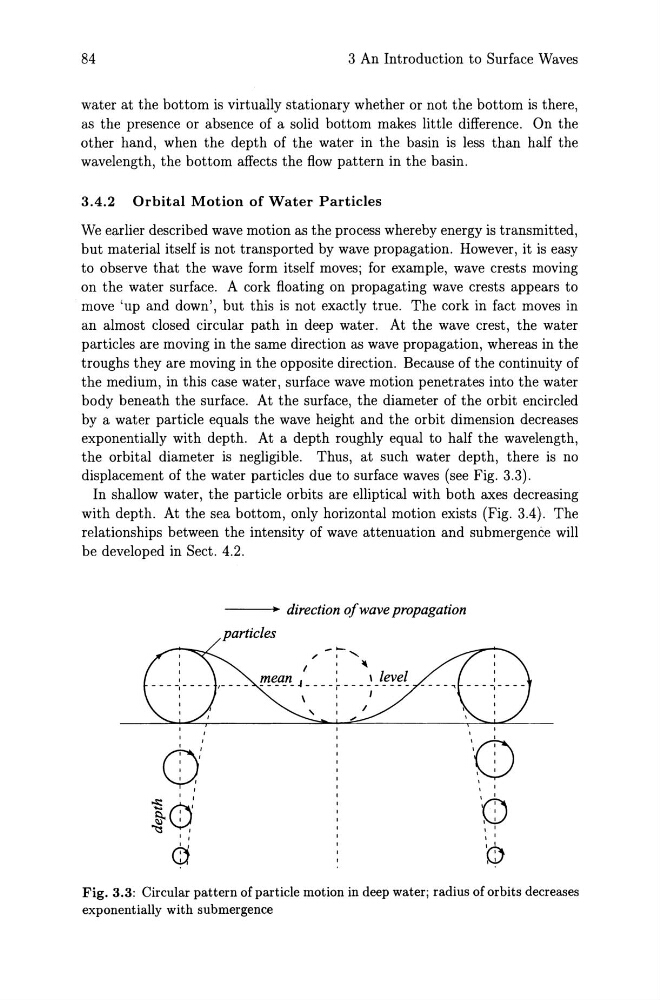
an almost closed circular path in deep water. At the wave crest, the water
particles are moving in the same direction as wave propagation, whereas in the
troughs they are moving in the opposite direction. Because of the continuity of
the medium, in this case water, surface wave motion penetrates into the water
body beneath the surface. At the surface, the diameter of the orbit encircled
by a water particle equals the wave height and the orbit dimension decreases
exponentially with depth. At a depth roughly equal to half the wavelength,
the orbital diameter is negligible. Thus, at such water depth, there is no
displacement of the water particles due to surface waves (see Fig. 3.3).
In shallow water, the particle orbits are elliptical with both axes decreasing
with depth. At the sea bottom, only horizontal motion exists (Fig. 3.4). The
relationships between the intensity of wave attenuation and submergence will
be developed in Sect. 4.2.
0
1:'
, ,
,
'SO' :
~:
~
,
, ,
6
---.~ direction of wave propagation
particles
_
0" ,,,I ' l l .
mean
:
\ level
-----~----'---I----/
,
"0' " :
, '
'0 ~ , '
, '
(;)
Fig. 3.3: Circular pattern of particle motion in deep water; radius of orbits decreases
exponentially with submergence
3 An Introduction to Surface Waves
water at the bottom is virtually stationary whether or not the bottom is there,
as the presence or absence of a solid bottom makes little difference. On the
other hand, when the depth of the water in the basin is less than half the
wavelength, the bottom affects the flow pattern in the basin.
3.4.2 Orbital Motion of Water Particles
We earlier described wave motion as the process whereby energy is transmitted,
but material itself is not transported by wave propagation. However, it is easy
to observe that the wave form itself moves; for example, wave crests moving
on the water surface. A cork floating on propagating wave crests appears to
move 'up and down', but this is not exactly true. The cork in fact moves in
an almost closed circular path in deep water. At the wave crest, the water
particles are moving in the same direction as wave propagation, whereas in the
troughs they are moving in the opposite direction. Because of the continuity of
the medium, in this case water, surface wave motion penetrates into the water
body beneath the surface. At the surface, the diameter of the orbit encircled
by a water particle equals the wave height and the orbit dimension decreases
exponentially with depth. At a depth roughly equal to half the wavelength,
the orbital diameter is negligible. Thus, at such water depth, there is no
displacement of the water particles due to surface waves (see Fig. 3.3).
In shallow water, the particle orbits are elliptical with both axes decreasing
with depth. At the sea bottom, only horizontal motion exists (Fig. 3.4). The
relationships between the intensity of wave attenuation and submergence will
be developed in Sect. 4.2.
0
1:'
, ,
,
'SO' :
~:
~
,
, ,
6
---.~ direction of wave propagation
particles
_
0" ,,,I ' l l .
mean
:
\ level
-----~----'---I----/
,
"0' " :
, '
'0 ~ , '
, '
(;)
Fig. 3.3: Circular pattern of particle motion in deep water; radius of orbits decreases
exponentially with submergence