

3.3 Types of Waves
81
Sect. 3.5). Earthquakes or eruptions of underwater volcanos move the sea bed
which in turn displaces the sea surface. Such wave is known as tsunami. More
details are given in Sect. 3.6. Land masses sliding into reservoirs and bays, or
meteorological disturbances can create large standing waves known as seiches
(see Sect. 3.7).
In general, surface water waves are affected by both gravitational force and
surface tension. For very short waves (wavelength less than about 1.7 cm), surface tension is the dominant restoring force. These waves are called capillary
waves, and are important in the context of processes controlling interactions
between the atmosphere and ocean, and in remote sensing of the ocean surface.
In most oceanographic and other applications, the interest lies with longer
surface waves where the dominant maintaining force is gravity, and hence,
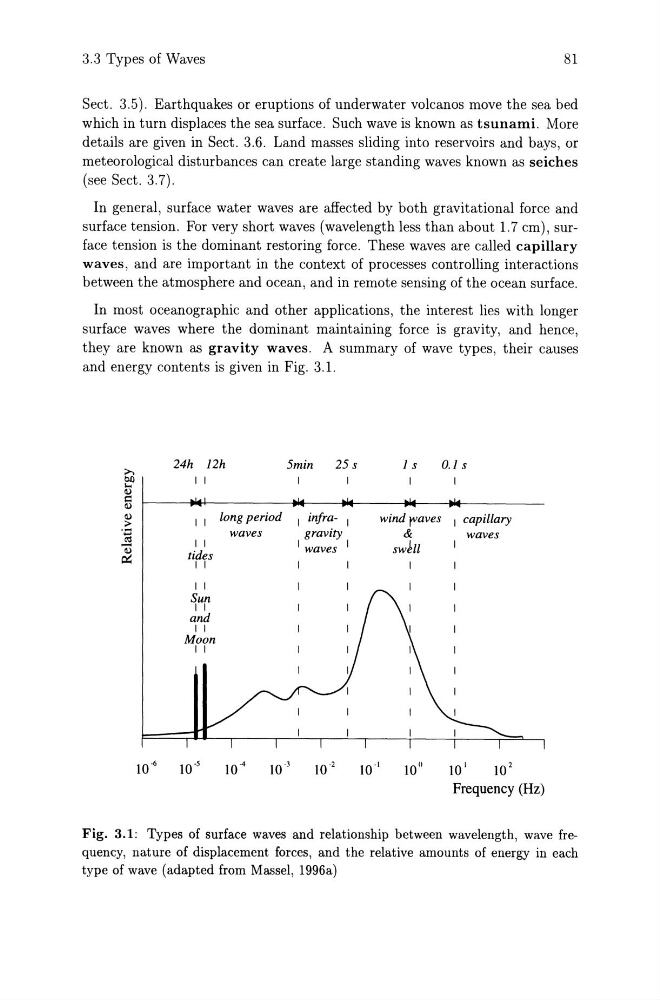
they are known as gravity waves. A summary of wave types, their causes
and energy contents is given in Fig. 3.1.
24h 12h
I I
I I long period
I I
tides
I I
I I
Sun
I I
and
I I
Moon
I I
waves
10 4
5min
25 s
I
I infra- I
gravity
I waves I
1 s
I
wind rvaves
&
sw~ll
10"
0.1 s
capillary
waves
10 I
10 2
Frequency (Hz)
Fig. 3.1: Types of surface waves and relationship between wavelength, wave frequency, nature of displacement forces, and the relative amounts of energy in each
type of wave (adapted from Massel, 1996a)
81
Sect. 3.5). Earthquakes or eruptions of underwater volcanos move the sea bed
which in turn displaces the sea surface. Such wave is known as tsunami. More
details are given in Sect. 3.6. Land masses sliding into reservoirs and bays, or
meteorological disturbances can create large standing waves known as seiches
(see Sect. 3.7).
In general, surface water waves are affected by both gravitational force and
surface tension. For very short waves (wavelength less than about 1.7 cm), surface tension is the dominant restoring force. These waves are called capillary
waves, and are important in the context of processes controlling interactions
between the atmosphere and ocean, and in remote sensing of the ocean surface.
In most oceanographic and other applications, the interest lies with longer
surface waves where the dominant maintaining force is gravity, and hence,
they are known as gravity waves. A summary of wave types, their causes
and energy contents is given in Fig. 3.1.
24h 12h
I I
I I long period
I I
tides
I I
I I
Sun
I I
and
I I
Moon
I I
waves
10 4
5min
25 s
I
I infra- I
gravity
I waves I
1 s
I
wind rvaves
&
sw~ll
10"
0.1 s
capillary
waves
10 I
10 2
Frequency (Hz)
Fig. 3.1: Types of surface waves and relationship between wavelength, wave frequency, nature of displacement forces, and the relative amounts of energy in each
type of wave (adapted from Massel, 1996a)