

64
2 Water at Rest and in Motion
perpendicular to the cylinder's axis. As usually, the total force per unit cylinder
length imposed on the cylinder is given through integration of the pressure
distribution, p( 0), along the cylinder circumference, i. e.:
r 27r
F = - Jo p( O)a cos OdO,
(2.82)
in which a is the radius of the cylinder.
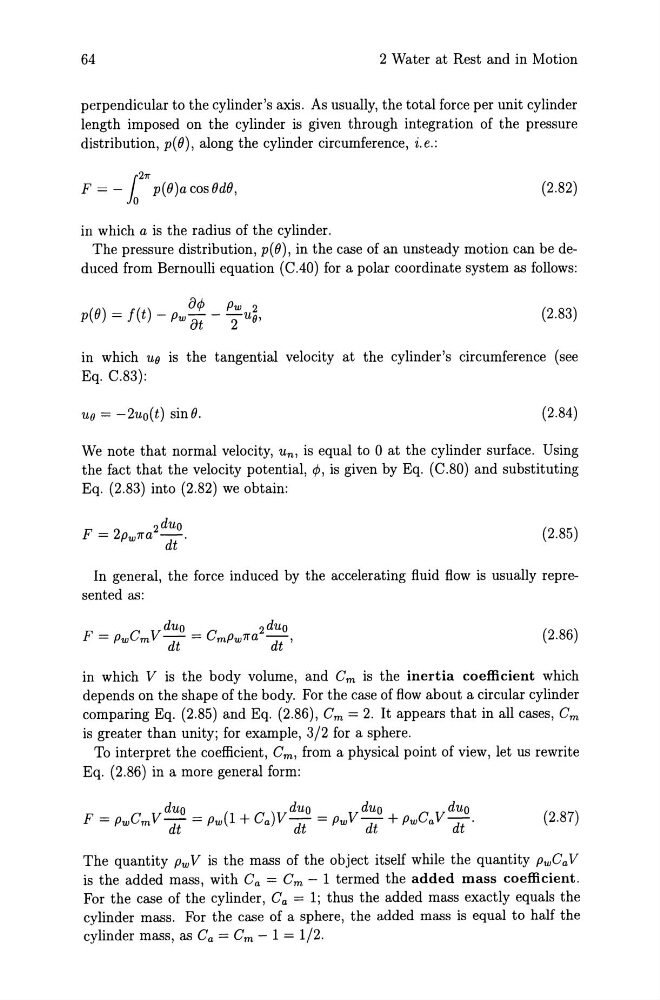
The pressure distribution, p(O), in the case of an unsteady motion can be deduced from Bernoulli equation (C.40) for a polar coordinate system as follows:
(2.83)
in which ue is the tangential velocity at the cylinder's circumference (see
Eq. C.83):
ufl = -2uo(t) sinO.
(2.84)
We note that normal velocity, Un, is equal to 0 at the cylinder surface. Using
the fact that the velocity potential, ¢, is given by Eq. (C.80) and substituting
Eq. (2.83) into (2.82) we obtain:
(2.85)
In general, the force induced by the accelerating fluid flow is usually represented as:
duo
2duO
F = PwCm V - = CmPw7ra - ,
dt
dt
(2.86)
in which V is the body volume, and Cm is the inertia coefficient which
depends on the shape of the body. For the case of flow about a circular cylinder
comparing Eq. (2.85) and Eq. (2.86), Cm = 2. It appears that in all cases, Cm
is greater than unity; for example, 3/2 for a sphere.
To interpret the coefficient, Cm, from a physical point of view, let us rewrite
Eq. (2.86) in a more general form:
duo
duo
duo
duo
F = PwCmV- = Pw(1 + Ca)V- = PwV - + PwCaV - .
&
&
&
&
(2.87)
The quantity Pw V is the mass of the object itself while the quantity PwCa V
is the added mass, with Ca = Cm - 1 termed the added mass coefficient.
For the case of the cylinder, Ca = 1; thus the added mass exactly equals the
cylinder mass. For the case of a sphere, the added mass is equal to half the
cylinder mass, as Ca = Cm - 1 = 1/2.
2 Water at Rest and in Motion
perpendicular to the cylinder's axis. As usually, the total force per unit cylinder
length imposed on the cylinder is given through integration of the pressure
distribution, p( 0), along the cylinder circumference, i. e.:
r 27r
F = - Jo p( O)a cos OdO,
(2.82)
in which a is the radius of the cylinder.
The pressure distribution, p(O), in the case of an unsteady motion can be deduced from Bernoulli equation (C.40) for a polar coordinate system as follows:
(2.83)
in which ue is the tangential velocity at the cylinder's circumference (see
Eq. C.83):
ufl = -2uo(t) sinO.
(2.84)
We note that normal velocity, Un, is equal to 0 at the cylinder surface. Using
the fact that the velocity potential, ¢, is given by Eq. (C.80) and substituting
Eq. (2.83) into (2.82) we obtain:
(2.85)
In general, the force induced by the accelerating fluid flow is usually represented as:
duo
2duO
F = PwCm V - = CmPw7ra - ,
dt
dt
(2.86)
in which V is the body volume, and Cm is the inertia coefficient which
depends on the shape of the body. For the case of flow about a circular cylinder
comparing Eq. (2.85) and Eq. (2.86), Cm = 2. It appears that in all cases, Cm
is greater than unity; for example, 3/2 for a sphere.
To interpret the coefficient, Cm, from a physical point of view, let us rewrite
Eq. (2.86) in a more general form:
duo
duo
duo
duo
F = PwCmV- = Pw(1 + Ca)V- = PwV - + PwCaV - .
&
&
&
&
(2.87)
The quantity Pw V is the mass of the object itself while the quantity PwCa V
is the added mass, with Ca = Cm - 1 termed the added mass coefficient.
For the case of the cylinder, Ca = 1; thus the added mass exactly equals the
cylinder mass. For the case of a sphere, the added mass is equal to half the
cylinder mass, as Ca = Cm - 1 = 1/2.