

62
2 Water at Rest and in Motion
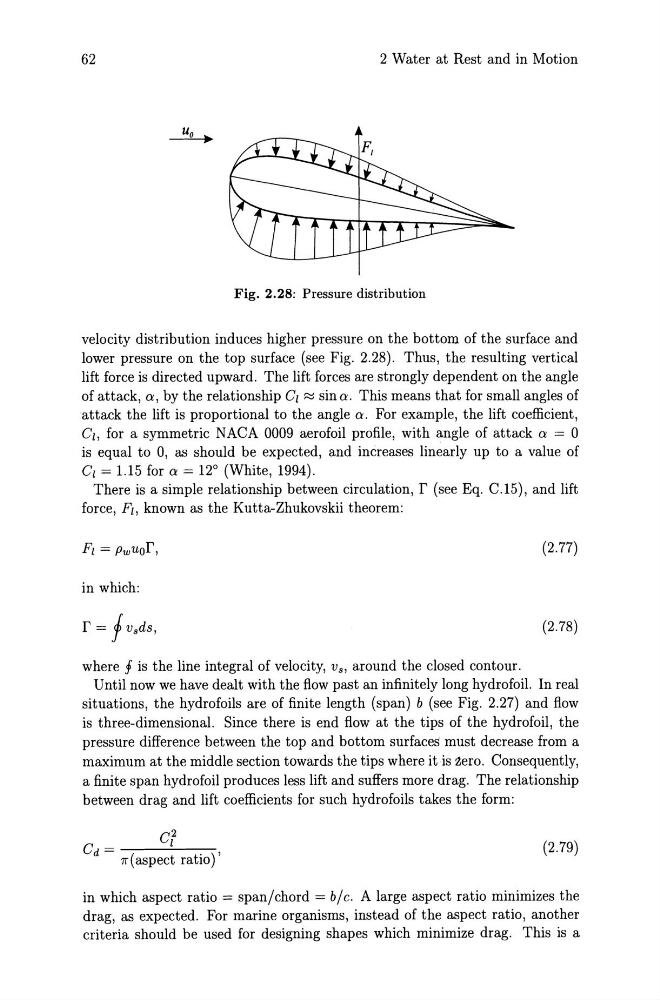
Fig. 2.28: Pressure distribution
velocity distribution induces higher pressure on the bottom of the surface and
lower pressure on the top surface (see Fig. 2.28). Thus, the resulting vertical
lift force is directed upward. The lift forces are strongly dependent on the angle
of attack, a, by the relationship Cl :::::: sin a. This means that for small angles of
attack the lift is proportional to the angle a. For example, the lift coefficient,
Cz, for a symmetric NACA 0009 aerofoil profile, with angle of attack a = 0
is equal to 0, as should be expected, and increases linearly up to a value of
Cl = 1.15 for a = 12° (White, 1994).
There is a simple relationship between circulation, r (see Eq. C.15), and lift
force, Fl, known as the Kutta-Zhukovskii theorem:
(2.77)
in which:
r = f vsds,
(2.78)
where f is the line integral of velocity, Vs, around the closed contour.
Until now we have dealt with the flow past an infinitely long hydrofoil. In real
situations, the hydrofoils are of finite length (span) b (see Fig. 2.27) and flow
is three-dimensional. Since there is end flow at the tips of the hydrofoil, the
pressure difference between the top and bottom surfaces must decrease from a
maximum at the middle section towards the tips where it is ~ero. Consequently,
a finite span hydrofoil produces less lift and suffers more drag. The relationship
between drag and lift coefficients for such hydrofoils takes the form:
c1
Cd = (
. )'
7r aspect ratIO
(2.79)
in which aspect ratio = span/chord = b/c. A large aspect ratio minimizes the
drag, as expected. For marine organisms, instead of the aspect ratio, another
criteria should be used for designing shapes which minimize drag. This is a
2 Water at Rest and in Motion
Fig. 2.28: Pressure distribution
velocity distribution induces higher pressure on the bottom of the surface and
lower pressure on the top surface (see Fig. 2.28). Thus, the resulting vertical
lift force is directed upward. The lift forces are strongly dependent on the angle
of attack, a, by the relationship Cl :::::: sin a. This means that for small angles of
attack the lift is proportional to the angle a. For example, the lift coefficient,
Cz, for a symmetric NACA 0009 aerofoil profile, with angle of attack a = 0
is equal to 0, as should be expected, and increases linearly up to a value of
Cl = 1.15 for a = 12° (White, 1994).
There is a simple relationship between circulation, r (see Eq. C.15), and lift
force, Fl, known as the Kutta-Zhukovskii theorem:
(2.77)
in which:
r = f vsds,
(2.78)
where f is the line integral of velocity, Vs, around the closed contour.
Until now we have dealt with the flow past an infinitely long hydrofoil. In real
situations, the hydrofoils are of finite length (span) b (see Fig. 2.27) and flow
is three-dimensional. Since there is end flow at the tips of the hydrofoil, the
pressure difference between the top and bottom surfaces must decrease from a
maximum at the middle section towards the tips where it is ~ero. Consequently,
a finite span hydrofoil produces less lift and suffers more drag. The relationship
between drag and lift coefficients for such hydrofoils takes the form:
c1
Cd = (
. )'
7r aspect ratIO
(2.79)
in which aspect ratio = span/chord = b/c. A large aspect ratio minimizes the
drag, as expected. For marine organisms, instead of the aspect ratio, another
criteria should be used for designing shapes which minimize drag. This is a