

2.6 Forces Imposed by Fluid Flow
59
2.6.3 Lift Force
As was shown in the previous section, the asymmetry of the pressure distribution is responsible for creating a drag force acting on a body immersed in a
fluid, in the direction of relative motion. Apart from the drag force, the pressure asymmetry around some bodies creates a force component perpendicular
to the drag, called lift. Due to this lift, birds, insects, gliders and airplanes
can fly. The lift force is also important for life in the ocean and many marine
organisms are subject to this lift. Limpets, flatfish, starfish, chitons and snails
are but a few of the obvious examples.
To explore the nature of the lift force, let us again consider a horizontal
cylinder, as in Fig. 2.22a. As the cylinder is symmetrical and the pressure
distribution at its circumference is symmetrical with respect to horizontal and
vertical axis, there is no net force in an ideal fluid. For a real fluid, however,
there is some horizontal force, but still there is no force perpendicular to the
flow.
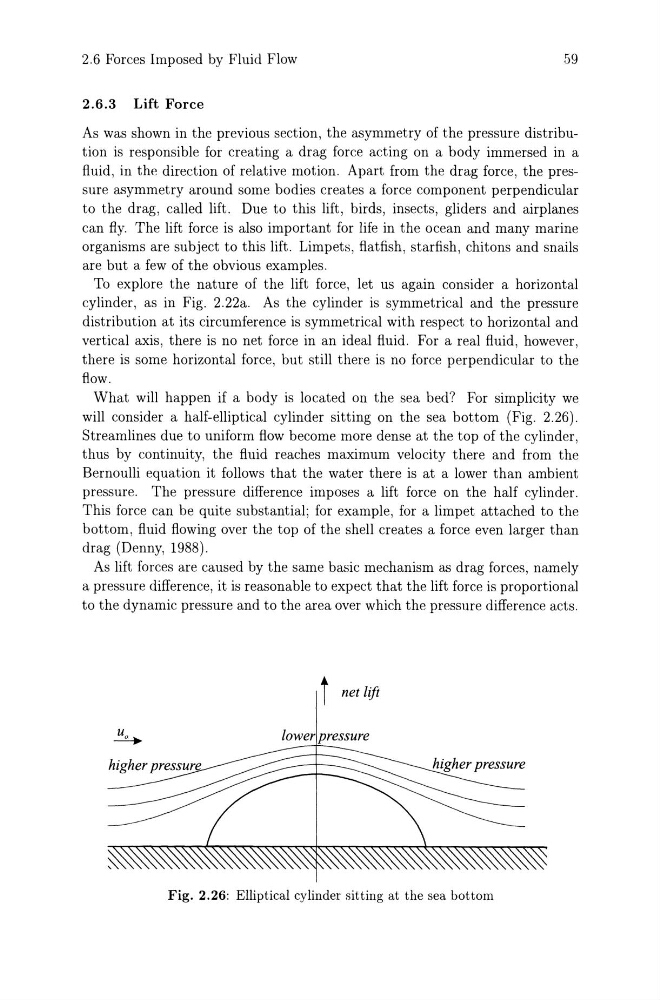
What will happen if a body is located on the sea bed? For simplicity we
will consider a half-elliptical cylinder sitting on the sea bottom (Fig. 2.26).
Streamlines due to uniform flow become more dense at the top of the cylinder,
thus by continuity, the fluid reaches maximum velocity there and from the
Bernoulli equation it follows that the water there is at a lower than ambient
pressure. The pressure difference imposes a lift force on the half cylinder.
This force can be quite substantial; for example, for a limpet attached to the
bottom, fluid flowing over the top of the shell creates a force even larger than
drag (Denny, 1988).
As lift forces are caused by the same basic mechanism as drag forces, namely
a pressure difference, it is reasonable to expect that the lift force is proportional
to the dynamic pressure and to the area over which the pressure difference acts.
t net lift
lower pressure
higher pressure
higher pressure
Fig. 2.26: Elliptical cylinder sitting at the sea bottom
59
2.6.3 Lift Force
As was shown in the previous section, the asymmetry of the pressure distribution is responsible for creating a drag force acting on a body immersed in a
fluid, in the direction of relative motion. Apart from the drag force, the pressure asymmetry around some bodies creates a force component perpendicular
to the drag, called lift. Due to this lift, birds, insects, gliders and airplanes
can fly. The lift force is also important for life in the ocean and many marine
organisms are subject to this lift. Limpets, flatfish, starfish, chitons and snails
are but a few of the obvious examples.
To explore the nature of the lift force, let us again consider a horizontal
cylinder, as in Fig. 2.22a. As the cylinder is symmetrical and the pressure
distribution at its circumference is symmetrical with respect to horizontal and
vertical axis, there is no net force in an ideal fluid. For a real fluid, however,
there is some horizontal force, but still there is no force perpendicular to the
flow.
What will happen if a body is located on the sea bed? For simplicity we
will consider a half-elliptical cylinder sitting on the sea bottom (Fig. 2.26).
Streamlines due to uniform flow become more dense at the top of the cylinder,
thus by continuity, the fluid reaches maximum velocity there and from the
Bernoulli equation it follows that the water there is at a lower than ambient
pressure. The pressure difference imposes a lift force on the half cylinder.
This force can be quite substantial; for example, for a limpet attached to the
bottom, fluid flowing over the top of the shell creates a force even larger than
drag (Denny, 1988).
As lift forces are caused by the same basic mechanism as drag forces, namely
a pressure difference, it is reasonable to expect that the lift force is proportional
to the dynamic pressure and to the area over which the pressure difference acts.
t net lift
lower pressure
higher pressure
higher pressure
Fig. 2.26: Elliptical cylinder sitting at the sea bottom