

2.6 Forces Imposed by Fluid Flow
53
p(G)
dG
x
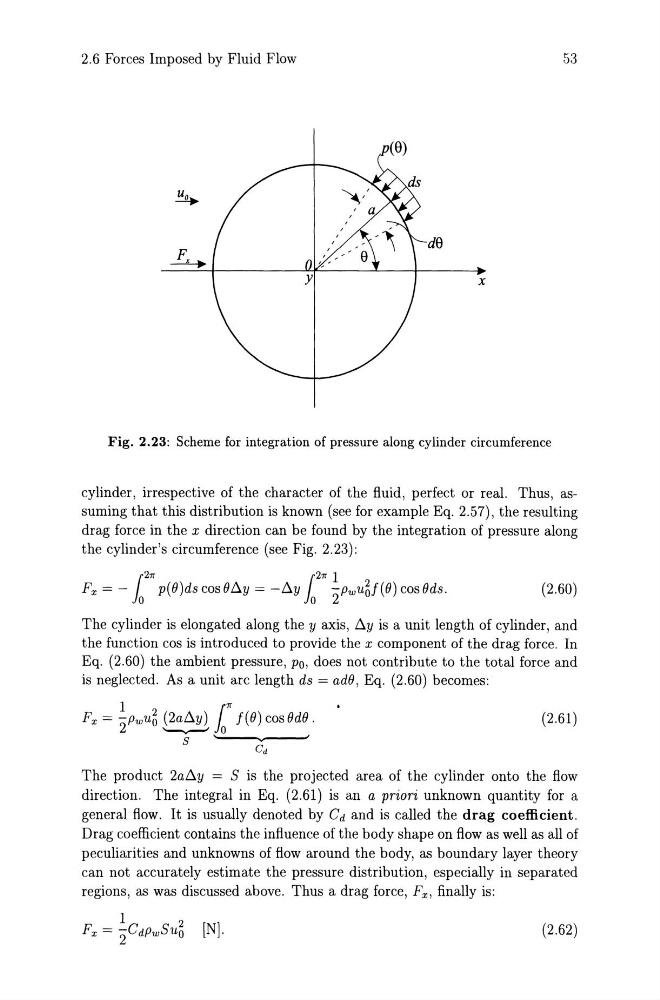
Fig. 2.23: Scheme for integration of pressure along cylinder circumference
cylinder, irrespective of the character of the fluid, perfect or real. Thus, assuming that this distribution is known (see for example Eq. 2.57), the resulting
drag force in the x direction can be found by the integration of pressure along
the cylinder's circumference (see Fig. 2.23):
Fx = - r
21r
p(B)dscosB~y = -~y r
21r
~Pwu6f(B)cosBds.
Jo
Jo 2
(2.60)
The cylinder is elongated along the y axis, ~y is a unit length of cylinder, and
the function cos is introduced to provide the x component of the drag force. In
Eq. (2.60) the ambient pressure, Po, does not contribute to the total force and
is neglected. As a unit arc length ds = adB, Eq. (2.60) becomes:
1
lo1r
Fx = -PwU6 (2a~y)
f(B)cosBdB.
2
'-v---" 0
S
' - . . . . - - '
Cd
(2.61 )
The product 2a~y = S is the projected area of the cylinder onto the flow
direction. The integral in Eq. (2.61) is an a priori unknown quantity for a
general flow. It is usually denoted by Cd and is called the drag coefficient.
Drag coefficient contains the influence of the body shape on flow as well as all of
peculiarities and unknowns of flow around the body, as boundary layer theory
can not accurately estimate the pressure distribution, especially in separated
regions, as was discussed above. Thus a drag force, Fx , finally is:
1
2
Fx = 2CdPwSUO [N].
(2.62)
53
p(G)
dG
x
Fig. 2.23: Scheme for integration of pressure along cylinder circumference
cylinder, irrespective of the character of the fluid, perfect or real. Thus, assuming that this distribution is known (see for example Eq. 2.57), the resulting
drag force in the x direction can be found by the integration of pressure along
the cylinder's circumference (see Fig. 2.23):
Fx = - r
21r
p(B)dscosB~y = -~y r
21r
~Pwu6f(B)cosBds.
Jo
Jo 2
(2.60)
The cylinder is elongated along the y axis, ~y is a unit length of cylinder, and
the function cos is introduced to provide the x component of the drag force. In
Eq. (2.60) the ambient pressure, Po, does not contribute to the total force and
is neglected. As a unit arc length ds = adB, Eq. (2.60) becomes:
1
lo1r
Fx = -PwU6 (2a~y)
f(B)cosBdB.
2
'-v---" 0
S
' - . . . . - - '
Cd
(2.61 )
The product 2a~y = S is the projected area of the cylinder onto the flow
direction. The integral in Eq. (2.61) is an a priori unknown quantity for a
general flow. It is usually denoted by Cd and is called the drag coefficient.
Drag coefficient contains the influence of the body shape on flow as well as all of
peculiarities and unknowns of flow around the body, as boundary layer theory
can not accurately estimate the pressure distribution, especially in separated
regions, as was discussed above. Thus a drag force, Fx , finally is:
1
2
Fx = 2CdPwSUO [N].
(2.62)