

478
Appendix B International System of Units
B.3.8 Energy and Power
Energy expresses the capacity for doing work. Therefore, energy and work have
the same units. Work is expressed as follows: Work (N x m or J) = Force
(N) x distance (m). The J is an abbreviation for joule, i.e.: 1 J = 1 N x 1 m
= 1 kg x 1 m 2 /s2. In this book, energy is usually symbolized by E.
Power is the amount of work done per unit time, i.e.: Power (J/s or Watt)
= Work (J)/time (s) and 1 Watt = J/s = 1 kg x m 2 /s 3 . In this book power
is symbolized by P. For example, in Sect. 4.2 it was shown that wave energy
per unit area is given by:
1
2
E = spwgH ,
(B.14)
in which Pw is the sea water density and H is the wave height. Thus, if wave
height is 1 m, wave period is 4 s and water density is 1023 kg/m 3 , wave energy
per m 2 is 1254 J /m 2 and wave power per m 2 is 314 W /m2.
B.4 Conversion Factors Between BG and SI Units
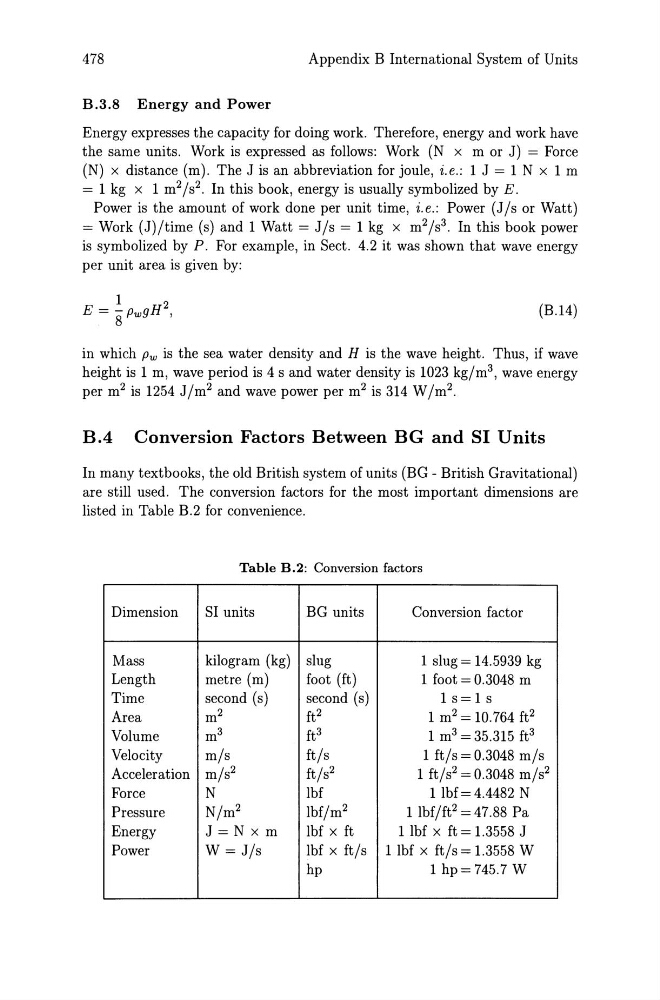
In many textbooks, the old British system of units (BG - British Gravitational)
are still used. The conversion factors for the most important dimensions are
listed in Table B.2 for convenience.
Table B.2: Conversion factors
Dimension
SI units
BG units
Conversion factor
Mass
kilogram (kg) slug
1 slug = 14.5939 kg
Length
metre (m)
foot (ft)
1 foot = 0.3048 m
Time
second (s)
second (s)
1 s = 1 s
Area
m 2
ft 2
1 m 2 = 10.764 ft 2
Volume
m 3
ft 3
1 m 3 = 35.315 ft 3
Velocity
m/s
ft/s
1 ft/s = 0.3048 m/s
Acceleration m/s 2
ft/s2
1 ft/s2 = 0.3048 m/s 2
Force
N
lbf
1 lbf = 4.4482 N
Pressure
N/m 2
Ibf/m 2
1 Ibf/ft 2 = 47.88 Pa
Energy
J=Nxm
lbf x ft
1 lbf x ft = 1.3558 J
Power
W = J/s
lbf x ft/s 1 lbf x ft/s = 1.3558 W
hp
1 hp=745.7 W
Appendix B International System of Units
B.3.8 Energy and Power
Energy expresses the capacity for doing work. Therefore, energy and work have
the same units. Work is expressed as follows: Work (N x m or J) = Force
(N) x distance (m). The J is an abbreviation for joule, i.e.: 1 J = 1 N x 1 m
= 1 kg x 1 m 2 /s2. In this book, energy is usually symbolized by E.
Power is the amount of work done per unit time, i.e.: Power (J/s or Watt)
= Work (J)/time (s) and 1 Watt = J/s = 1 kg x m 2 /s 3 . In this book power
is symbolized by P. For example, in Sect. 4.2 it was shown that wave energy
per unit area is given by:
1
2
E = spwgH ,
(B.14)
in which Pw is the sea water density and H is the wave height. Thus, if wave
height is 1 m, wave period is 4 s and water density is 1023 kg/m 3 , wave energy
per m 2 is 1254 J /m 2 and wave power per m 2 is 314 W /m2.
B.4 Conversion Factors Between BG and SI Units
In many textbooks, the old British system of units (BG - British Gravitational)
are still used. The conversion factors for the most important dimensions are
listed in Table B.2 for convenience.
Table B.2: Conversion factors
Dimension
SI units
BG units
Conversion factor
Mass
kilogram (kg) slug
1 slug = 14.5939 kg
Length
metre (m)
foot (ft)
1 foot = 0.3048 m
Time
second (s)
second (s)
1 s = 1 s
Area
m 2
ft 2
1 m 2 = 10.764 ft 2
Volume
m 3
ft 3
1 m 3 = 35.315 ft 3
Velocity
m/s
ft/s
1 ft/s = 0.3048 m/s
Acceleration m/s 2
ft/s2
1 ft/s2 = 0.3048 m/s 2
Force
N
lbf
1 lbf = 4.4482 N
Pressure
N/m 2
Ibf/m 2
1 Ibf/ft 2 = 47.88 Pa
Energy
J=Nxm
lbf x ft
1 lbf x ft = 1.3558 J
Power
W = J/s
lbf x ft/s 1 lbf x ft/s = 1.3558 W
hp
1 hp=745.7 W