

32
incoming
flow
2 Water at Rest and in Motion
viscous regions where Bernoulli's equation fails
separated flow
Fig. 2.9: Flow past an island
Equation (2.30) was discovered by Torricelli in 1644. In fact, this equation
can also be derived from the conservation of energy principle. The potential
energy of fluid in a tank (mgh) is entirely converted to kinetic energy (mV 2 2 /2).
Assuming that motion is frictionless and that no net pressure work is done (the
term m p/ Pw in Eq. (2.25) vanishes), equating both energies gives velocity V2
as in Eq. (2.30).
Although the Bernoulli equation is widely used, there are, however, some
assumptions under which this equation is valid. Here we stress them again:
• Flow is steady; for unsteady flow a 'Bernoulli constant', a function of
time, and Eq. (C.39) should be used.
• Fluid is incompressible.
• It can be applied along any streamline, but not across different streamlines, as different streamlines may have different 'Bernoulli constant'.
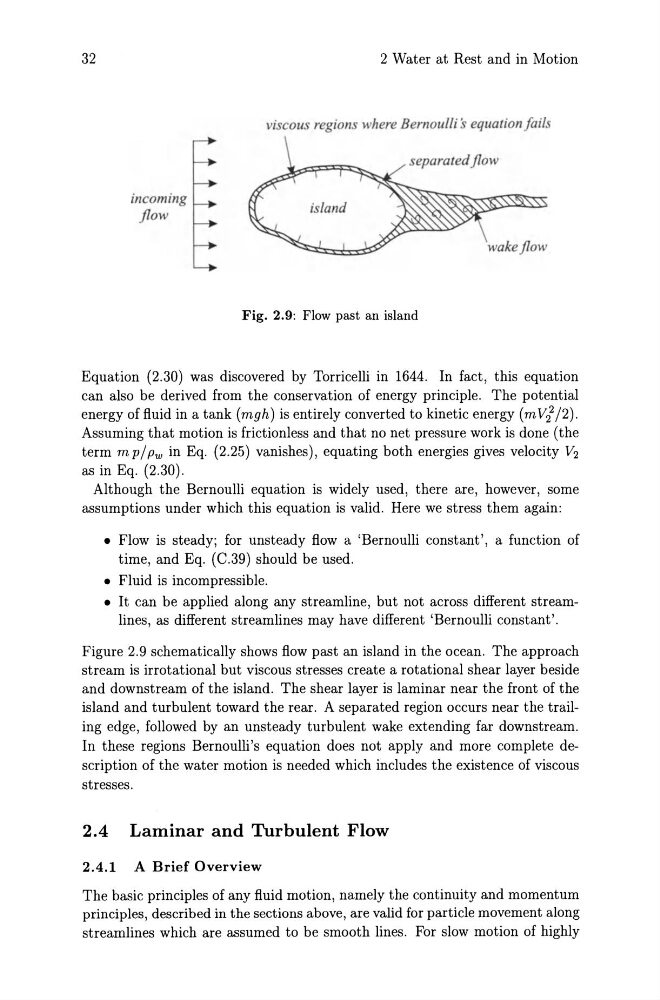
Figure 2.9 schematically shows flow past an island in the ocean. The approach
stream is irrotational but viscous stresses create a rotational shear layer beside
and downstream of the island. The shear layer is laminar near the front of the
island and turbulent toward the rear. A separated region occurs near the trailing edge, followed by an unsteady turbulent wake extending far downstream.
In these regions Bernoulli's equation does not apply and more complete description of the water motion is needed which includes the existence of viscous
stresses.
2.4 Laminar and Turbulent Flow
2.4.1 A Brief Overview
The basic principles of any fluid motion, namely the continuity and momentum
principles, described in the sections above, are valid for particle movement along
streamlines which are assumed to be smooth lines. For slow motion of highly
incoming
flow
2 Water at Rest and in Motion
viscous regions where Bernoulli's equation fails
separated flow
Fig. 2.9: Flow past an island
Equation (2.30) was discovered by Torricelli in 1644. In fact, this equation
can also be derived from the conservation of energy principle. The potential
energy of fluid in a tank (mgh) is entirely converted to kinetic energy (mV 2 2 /2).
Assuming that motion is frictionless and that no net pressure work is done (the
term m p/ Pw in Eq. (2.25) vanishes), equating both energies gives velocity V2
as in Eq. (2.30).
Although the Bernoulli equation is widely used, there are, however, some
assumptions under which this equation is valid. Here we stress them again:
• Flow is steady; for unsteady flow a 'Bernoulli constant', a function of
time, and Eq. (C.39) should be used.
• Fluid is incompressible.
• It can be applied along any streamline, but not across different streamlines, as different streamlines may have different 'Bernoulli constant'.
Figure 2.9 schematically shows flow past an island in the ocean. The approach
stream is irrotational but viscous stresses create a rotational shear layer beside
and downstream of the island. The shear layer is laminar near the front of the
island and turbulent toward the rear. A separated region occurs near the trailing edge, followed by an unsteady turbulent wake extending far downstream.
In these regions Bernoulli's equation does not apply and more complete description of the water motion is needed which includes the existence of viscous
stresses.
2.4 Laminar and Turbulent Flow
2.4.1 A Brief Overview
The basic principles of any fluid motion, namely the continuity and momentum
principles, described in the sections above, are valid for particle movement along
streamlines which are assumed to be smooth lines. For slow motion of highly