

14.4 Waves at Coral Reefs
439
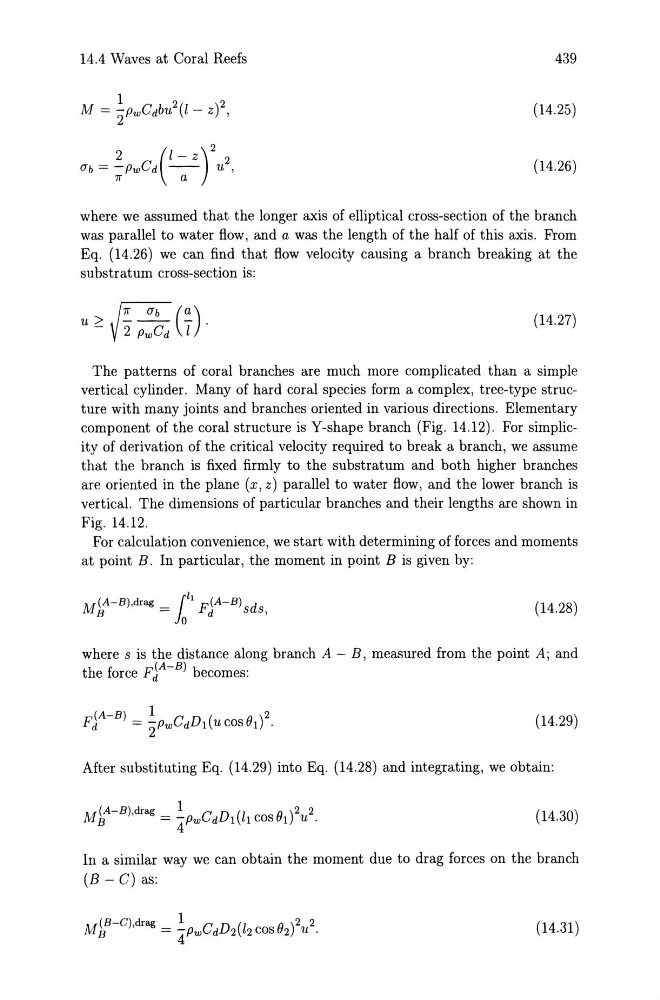
(14.25)
(14.26)
where we assumed that the longer axis of elliptical cross-section of the branch
was parallel to water flow, and a was the length of the half of this axis. From
Eq. (14.26) we can find that flow velocity causing a branch breaking at the
substratum cross-section is:
~(a)
u;::: V' 2 PwCd T .
(14.27)
The patterns of coral branches are much more complicated than a simple
vertical cylinder. Many of hard coral species form a complex, tree-type structure with many joints and branches oriented in various directions. Elementary
component of the coral structure is V-shape branch (Fig. 14.12). For simplicity of derivation of the critical velocity required to break a branch, we assume
that the branch is fixed firmly to the substratum and both higher branches
are oriented in the plane (x, z) parallel to water flow, and the lower branch is
vertical. The dimensions of particular branches and their lengths are shown in
Fig. 14.12.
For calculation convenience, we start with determining of forces and moments
at point B. In particular, the moment in point B is given by:
M (A-B),drag -iiI p(A-B) d
B
-
d
S s,
o
(14.28)
where S is the distance along branch A - B, measured from the point A; and
the force pY-B) becomes:
(14.29)
After substituting Eq. (14.29) into Eq. (14.28) and integrating, we obtain:
(14.30)
In a similar way we can obtain the moment due to drag forces on the branch
(B - C) as:
(14.31)
439
(14.25)
(14.26)
where we assumed that the longer axis of elliptical cross-section of the branch
was parallel to water flow, and a was the length of the half of this axis. From
Eq. (14.26) we can find that flow velocity causing a branch breaking at the
substratum cross-section is:
~(a)
u;::: V' 2 PwCd T .
(14.27)
The patterns of coral branches are much more complicated than a simple
vertical cylinder. Many of hard coral species form a complex, tree-type structure with many joints and branches oriented in various directions. Elementary
component of the coral structure is V-shape branch (Fig. 14.12). For simplicity of derivation of the critical velocity required to break a branch, we assume
that the branch is fixed firmly to the substratum and both higher branches
are oriented in the plane (x, z) parallel to water flow, and the lower branch is
vertical. The dimensions of particular branches and their lengths are shown in
Fig. 14.12.
For calculation convenience, we start with determining of forces and moments
at point B. In particular, the moment in point B is given by:
M (A-B),drag -iiI p(A-B) d
B
-
d
S s,
o
(14.28)
where S is the distance along branch A - B, measured from the point A; and
the force pY-B) becomes:
(14.29)
After substituting Eq. (14.29) into Eq. (14.28) and integrating, we obtain:
(14.30)
In a similar way we can obtain the moment due to drag forces on the branch
(B - C) as:
(14.31)