

416
13 Transport and Mixing in Coastal Ecosystems
Let us assume additionally that coral eggs and larvae are released instantaneously at the origin of coordinate system (x = y = 0), settling and predation
are omitted, and the turbulent diffusion coefficients, Kx and Ky, are constant.
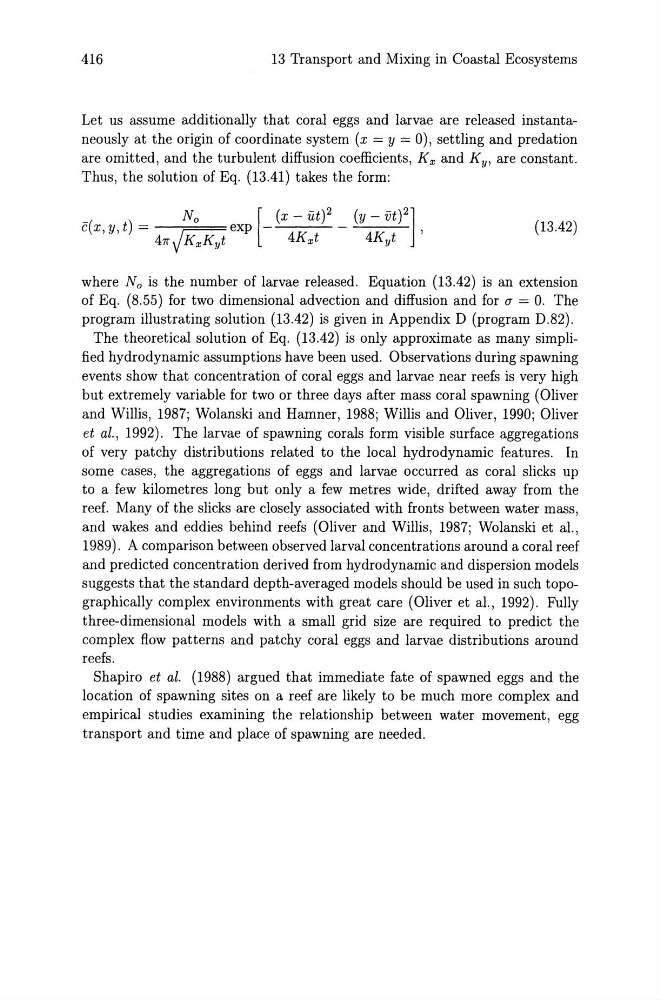
Thus, the solution of Eq. (13.41) takes the form:
_
No
[ (x - ut)2 (y - vt)2]
c( x, y, t) =
rr;:r;-;. exp - 4K t - 4K t '
47ryKxKyt
x
y
(13.42)
where No is the number of larvae released. Equation (13.42) is an extension
of Eq. (8.55) for two dimensional advection and diffusion and for (J = O. The
program illustrating solution (13.42) is given in Appendix D (program D.82).
The theoretical solution of Eq. (13.42) is only approximate as many simplified hydrodynamic assumptions have been used. Observations during spawning
events show that concentration of coral eggs and larvae near reefs is very high
but extremely variable for two or three days after mass coral spawning (Oliver
and Willis, 1987; Wolanski and Hamner, 1988; Willis and Oliver, 1990; Oliver
et al., 1992). The larvae of spawning corals form visible surface aggregations
of very patchy distributions related to the local hydrodynamic features. In
some cases, the aggregations of eggs and larvae occurred as coral slicks up
to a few kilometres long but only a few metres wide, drifted away from the
reef. Many of the slicks are closely associated with fronts between water mass,
and wakes and eddies behind reefs (Oliver and Willis, 1987; Wolanski et al.,
1989). A comparison between observed larval concentrations around a coral reef
and predicted concentration derived from hydrodynamic and dispersion models
suggests that the standard depth-averaged models should be used in such topographically complex environments with great care (Oliver et al., 1992). Fully
three-dimensional models with a small grid size are required to predict the
complex flow patterns and patchy coral eggs and larvae distributions around
reefs.
Shapiro et al. (1988) argued that immediate fate of spawned eggs and the
location of spawning sites on a reef are likely to be much more complex and
empirical studies examining the relationship between water movement, egg
transport and time and place of spawning are needed.
13 Transport and Mixing in Coastal Ecosystems
Let us assume additionally that coral eggs and larvae are released instantaneously at the origin of coordinate system (x = y = 0), settling and predation
are omitted, and the turbulent diffusion coefficients, Kx and Ky, are constant.
Thus, the solution of Eq. (13.41) takes the form:
_
No
[ (x - ut)2 (y - vt)2]
c( x, y, t) =
rr;:r;-;. exp - 4K t - 4K t '
47ryKxKyt
x
y
(13.42)
where No is the number of larvae released. Equation (13.42) is an extension
of Eq. (8.55) for two dimensional advection and diffusion and for (J = O. The
program illustrating solution (13.42) is given in Appendix D (program D.82).
The theoretical solution of Eq. (13.42) is only approximate as many simplified hydrodynamic assumptions have been used. Observations during spawning
events show that concentration of coral eggs and larvae near reefs is very high
but extremely variable for two or three days after mass coral spawning (Oliver
and Willis, 1987; Wolanski and Hamner, 1988; Willis and Oliver, 1990; Oliver
et al., 1992). The larvae of spawning corals form visible surface aggregations
of very patchy distributions related to the local hydrodynamic features. In
some cases, the aggregations of eggs and larvae occurred as coral slicks up
to a few kilometres long but only a few metres wide, drifted away from the
reef. Many of the slicks are closely associated with fronts between water mass,
and wakes and eddies behind reefs (Oliver and Willis, 1987; Wolanski et al.,
1989). A comparison between observed larval concentrations around a coral reef
and predicted concentration derived from hydrodynamic and dispersion models
suggests that the standard depth-averaged models should be used in such topographically complex environments with great care (Oliver et al., 1992). Fully
three-dimensional models with a small grid size are required to predict the
complex flow patterns and patchy coral eggs and larvae distributions around
reefs.
Shapiro et al. (1988) argued that immediate fate of spawned eggs and the
location of spawning sites on a reef are likely to be much more complex and
empirical studies examining the relationship between water movement, egg
transport and time and place of spawning are needed.