

414
13 Transport and Mixing in Coastal Ecosystems
The rate of larval settlement is affected by the density of roughness elements
that dominate bottom topography. Eckman (1990) showed that the rate of settlement increases monotonically with the real density of roughness elements.
Relatively flat bottoms experience rates of settlement of 1-2 orders of magnitude lower than bottoms with relatively high densities of roughness.
13.4.2 External Fertilization
Many aquatic animals and algae reproduce by extruding sperm and ova into the
water environment, where they mix together and fertilize. For many organisms
such as corals or sea anemones, the mobility of sperm and ova is totally reliant
on turbulent mixing of the ambient environment. They can be considered as
passively transported by water. Following Denny and Shibata (1989), consider
a turbulent benthic boundary layer with water moving at an average velocity
(). We adopt coordinate system (Xl, Yl, Zl) with the origin located at the substratum. Sperm is released from a single point (0,0, h) located at a height,
h, above the substratum and at a distance, l, upstream from where the ova
are released. The sperm and ova are turbulently mixed and produce plumes
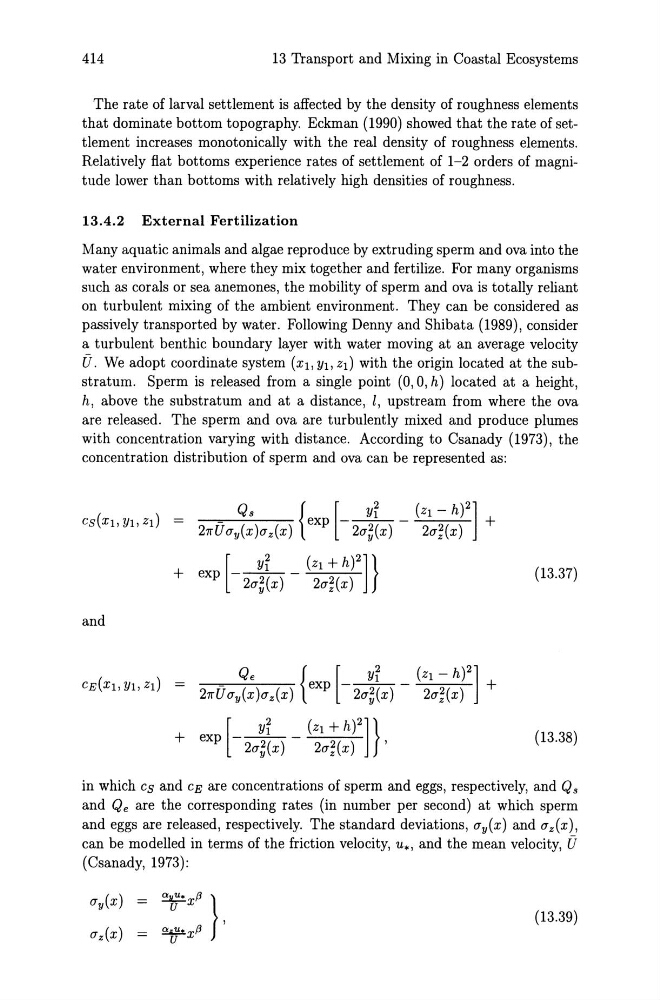
with concentration varying with distance. According to Csanady (1973), the
concentration distribution of sperm and ova can be represented as:
+ exp [ _ _ Yi _ _ ..:...(Z_l ~+~h,-)2] }
2(T~(x)
2(T;(x)
(13.37)
and
+ exp [ _ _ Yi _ _ ..:...(Z_l ..,-+_h),-2]}
2(T~(x)
2(T;(x)
,
(13.38)
in which Cs and CE are concentrations of sperm and eggs, respectively, and Q 8
and Qe are the corresponding rates (in number per second) at which sperm
and eggs are released, respectively. The standard deviations, (Ty(x) and (TAx),
can be modelled in terms of the friction velocity, u*, and the mean velocity, ()
(Csanady, 1973):
(tyu. ~ }
u x
,
(tzu. x~
U
(13.39)
13 Transport and Mixing in Coastal Ecosystems
The rate of larval settlement is affected by the density of roughness elements
that dominate bottom topography. Eckman (1990) showed that the rate of settlement increases monotonically with the real density of roughness elements.
Relatively flat bottoms experience rates of settlement of 1-2 orders of magnitude lower than bottoms with relatively high densities of roughness.
13.4.2 External Fertilization
Many aquatic animals and algae reproduce by extruding sperm and ova into the
water environment, where they mix together and fertilize. For many organisms
such as corals or sea anemones, the mobility of sperm and ova is totally reliant
on turbulent mixing of the ambient environment. They can be considered as
passively transported by water. Following Denny and Shibata (1989), consider
a turbulent benthic boundary layer with water moving at an average velocity
(). We adopt coordinate system (Xl, Yl, Zl) with the origin located at the substratum. Sperm is released from a single point (0,0, h) located at a height,
h, above the substratum and at a distance, l, upstream from where the ova
are released. The sperm and ova are turbulently mixed and produce plumes
with concentration varying with distance. According to Csanady (1973), the
concentration distribution of sperm and ova can be represented as:
+ exp [ _ _ Yi _ _ ..:...(Z_l ~+~h,-)2] }
2(T~(x)
2(T;(x)
(13.37)
and
+ exp [ _ _ Yi _ _ ..:...(Z_l ..,-+_h),-2]}
2(T~(x)
2(T;(x)
,
(13.38)
in which Cs and CE are concentrations of sperm and eggs, respectively, and Q 8
and Qe are the corresponding rates (in number per second) at which sperm
and eggs are released, respectively. The standard deviations, (Ty(x) and (TAx),
can be modelled in terms of the friction velocity, u*, and the mean velocity, ()
(Csanady, 1973):
(tyu. ~ }
u x
,
(tzu. x~
U
(13.39)