

412
13 Transport and Mixing in Coastal Ecosystems
necessary to overcome the resistance forces. However, many aquatic organisms
are not able to generate any thrust and they are passively transported by water
movement. In this section we will examine mechanisms through which flow in
the coastal zone results in the transport of the planktonic larvae of benthic
species, such as a barnacle cyprid, the pluteus of a sea urchin, or gametes and
spores. Especially in the surf zone where water motion is very turbulent, the
sinking or swimming velocities of larvae and spores are small (from about 0.0001
to 0.01 m/s), compared to the ambient water fluctuations. The organisms
have little or no control over the rate at which they are transported to the
substratum. However, the biology of larvae requires that the organisms must
return to the substratum before they can metamorphose and grow into adults
(Denny and Shibata, 1989).
Let us consider a larva or spore travelling at a height, Zl, above the substratum. The water is turbulent and well mixed throughout the depth. The
diffusivity is assumed to be uniform in the horizontal direction. Because the size
of eddies is constrained by the presence of the nearby substratum, the vertical
turbulent diffusion coefficient is much smaller than the horizontal diffusivity.
Using the logic by Berg (1983) in his examination of the mechanism of 'diffusion to capture', Denny and Shibata (1989) have found that the ensemble
average time that it takes the larva to reach the substratum from height Zl
becomes:
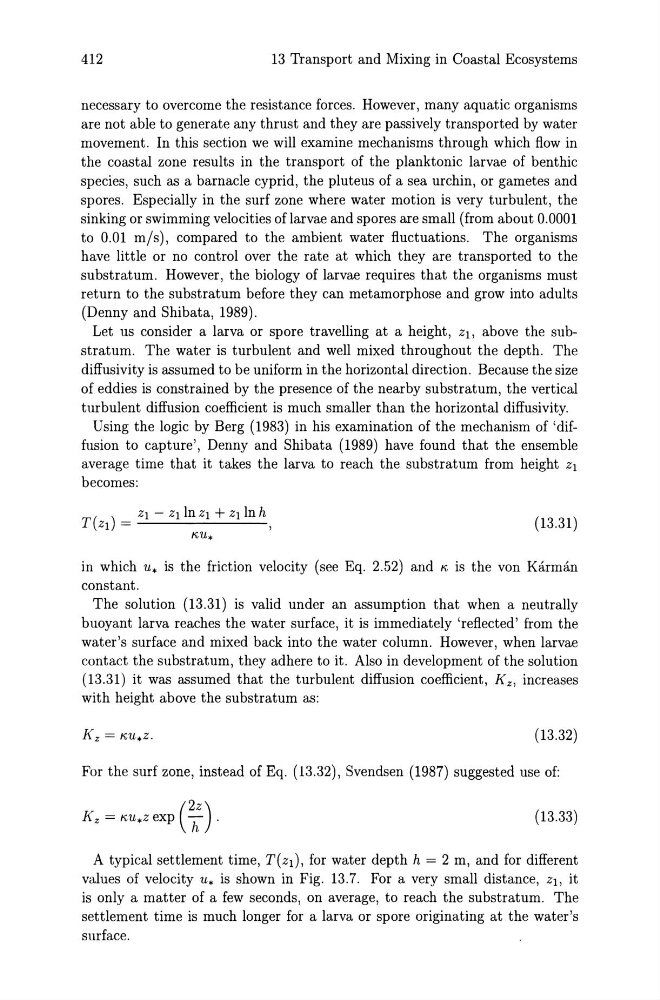
(13.31 )
in which u. is the friction velocity (see Eq. 2.52) and K is the von Karman
constant.
The solution (13.31) is valid under an assumption that when a neutrally
buoyant larva reaches the water surface, it is immediately 'reflected' from the
water's surface and mixed back into the water column. However, when larvae
contact the substratum, they adhere to it. Also in development of the solution
(13.31) it was assumed that the turbulent diffusion coefficient, K z, increases
with height above the substratum as:
(13.32)
For the surf zone, instead of Eq. (13.32), Svendsen (1987) suggested use of:
(13.33)
A typical settlement time, T(Zl), for water depth h = 2 m, and for different
values of velocity u. is shown in Fig. 13.7. For a very small distance, Zl, it
is only a matter of a few seconds, on average, to reach the substratum. The
settlement time is much longer for a larva or spore originating at the water's
surface.
13 Transport and Mixing in Coastal Ecosystems
necessary to overcome the resistance forces. However, many aquatic organisms
are not able to generate any thrust and they are passively transported by water
movement. In this section we will examine mechanisms through which flow in
the coastal zone results in the transport of the planktonic larvae of benthic
species, such as a barnacle cyprid, the pluteus of a sea urchin, or gametes and
spores. Especially in the surf zone where water motion is very turbulent, the
sinking or swimming velocities of larvae and spores are small (from about 0.0001
to 0.01 m/s), compared to the ambient water fluctuations. The organisms
have little or no control over the rate at which they are transported to the
substratum. However, the biology of larvae requires that the organisms must
return to the substratum before they can metamorphose and grow into adults
(Denny and Shibata, 1989).
Let us consider a larva or spore travelling at a height, Zl, above the substratum. The water is turbulent and well mixed throughout the depth. The
diffusivity is assumed to be uniform in the horizontal direction. Because the size
of eddies is constrained by the presence of the nearby substratum, the vertical
turbulent diffusion coefficient is much smaller than the horizontal diffusivity.
Using the logic by Berg (1983) in his examination of the mechanism of 'diffusion to capture', Denny and Shibata (1989) have found that the ensemble
average time that it takes the larva to reach the substratum from height Zl
becomes:
(13.31 )
in which u. is the friction velocity (see Eq. 2.52) and K is the von Karman
constant.
The solution (13.31) is valid under an assumption that when a neutrally
buoyant larva reaches the water surface, it is immediately 'reflected' from the
water's surface and mixed back into the water column. However, when larvae
contact the substratum, they adhere to it. Also in development of the solution
(13.31) it was assumed that the turbulent diffusion coefficient, K z, increases
with height above the substratum as:
(13.32)
For the surf zone, instead of Eq. (13.32), Svendsen (1987) suggested use of:
(13.33)
A typical settlement time, T(Zl), for water depth h = 2 m, and for different
values of velocity u. is shown in Fig. 13.7. For a very small distance, Zl, it
is only a matter of a few seconds, on average, to reach the substratum. The
settlement time is much longer for a larva or spore originating at the water's
surface.