

13.2 Transport and Mixing in Estuaries
397
Sediments are important carriers of dissolved and particulate trace elements
in the hydrological cycle. The concentration of trace metals depends on the
sediment erosion and deposition processes, however, the geochemistry involved
in the process of the dynamics of trace elements is beyond the scope of the
book.
13.2.3 Dispersion in Non-Vegetated and Vegetated Estuaries
In Chap. 8, we have examined the basic features of diffusion and dispersion
phenomena. In particular, as was shown in Sect. 8.3.4, diffusion experiments
with the release of rhodamine dye are commonly used to determine the mixing
characteristics in deep and shallow waters. Dye experiments have become more
and more popular as part of environmental impact assessment studies for such
things as industrial releases or the agriculture industry (Elliott et at., 1997).
However, the dependence of the mixing coefficients on the local environmental
conditions, such as water depth, tidal current and wind speed, usually has to
be parameterized, and the dye data are analyzed using the one-dimensional
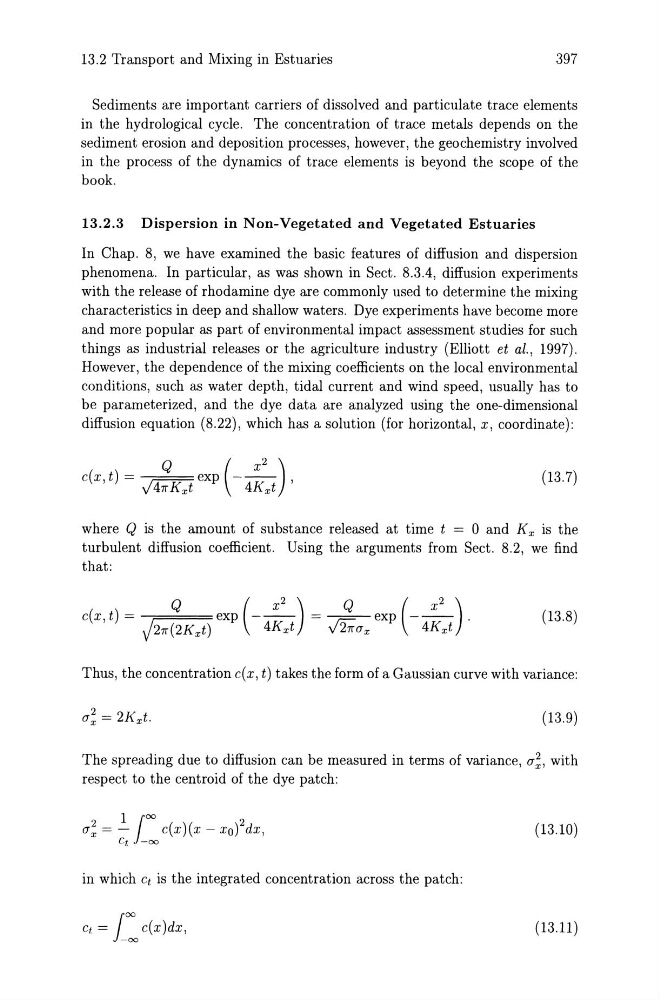
diffusion equation (8.22), which has a solution (for horizontal, x, coordinate):
C x t -
ex - - -
Q
(x2 )
( , ) -.;;r:;rKJ P 4Kxt'
(13.7)
where Q is the amount of substance released at time t = 0 and Kx is the
turbulent diffusion coefficient. Using the arguments from Sect. 8.2, we find
that:
(13.8)
Thus, the concentration c(x, t) takes the form of a Gaussian curve with variance:
(13.9)
The spreading due to diffusion can be measured in terms of variance, 0";, with
respect to the centroid of the dye patch:
1 Joo
2
0"; = 0, -00 c(x)(x - xo) dx,
(13.10)
in which Ct is the integrated concentration across the patch:
Ct = i: c(x)dx,
(13.11)
397
Sediments are important carriers of dissolved and particulate trace elements
in the hydrological cycle. The concentration of trace metals depends on the
sediment erosion and deposition processes, however, the geochemistry involved
in the process of the dynamics of trace elements is beyond the scope of the
book.
13.2.3 Dispersion in Non-Vegetated and Vegetated Estuaries
In Chap. 8, we have examined the basic features of diffusion and dispersion
phenomena. In particular, as was shown in Sect. 8.3.4, diffusion experiments
with the release of rhodamine dye are commonly used to determine the mixing
characteristics in deep and shallow waters. Dye experiments have become more
and more popular as part of environmental impact assessment studies for such
things as industrial releases or the agriculture industry (Elliott et at., 1997).
However, the dependence of the mixing coefficients on the local environmental
conditions, such as water depth, tidal current and wind speed, usually has to
be parameterized, and the dye data are analyzed using the one-dimensional
diffusion equation (8.22), which has a solution (for horizontal, x, coordinate):
C x t -
ex - - -
Q
(x2 )
( , ) -.;;r:;rKJ P 4Kxt'
(13.7)
where Q is the amount of substance released at time t = 0 and Kx is the
turbulent diffusion coefficient. Using the arguments from Sect. 8.2, we find
that:
(13.8)
Thus, the concentration c(x, t) takes the form of a Gaussian curve with variance:
(13.9)
The spreading due to diffusion can be measured in terms of variance, 0";, with
respect to the centroid of the dye patch:
1 Joo
2
0"; = 0, -00 c(x)(x - xo) dx,
(13.10)
in which Ct is the integrated concentration across the patch:
Ct = i: c(x)dx,
(13.11)