

358
11 Locomotion of Marine Animals
in this low Reynolds number environment is quite successfully predicted by the
method known as 'resistive force theory' (Holberton, 1977; Daniel et al., 1992).
Locomotion is an energetically costly activity that may comprise a significant
component of an animal's overall energy budget. Thus, it is advantageous for
animals to use a locomotion strategy which minimizes energy expenditure.
Many fish species spend most of their time cruising only within a restricted
area, such as a territory or a feeding range. They also try to adopt some
optimum speed when the amount of energy per unit distance covered reaches
a minimum.
11.3.2 Classification of Fish Swimming Modes
The propulsive movements of fish are usually classified as anguilliform, named
after the eel, Anguilla, carangiform, named after the jack, Caranx, and ostraciiform, named after the boxfish, Ostracion (Blake, 1983; Vogel, 1994).
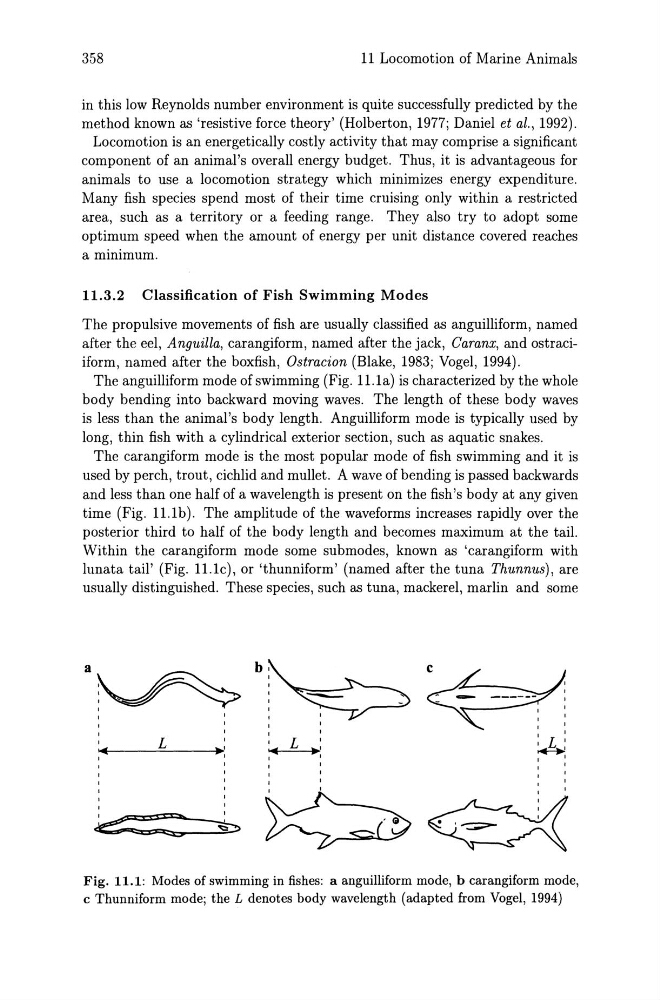
The anguilliform mode of swimming (Fig. 11.1a) is characterized by the whole
body bending into backward moving waves. The length of these body waves
is less than the animal's body length. Anguilliform mode is typically used by
long, thin fish with a cylindrical exterior section, such as aquatic snakes.
The carangiform mode is the most popular mode of fish swimming and it is
used by perch, trout, cichlid and mullet. A wave of bending is passed backwards
and less than one half of a wavelength is present on the fish's body at any given
time (Fig. 11.1 b). The amplitude of the waveforms increases rapidly over the
posterior third to half of the body length and becomes maximum at the tail.
Within the carangiform mode some submodes, known as 'carangiform with
lunata tail' (Fig. ll.lc), or 'thunniform' (named after the tuna Thunnus) , are
usually distinguished. These species, such as tuna, mackerel, marlin and some
a~
,
,
,0(
,
L
c
,
,
, '
, L'
~ ,
~~
Fig. 11.1: Modes of swimming in fishes: a anguilliform mode, b carangiform mode,
c Thunniform mode; the L denotes body wavelength (adapted from Vogel, 1994)
11 Locomotion of Marine Animals
in this low Reynolds number environment is quite successfully predicted by the
method known as 'resistive force theory' (Holberton, 1977; Daniel et al., 1992).
Locomotion is an energetically costly activity that may comprise a significant
component of an animal's overall energy budget. Thus, it is advantageous for
animals to use a locomotion strategy which minimizes energy expenditure.
Many fish species spend most of their time cruising only within a restricted
area, such as a territory or a feeding range. They also try to adopt some
optimum speed when the amount of energy per unit distance covered reaches
a minimum.
11.3.2 Classification of Fish Swimming Modes
The propulsive movements of fish are usually classified as anguilliform, named
after the eel, Anguilla, carangiform, named after the jack, Caranx, and ostraciiform, named after the boxfish, Ostracion (Blake, 1983; Vogel, 1994).
The anguilliform mode of swimming (Fig. 11.1a) is characterized by the whole
body bending into backward moving waves. The length of these body waves
is less than the animal's body length. Anguilliform mode is typically used by
long, thin fish with a cylindrical exterior section, such as aquatic snakes.
The carangiform mode is the most popular mode of fish swimming and it is
used by perch, trout, cichlid and mullet. A wave of bending is passed backwards
and less than one half of a wavelength is present on the fish's body at any given
time (Fig. 11.1 b). The amplitude of the waveforms increases rapidly over the
posterior third to half of the body length and becomes maximum at the tail.
Within the carangiform mode some submodes, known as 'carangiform with
lunata tail' (Fig. ll.lc), or 'thunniform' (named after the tuna Thunnus) , are
usually distinguished. These species, such as tuna, mackerel, marlin and some
a~
,
,
,0(
,
L
c
,
,
, '
, L'
~ ,
~~
Fig. 11.1: Modes of swimming in fishes: a anguilliform mode, b carangiform mode,
c Thunniform mode; the L denotes body wavelength (adapted from Vogel, 1994)