

352
10. Mechanical Properties of Biological Materials
Table 10.2: Densities of some inorganic and biological materials (adapted from
Denny, 1993)
Material
Density (kg/m 3 )
Inorganic materials:
Sea water
1026
Calcium carbonate
2700
Quartz
2700
Dense sand
1895
Iron
7870
Organic materials:
Coral skeleton
2000
Nautilus shell
2700
Whale ear bone
2470
Proteins
1350
Muscle
1050-1080
Fats and oils
915-945
Body fluids (blood, hemolymph)
1010
density, Pw, is equal to 1026.9 kg/m 3 . Generally, density changes with submergence in the water column, as water temperature and salinity change (see
Chap. 6). However, for simplicity of calculations, we assume that for some
depth range, the density, Pw, remains constant.
Marine animals, taken as a whole, have densities between 1060 and 1090
kg/m 3 . The most dense part of an animal is its skeleton, primarily made of
calcium carbonate of density 2700 kg/m 3 (for example, shells of snails and
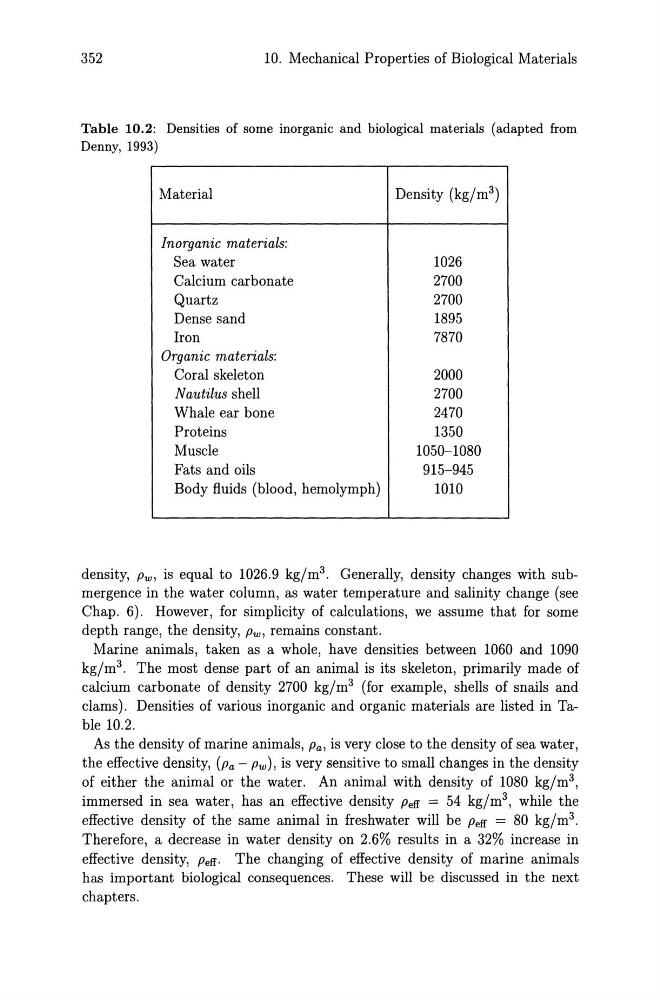
clams). Densities of various inorganic and organic materials are listed in Table 10.2.
As the density of marine animals, Pa, is very close to the density of sea water,
the effective density, (Pa - Pw), is very sensitive to small changes in the density
of either the animal or the water. An animal with density of 1080 kg/m 3 ,
immersed in sea water, has an effective density Peff = 54 kg/m 3 , while the
effective density of the same animal in freshwater will be Peff = 80 kg/m 3 .
Therefore, a decrease in water density on 2.6% results in a 32% increase in
effective density, Peff. The changing of effective density of marine animals
has important biological consequences. These will be discussed in the next
chapters.
10. Mechanical Properties of Biological Materials
Table 10.2: Densities of some inorganic and biological materials (adapted from
Denny, 1993)
Material
Density (kg/m 3 )
Inorganic materials:
Sea water
1026
Calcium carbonate
2700
Quartz
2700
Dense sand
1895
Iron
7870
Organic materials:
Coral skeleton
2000
Nautilus shell
2700
Whale ear bone
2470
Proteins
1350
Muscle
1050-1080
Fats and oils
915-945
Body fluids (blood, hemolymph)
1010
density, Pw, is equal to 1026.9 kg/m 3 . Generally, density changes with submergence in the water column, as water temperature and salinity change (see
Chap. 6). However, for simplicity of calculations, we assume that for some
depth range, the density, Pw, remains constant.
Marine animals, taken as a whole, have densities between 1060 and 1090
kg/m 3 . The most dense part of an animal is its skeleton, primarily made of
calcium carbonate of density 2700 kg/m 3 (for example, shells of snails and
clams). Densities of various inorganic and organic materials are listed in Table 10.2.
As the density of marine animals, Pa, is very close to the density of sea water,
the effective density, (Pa - Pw), is very sensitive to small changes in the density
of either the animal or the water. An animal with density of 1080 kg/m 3 ,
immersed in sea water, has an effective density Peff = 54 kg/m 3 , while the
effective density of the same animal in freshwater will be Peff = 80 kg/m 3 .
Therefore, a decrease in water density on 2.6% results in a 32% increase in
effective density, Peff. The changing of effective density of marine animals
has important biological consequences. These will be discussed in the next
chapters.