

2.2 Water at Rest: Hydrostatics
19
2.2 Water at Rest: Hydrostatics
2.2.1 Pressure Distribution in Water
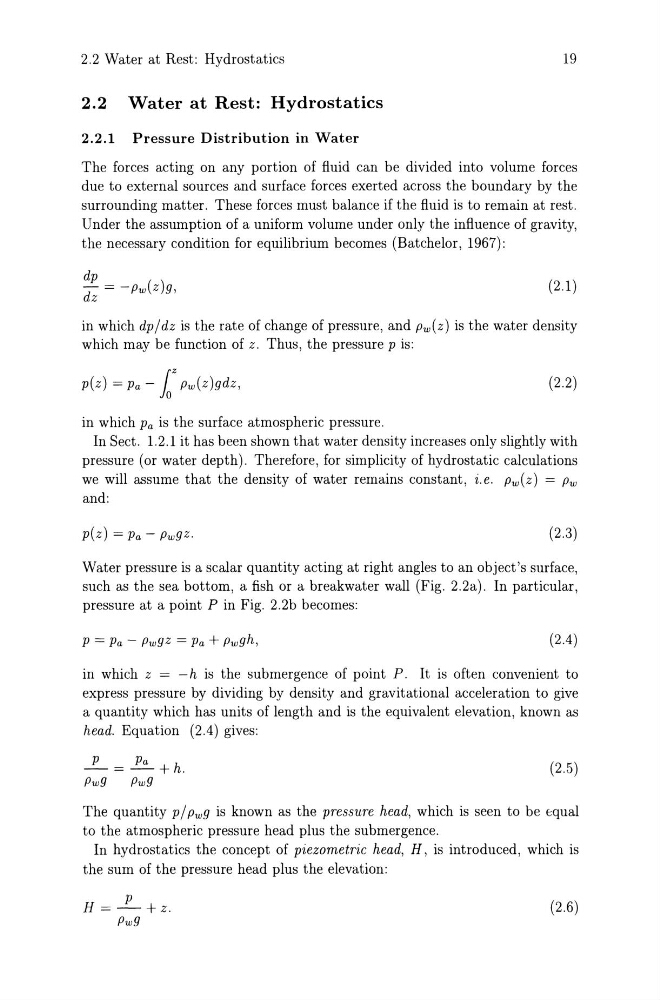
The forces acting on any portion of fluid can be divided into volume forces
due to external sources and surface forces exerted across the boundary by the
surrounding matter. These forces must balance if the fluid is to remain at rest.
Under the assumption of a uniform volume under only the influence of gravity,
the necessary condition for equilibrium becomes (Batchelor, 1967):
(2.1 )
in which dp/ dz is the rate of change of pressure, and Pw(z) is the water density
which may be function of z. Thus, the pressure pis:
p(z) = Pa - foz Pw(z)gdz,
(2.2)
in which Pa is the surface atmospheric pressure.
In Sect. l.2.1 it has been shown that water density increases only slightly with
pressure (or water depth). Therefore, for simplicity of hydrostatic calculations
we will assume that the density of water remains constant, i.e. Pw(z) = Pw
and:
p(z) = Pa - Pwg z .
(2.3)
Water pressure is a scalar quantity acting at right angles to an object's surface,
such as the sea bottom, a fish or a breakwater wall (Fig. 2.2a). In particular,
pressure at a point P in Fig. 2.2b becomes:
P = Pa - Pwg z = Pa + Pwgh ,
(2.4)
in which z = -h is the submergence of point P. It is often convenient to
express pressure by dividing by density and gravitational acceleration to give
a quantity which has units of length and is the equivalent elevation, known as
head. Equation (2.4) gives:
~=~+h.
(2.5)
Pwg
Pwg
The quantity p/ Pwg is known as the pressure head, which is seen to be tqual
to the atmospheric pressure head plus the submergence.
In hydrostatics the concept of piezometric head, H, is introduced, which is
the sum of the pressure head plus the elevation:
P
H = -+z.
(2.6)
Pwg
19
2.2 Water at Rest: Hydrostatics
2.2.1 Pressure Distribution in Water
The forces acting on any portion of fluid can be divided into volume forces
due to external sources and surface forces exerted across the boundary by the
surrounding matter. These forces must balance if the fluid is to remain at rest.
Under the assumption of a uniform volume under only the influence of gravity,
the necessary condition for equilibrium becomes (Batchelor, 1967):
(2.1 )
in which dp/ dz is the rate of change of pressure, and Pw(z) is the water density
which may be function of z. Thus, the pressure pis:
p(z) = Pa - foz Pw(z)gdz,
(2.2)
in which Pa is the surface atmospheric pressure.
In Sect. l.2.1 it has been shown that water density increases only slightly with
pressure (or water depth). Therefore, for simplicity of hydrostatic calculations
we will assume that the density of water remains constant, i.e. Pw(z) = Pw
and:
p(z) = Pa - Pwg z .
(2.3)
Water pressure is a scalar quantity acting at right angles to an object's surface,
such as the sea bottom, a fish or a breakwater wall (Fig. 2.2a). In particular,
pressure at a point P in Fig. 2.2b becomes:
P = Pa - Pwg z = Pa + Pwgh ,
(2.4)
in which z = -h is the submergence of point P. It is often convenient to
express pressure by dividing by density and gravitational acceleration to give
a quantity which has units of length and is the equivalent elevation, known as
head. Equation (2.4) gives:
~=~+h.
(2.5)
Pwg
Pwg
The quantity p/ Pwg is known as the pressure head, which is seen to be tqual
to the atmospheric pressure head plus the submergence.
In hydrostatics the concept of piezometric head, H, is introduced, which is
the sum of the pressure head plus the elevation:
P
H = -+z.
(2.6)
Pwg