

8.6 Sediment Transport in Coastal Zone
303
t (out)
qc
i+l,j+l
i+l.i
--+
--+
&
(in)
(out)
ql
ql
i,j+l
t
i,j
(in)
qc
~y
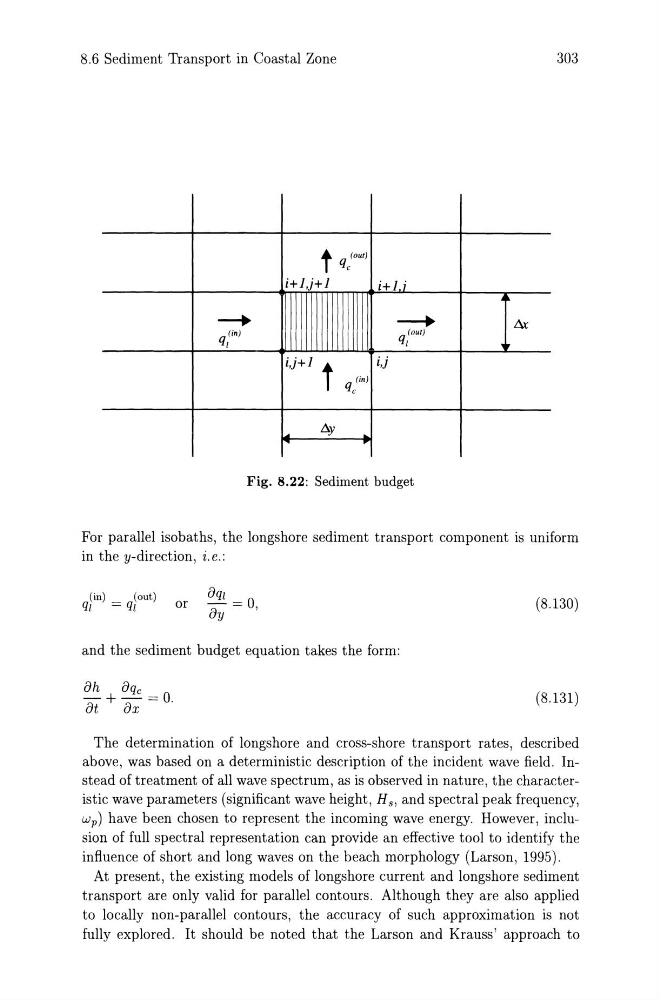
Fig. 8.22: Sediment budget
For parallel isobaths, the longshore sediment transport component is uniform
in the y-direction, i. e.:
(in)
(out)
or
ql
= ql
Oql = 0
oy
,
and the sediment budget equation takes the form:
oh
oqc
- + - = 0 .
at ax
(8.130)
(8.131)
The determination of longshore and cross-shore transport rates, described
above, was based on a deterministic description of the incident wave field. Instead of treatment of all wave spectrum, as is observed in nature, the characteristic wave parameters (significant wave height, H s , and spectral peak frequency,
w p ) have been chosen to represent the incoming wave energy. However, inclusion of full spectral representation can provide an effective tool to identify the
influence of short and long waves on the beach morphology (Larson, 1995).
At present, the existing models of longshore current and longshore sediment
transport are only valid for parallel contours. Although they are also applied
to locally non-parallel contours, the accuracy of such approximation is not
fully explored. It should be noted that the Larson and Krauss' approach to
303
t (out)
qc
i+l,j+l
i+l.i
--+
--+
&
(in)
(out)
ql
ql
i,j+l
t
i,j
(in)
qc
~y
Fig. 8.22: Sediment budget
For parallel isobaths, the longshore sediment transport component is uniform
in the y-direction, i. e.:
(in)
(out)
or
ql
= ql
Oql = 0
oy
,
and the sediment budget equation takes the form:
oh
oqc
- + - = 0 .
at ax
(8.130)
(8.131)
The determination of longshore and cross-shore transport rates, described
above, was based on a deterministic description of the incident wave field. Instead of treatment of all wave spectrum, as is observed in nature, the characteristic wave parameters (significant wave height, H s , and spectral peak frequency,
w p ) have been chosen to represent the incoming wave energy. However, inclusion of full spectral representation can provide an effective tool to identify the
influence of short and long waves on the beach morphology (Larson, 1995).
At present, the existing models of longshore current and longshore sediment
transport are only valid for parallel contours. Although they are also applied
to locally non-parallel contours, the accuracy of such approximation is not
fully explored. It should be noted that the Larson and Krauss' approach to