

8.4 Diffusion and Mixing in the Ocean
283
r-0
s
'-'
..c
c.-IOO (1)
"0
....
~ -200
~
-300
-400
-500
-600
-700
-800
0.0
0.5
1.0
1.5
2.0
Radioactivity (Bq/m2/ s)
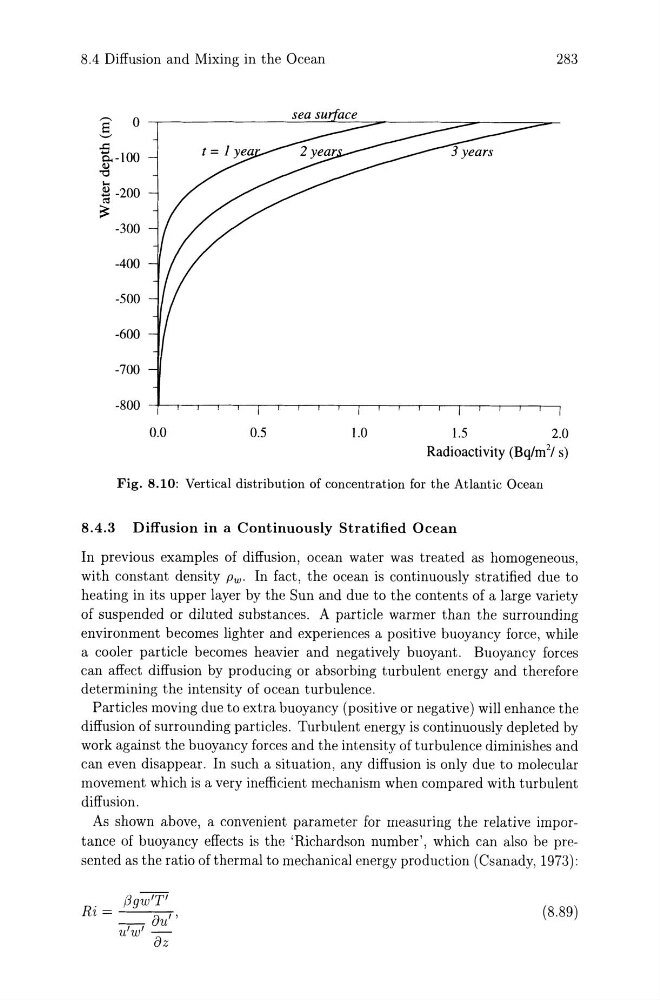
Fig. 8.10: Vertical distribution of concentration for the Atlantic Ocean
8.4.3 Diffusion in a Continuously Stratified Ocean
In previous examples of diffusion, ocean water was treated as homogeneous,
with constant density Pw. In fact, the ocean is continuously stratified due to
heating in its upper layer by the Sun and due to the contents of a large variety
of suspended or diluted substances. A particle warmer than the surrounding
environment becomes lighter and experiences a positive buoyancy force, while
a cooler particle becomes heavier and negatively buoyant. Buoyancy forces
can affect diffusion by producing or absorbing turbulent energy and therefore
determining the intensity of ocean turbulence.
Particles moving due to extra buoyancy (positive or negative) will enhance the
diffusion of surrounding particles. Turbulent energy is continuously depleted by
work against the buoyancy forces and the intensity of turbulence diminishes and
can even disappear. In such a situation, any diffusion is only due to molecular
movement which is a very inefficient mechanism when compared with turbulent
diffusion.
As shown above, a convenient parameter for measuring the relative importance of buoyancy effects is the 'Richardson number', which can also be presented as the ratio of thermal to mechanical energy production (Csanady, 1973):
.
/3gw'T'
R~ =
f) "
- - u
u'w'oz
(8.89)
283
r-0
s
'-'
..c
c.-IOO (1)
"0
....
~ -200
~
-300
-400
-500
-600
-700
-800
0.0
0.5
1.0
1.5
2.0
Radioactivity (Bq/m2/ s)
Fig. 8.10: Vertical distribution of concentration for the Atlantic Ocean
8.4.3 Diffusion in a Continuously Stratified Ocean
In previous examples of diffusion, ocean water was treated as homogeneous,
with constant density Pw. In fact, the ocean is continuously stratified due to
heating in its upper layer by the Sun and due to the contents of a large variety
of suspended or diluted substances. A particle warmer than the surrounding
environment becomes lighter and experiences a positive buoyancy force, while
a cooler particle becomes heavier and negatively buoyant. Buoyancy forces
can affect diffusion by producing or absorbing turbulent energy and therefore
determining the intensity of ocean turbulence.
Particles moving due to extra buoyancy (positive or negative) will enhance the
diffusion of surrounding particles. Turbulent energy is continuously depleted by
work against the buoyancy forces and the intensity of turbulence diminishes and
can even disappear. In such a situation, any diffusion is only due to molecular
movement which is a very inefficient mechanism when compared with turbulent
diffusion.
As shown above, a convenient parameter for measuring the relative importance of buoyancy effects is the 'Richardson number', which can also be presented as the ratio of thermal to mechanical energy production (Csanady, 1973):
.
/3gw'T'
R~ =
f) "
- - u
u'w'oz
(8.89)