

8.3 Concentration of Matter for Molecular and Turbulent Diffusion
273
and evolution of the spreading substance can be found from Eq. (8.55) for (J = 0
as:
_
M
[ (x - ftt)2]
C = J47rKxt exp - 4Kxt
.
(8.59)
Similarly as above, the tracer material moves downstream and spreads out as
a symmetrical Gaussian curve.
Advance Front of Substance in a Steady Uniform Flow. Instead of a
finite quantity introduced instantaneously at x = 0 and t = 0, it is assumed
that there is continuous input of substance from time t = 0, at a rate of
Q i = dM / dT in each increment of time dT. The concentration increment, dc,
due to an input dM, at time T can be found from Eq. (8.59) as (Ippen, 1966):
_
Qi
lot 1
{[X-ft(t-T)]2}
c(x,t) = ~
~exp -
(
)
dT.
47r K x 0 v t - T
4K x t - T
(8.60)
This is not a trivial integral and details of integration are given in Appendix C.7.
Using Eqs. (C.I72) and (C.173) we finally obtain:
2Q·
(C
[ ( a) 2 ]
c(x, t) = fi~ exp(2a) io exp - ;; - x 2 dx,
(8.61 )
or:
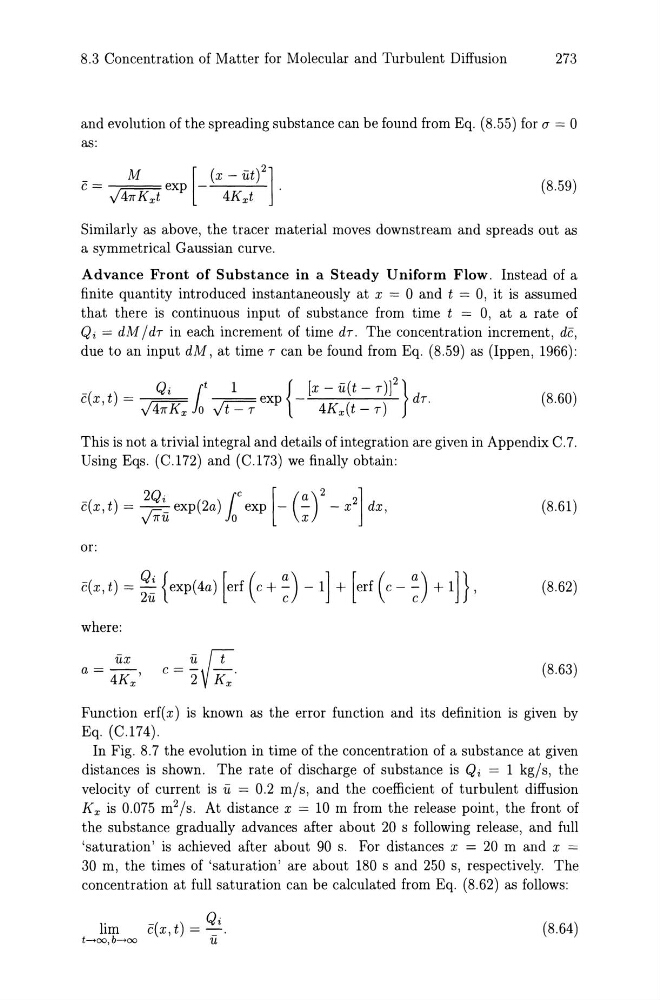
(8.62)
where:
(8.63)
Function erf(x) is known as the error function and its definition is given by
Eq. (C.174).
In Fig. 8.7 the evolution in time of the concentration of a substance at given
distances is shown. The rate of discharge of substance is Qi = 1 kg/s, the
velocity of current is ft = 0.2 mis, and the coefficient of turbulent diffusion
Kx is 0.075 m 2 /s. At distance x = 10 m from the release point, the front of
the substance gradually advances after about 20 s following release, and full
'saturation' is achieved after about 90 s. For distances x = 20 m and x =
30 m, the times of 'saturation' are about 180 sand 250 s, respectively. The
concentration at full saturation can be calculated from Eq. (8.62) as follows:
1 .
-() Qi
1m
c x,t =-=-.
t---too,b---too
u
(8.64)
273
and evolution of the spreading substance can be found from Eq. (8.55) for (J = 0
as:
_
M
[ (x - ftt)2]
C = J47rKxt exp - 4Kxt
.
(8.59)
Similarly as above, the tracer material moves downstream and spreads out as
a symmetrical Gaussian curve.
Advance Front of Substance in a Steady Uniform Flow. Instead of a
finite quantity introduced instantaneously at x = 0 and t = 0, it is assumed
that there is continuous input of substance from time t = 0, at a rate of
Q i = dM / dT in each increment of time dT. The concentration increment, dc,
due to an input dM, at time T can be found from Eq. (8.59) as (Ippen, 1966):
_
Qi
lot 1
{[X-ft(t-T)]2}
c(x,t) = ~
~exp -
(
)
dT.
47r K x 0 v t - T
4K x t - T
(8.60)
This is not a trivial integral and details of integration are given in Appendix C.7.
Using Eqs. (C.I72) and (C.173) we finally obtain:
2Q·
(C
[ ( a) 2 ]
c(x, t) = fi~ exp(2a) io exp - ;; - x 2 dx,
(8.61 )
or:
(8.62)
where:
(8.63)
Function erf(x) is known as the error function and its definition is given by
Eq. (C.174).
In Fig. 8.7 the evolution in time of the concentration of a substance at given
distances is shown. The rate of discharge of substance is Qi = 1 kg/s, the
velocity of current is ft = 0.2 mis, and the coefficient of turbulent diffusion
Kx is 0.075 m 2 /s. At distance x = 10 m from the release point, the front of
the substance gradually advances after about 20 s following release, and full
'saturation' is achieved after about 90 s. For distances x = 20 m and x =
30 m, the times of 'saturation' are about 180 sand 250 s, respectively. The
concentration at full saturation can be calculated from Eq. (8.62) as follows:
1 .
-() Qi
1m
c x,t =-=-.
t---too,b---too
u
(8.64)