

268
8 Transport in the Oceans and Coastal Zone
describes the particles spreading in the river. However, to include both diffusion effects and velocity shear, or possible circulation effects, we use the term
dispersion rather than diffusion. Also, the value of coefficient K, which we
rename as the dispersion coefficient, will be different as it results from the
process of dispersion due to shearing.
Theory of shear flow dispersion was initiated by Sir Geoffrey Taylor, who, in
his paper published in 1953, described the spreading of dissolved contaminants
in laminar flow through a pipe (Taylor, 1953). His method was later extended
to the flows between two plates, in open channels and estuaries. In the next
subsections, following Fisher et al. (1979), we will describe Taylor's method.
In Chap. 13, we will apply these results for shear flows in coastal zones and
estuaries.
Dispersion of Contaminants in Laminar Flow Between Parallel Walls.
Let us consider flow between two parallel walls, separated by a distance h. The
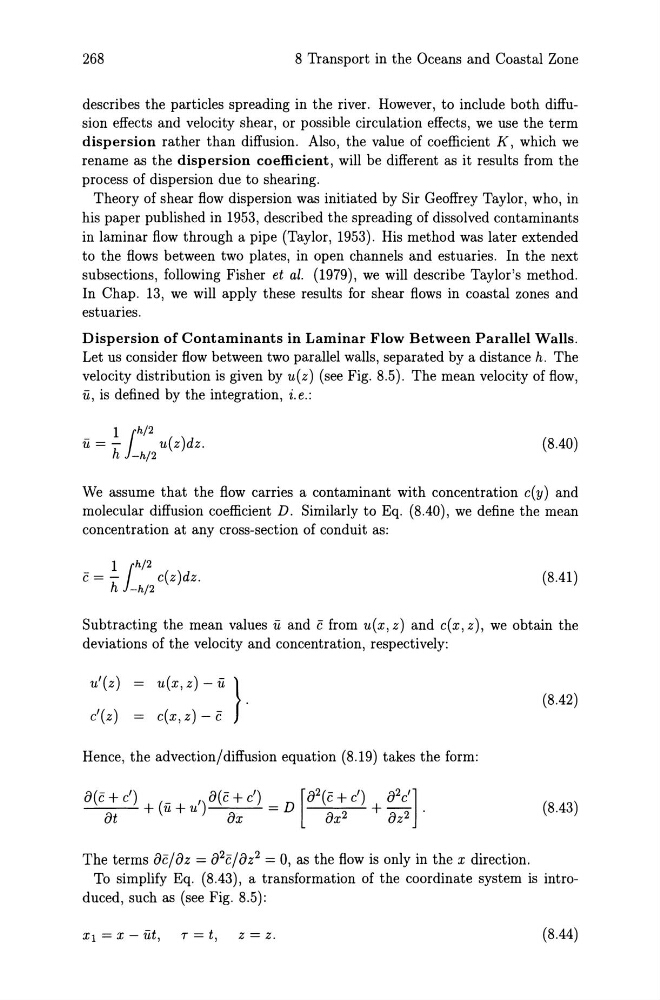
velocity distribution is given by u(z) (see Fig. 8.5). The mean velocity of flow,
ii, is defined by the integration, i.e.:
1jh/2
ii = -
u(z)dz.
h -h/2
(8.40)
We assume that the flow carries a contaminant with concentration c(y) and
molecular diffusion coefficient D. Similarly to Eq. (8.40), we define the mean
concentration at any cross-section of conduit as:
1jh/2
c=c(z)dz.
h -h/2
(8.41)
Subtracting the mean values ii and c from u(x,z) and c(x,z), we obtain the
deviations of the velocity and concentration, respectively:
u' ( z ) = u (x, z) - ii }.
c'(z) = c(x, z) - C
Hence, the advection/diffusion equation (8.19) takes the form:
8(c + c') (_ ,)8(c + c') _ [8 2 (c + c') 8 2 c']
8t
+ u + u 8x - D
8x2
+ 8z2 .
The terms 8c/8z = 8 2 c/8z 2 = 0, as the flow is only in the x direction.
(8.42)
(8.43)
To simplify Eq. (8.43), a transformation of the coordinate system is introduced, such as (see Fig. 8.5):
Xl = X - iit, T = t, z = z.
(8.44)
8 Transport in the Oceans and Coastal Zone
describes the particles spreading in the river. However, to include both diffusion effects and velocity shear, or possible circulation effects, we use the term
dispersion rather than diffusion. Also, the value of coefficient K, which we
rename as the dispersion coefficient, will be different as it results from the
process of dispersion due to shearing.
Theory of shear flow dispersion was initiated by Sir Geoffrey Taylor, who, in
his paper published in 1953, described the spreading of dissolved contaminants
in laminar flow through a pipe (Taylor, 1953). His method was later extended
to the flows between two plates, in open channels and estuaries. In the next
subsections, following Fisher et al. (1979), we will describe Taylor's method.
In Chap. 13, we will apply these results for shear flows in coastal zones and
estuaries.
Dispersion of Contaminants in Laminar Flow Between Parallel Walls.
Let us consider flow between two parallel walls, separated by a distance h. The
velocity distribution is given by u(z) (see Fig. 8.5). The mean velocity of flow,
ii, is defined by the integration, i.e.:
1jh/2
ii = -
u(z)dz.
h -h/2
(8.40)
We assume that the flow carries a contaminant with concentration c(y) and
molecular diffusion coefficient D. Similarly to Eq. (8.40), we define the mean
concentration at any cross-section of conduit as:
1jh/2
c=c(z)dz.
h -h/2
(8.41)
Subtracting the mean values ii and c from u(x,z) and c(x,z), we obtain the
deviations of the velocity and concentration, respectively:
u' ( z ) = u (x, z) - ii }.
c'(z) = c(x, z) - C
Hence, the advection/diffusion equation (8.19) takes the form:
8(c + c') (_ ,)8(c + c') _ [8 2 (c + c') 8 2 c']
8t
+ u + u 8x - D
8x2
+ 8z2 .
The terms 8c/8z = 8 2 c/8z 2 = 0, as the flow is only in the x direction.
(8.42)
(8.43)
To simplify Eq. (8.43), a transformation of the coordinate system is introduced, such as (see Fig. 8.5):
Xl = X - iit, T = t, z = z.
(8.44)