

262
8 Transport in the Oceans and Coastal Zone
eO
'--'
==0.1
.d .....
0..
~ -1
....
B o;j
~ -2
-3
-4
-5
-6
0.0
0.5
1.0
1.5
2.0
Concentration kg/m2
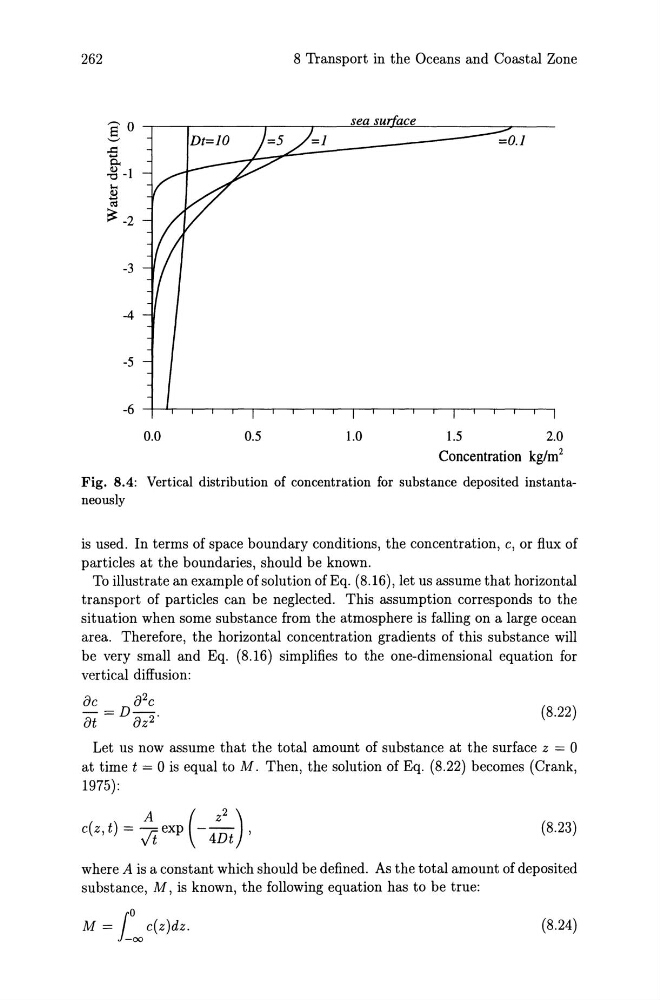
Fig. 8.4: Vertical distribution of concentration for substance deposited instantaneously
is used. In terms of space boundary conditions, the concentration, c, or flux of
particles at the boundaries, should be known.
To illustrate an example of solution of Eq. (8.16), let us assume that horizontal
transport of particles can be neglected. This assumption corresponds to the
situation when some substance from the atmosphere is falling on a large ocean
area. Therefore, the horizontal concentration gradients of this substance will
be very small and Eq. (8.16) simplifies to the one-dimensional equation for
vertical diffusion:
ac
a 2 c
- = D - .
at
az 2
(8.22)
Let us now assume that the total amount of substance at the surface z = 0
at time t = 0 is equal to M. Then, the solution of Eq. (8.22) becomes (Crank,
1975):
A
(z2 )
c(z, t) = Jt exp - 4Dt '
(8.23)
where A is a constant which should be defined. As the total amount of deposited
substance, M, is known, the following equation has to be true:
M = [0 00 c(z)dz.
(8.24)
8 Transport in the Oceans and Coastal Zone
eO
'--'
==0.1
.d .....
0..
~ -1
....
B o;j
~ -2
-3
-4
-5
-6
0.0
0.5
1.0
1.5
2.0
Concentration kg/m2
Fig. 8.4: Vertical distribution of concentration for substance deposited instantaneously
is used. In terms of space boundary conditions, the concentration, c, or flux of
particles at the boundaries, should be known.
To illustrate an example of solution of Eq. (8.16), let us assume that horizontal
transport of particles can be neglected. This assumption corresponds to the
situation when some substance from the atmosphere is falling on a large ocean
area. Therefore, the horizontal concentration gradients of this substance will
be very small and Eq. (8.16) simplifies to the one-dimensional equation for
vertical diffusion:
ac
a 2 c
- = D - .
at
az 2
(8.22)
Let us now assume that the total amount of substance at the surface z = 0
at time t = 0 is equal to M. Then, the solution of Eq. (8.22) becomes (Crank,
1975):
A
(z2 )
c(z, t) = Jt exp - 4Dt '
(8.23)
where A is a constant which should be defined. As the total amount of deposited
substance, M, is known, the following equation has to be true:
M = [0 00 c(z)dz.
(8.24)