

7.8 Coastal Water Movement
A - antinode
N - node
edge-wave
crest
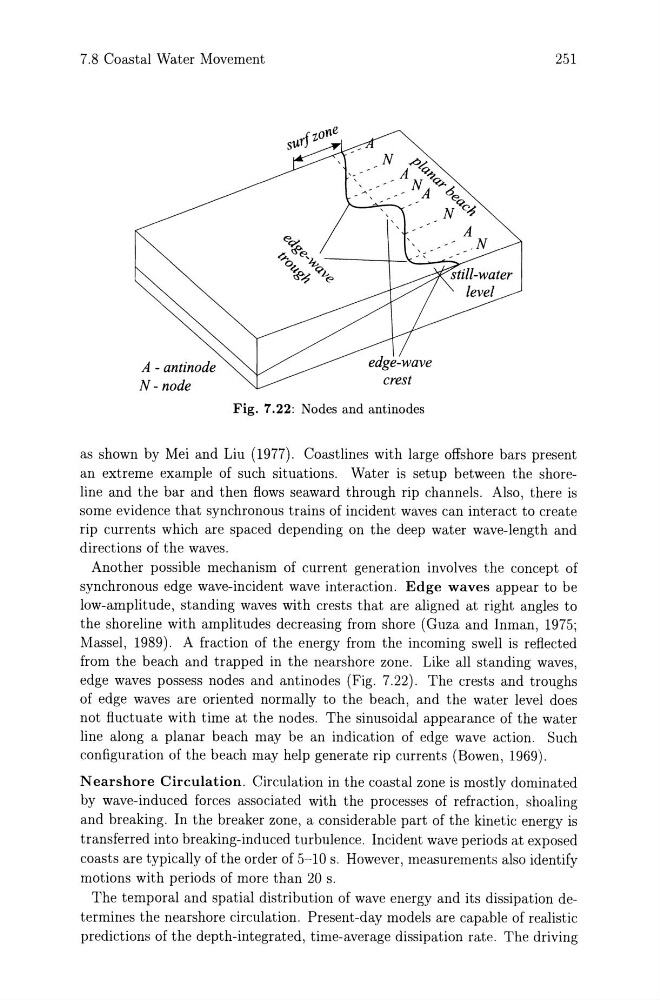
Fig. 7.22: Nodes and antinodes
A
.N
251
as shown by Mei and Liu (1977). Coastlines with large offshore bars present
an extreme example of such situations. Water is setup between the shoreline and the bar and then flows seaward through rip channels. Also, there is
some evidence that synchronous trains of incident waves can interact to create
rip currents which are spaced depending on the deep water wave-length and
directions of the waves.
Another possible mechanism of current generation involves the concept of
synchronous edge wave-incident wave interaction. Edge waves appear to be
low-amplitude, standing waves with crests that are aligned at right angles to
the shoreline with amplitudes decreasing from shore (Guza and Inman, 1975;
Massel, 1989). A fraction of the energy from the incoming swell is reflected
from the beach and trapped in the nearshore zone. Like all standing waves,
edge waves possess nodes and antinodes (Fig. 7.22). The crests and troughs
of edge waves are oriented normally to the beach, and the water level does
not fluctuate with time at the nodes. The sinusoidal appearance of the water
line along a planar beach may be an indication of edge wave action. Such
configuration of the beach may help generate rip currents (Bowen, 1969).
N earshore Circulation. Circulation in the coastal zone is mostly dominated
by wave-induced forces associated with the processes of refraction, shoaling
and breaking. In the breaker zone, a considerable part of the kinetic energy is
transferred into breaking-induced turbulence. Incident wave periods at exposed
coasts are typically of the order of 5-10 s. However, measurements also identify
motions with periods of more than 20 s.
The temporal and spatial distribution of wave energy and its dissipation determines the nearshore circulation. Present-day models are capable of realistic
predictions of the depth-integrated, time-average dissipation rate. The driving
A - antinode
N - node
edge-wave
crest
Fig. 7.22: Nodes and antinodes
A
.N
251
as shown by Mei and Liu (1977). Coastlines with large offshore bars present
an extreme example of such situations. Water is setup between the shoreline and the bar and then flows seaward through rip channels. Also, there is
some evidence that synchronous trains of incident waves can interact to create
rip currents which are spaced depending on the deep water wave-length and
directions of the waves.
Another possible mechanism of current generation involves the concept of
synchronous edge wave-incident wave interaction. Edge waves appear to be
low-amplitude, standing waves with crests that are aligned at right angles to
the shoreline with amplitudes decreasing from shore (Guza and Inman, 1975;
Massel, 1989). A fraction of the energy from the incoming swell is reflected
from the beach and trapped in the nearshore zone. Like all standing waves,
edge waves possess nodes and antinodes (Fig. 7.22). The crests and troughs
of edge waves are oriented normally to the beach, and the water level does
not fluctuate with time at the nodes. The sinusoidal appearance of the water
line along a planar beach may be an indication of edge wave action. Such
configuration of the beach may help generate rip currents (Bowen, 1969).
N earshore Circulation. Circulation in the coastal zone is mostly dominated
by wave-induced forces associated with the processes of refraction, shoaling
and breaking. In the breaker zone, a considerable part of the kinetic energy is
transferred into breaking-induced turbulence. Incident wave periods at exposed
coasts are typically of the order of 5-10 s. However, measurements also identify
motions with periods of more than 20 s.
The temporal and spatial distribution of wave energy and its dissipation determines the nearshore circulation. Present-day models are capable of realistic
predictions of the depth-integrated, time-average dissipation rate. The driving