

7.7 Continental Shelf Flow
243
7.7.4 Other Examples of Upwelling
Apart from coastal upwelling, oceanographers recognize two other types of
upwelling: polar and equatorial upwellings. These upwellings are also highly
productive, but the mechanisms that promote the upward motion of water in
each case is different. We start with the polar upwelling.
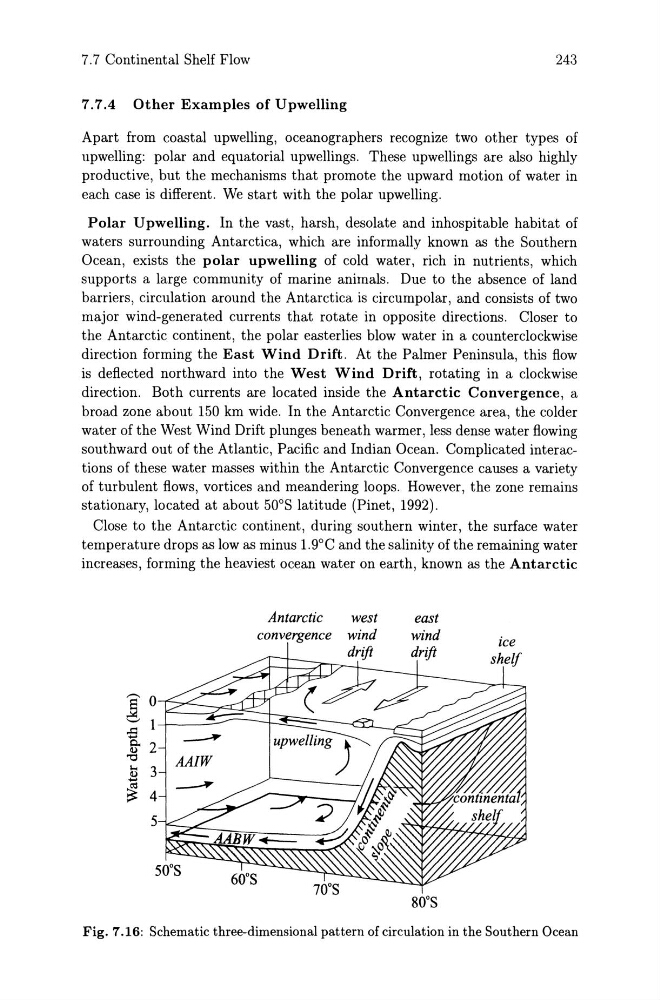
Polar Upwelling. In the vast, harsh, desolate and inhospitable habitat of
waters surrounding Antarctica, which are informally known as the Southern
Ocean, exists the polar upwelling of cold water, rich in nutrients, which
supports a large community of marine animals. Due to the absence of land
barriers, circulation around the Antarctica is circumpolar, and consists of two
major wind-generated currents that rotate in opposite directions. Closer to
the Antarctic continent, the polar easterlies blow water in a counterclockwise
direction forming the East Wind Drift. At the Palmer Peninsula, this flow
is deflected northward into the West Wind Drift, rotating in a clockwise
direction. Both currents are located inside the Antarctic Convergence, a
broad zone about 150 km wide. In the Antarctic Convergence area, the colder
water of the West Wind Drift plunges beneath warmer, less dense water flowing
southward out of the Atlantic, Pacific and Indian Ocean. Complicated interactions of these water masses within the Antarctic Convergence causes a variety
of turbulent flows, vortices and meandering loops. However, the zone remains
stationary, located at about 50 0 S latitude (Pinet, 1992).
Close to the Antarctic continent, during southern winter, the surface water
temperature drops as low as minus 1. 9°C and the salinity of the remaining water
increases, forming the heaviest ocean water on earth, known as the Antarctic
~O
il
fr 2
"0
E 3
~ 4
-+---Antarctic
convergence
5 Gt2::::--;;-n;;rrr-::---80
0
S
Fig. 7.16: Schematic three-dimensional pattern of circulation in the Southern Ocean
243
7.7.4 Other Examples of Upwelling
Apart from coastal upwelling, oceanographers recognize two other types of
upwelling: polar and equatorial upwellings. These upwellings are also highly
productive, but the mechanisms that promote the upward motion of water in
each case is different. We start with the polar upwelling.
Polar Upwelling. In the vast, harsh, desolate and inhospitable habitat of
waters surrounding Antarctica, which are informally known as the Southern
Ocean, exists the polar upwelling of cold water, rich in nutrients, which
supports a large community of marine animals. Due to the absence of land
barriers, circulation around the Antarctica is circumpolar, and consists of two
major wind-generated currents that rotate in opposite directions. Closer to
the Antarctic continent, the polar easterlies blow water in a counterclockwise
direction forming the East Wind Drift. At the Palmer Peninsula, this flow
is deflected northward into the West Wind Drift, rotating in a clockwise
direction. Both currents are located inside the Antarctic Convergence, a
broad zone about 150 km wide. In the Antarctic Convergence area, the colder
water of the West Wind Drift plunges beneath warmer, less dense water flowing
southward out of the Atlantic, Pacific and Indian Ocean. Complicated interactions of these water masses within the Antarctic Convergence causes a variety
of turbulent flows, vortices and meandering loops. However, the zone remains
stationary, located at about 50 0 S latitude (Pinet, 1992).
Close to the Antarctic continent, during southern winter, the surface water
temperature drops as low as minus 1. 9°C and the salinity of the remaining water
increases, forming the heaviest ocean water on earth, known as the Antarctic
~O
il
fr 2
"0
E 3
~ 4
-+---Antarctic
convergence
5 Gt2::::--;;-n;;rrr-::---80
0
S
Fig. 7.16: Schematic three-dimensional pattern of circulation in the Southern Ocean