

220
7 Ocean Currents
force balanced by the Coriolis type force. The reader wanting more details can
consult papers of Knauss (1961) and Leetmaa et al. (1981).
7.3.5 Currents in Non-Homogeneous Ocean
As was shown in Chap. 6, the density of the water in the oceans increases with
depth. Only in some exceptional cases, especially near the sea surface, can
the density of the water slightly decrease with depth before the usual increase
begins. In such stratified ocean, an important relationship exists between the
mass distribution and the relative velocity distribution in the vertical direction.
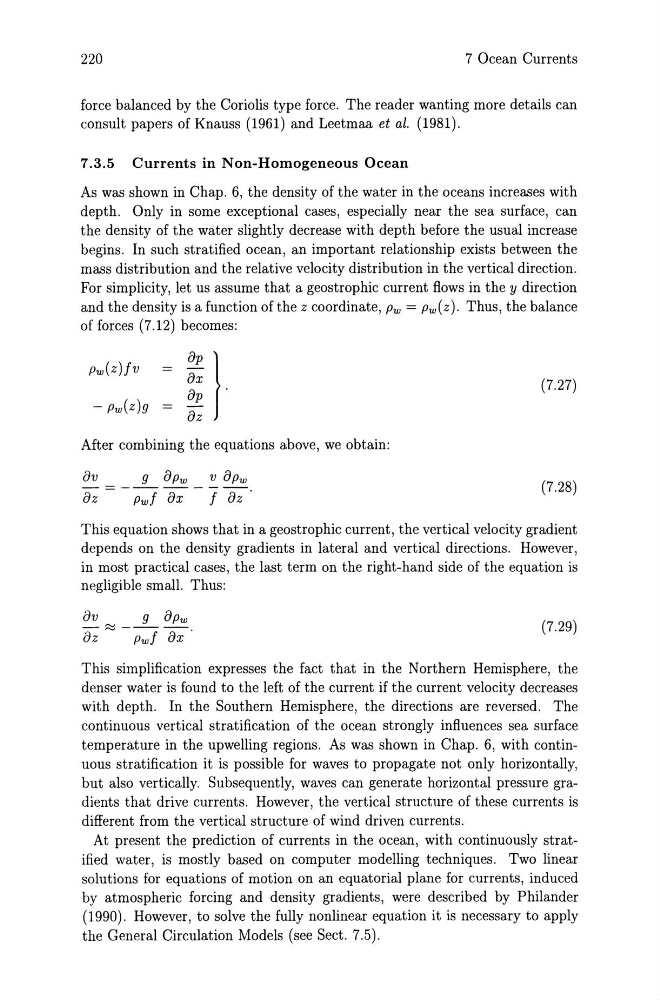
For simplicity, let us assume that a geostrophic current flows in the y direction
and the density is a function of the z coordinate, Pw = Pw(z). Thus, the balance
of forces (7.12) becomes:
Pw(z)fv
= op }
ox
op
.
oz
(7.27)
- Pw(z)g
After combining the equations above, we obtain:
ov
9 0pw
v 0Pw
--------oz
Pwf ox
f oz
(7.28)
This equation shows that in a geostrophic current, the vertical velocity gradient
depends on the density gradients in lateral and vertical directions. However,
in most practical cases, the last term on the right-hand side of the equation is
negligible small. Thus:
(7.29)
This simplification expresses the fact that in the Northern Hemisphere, the
denser water is found to the left of the current if the current velocity decreases
with depth. In the Southern Hemisphere, the directions are reversed. The
continuous vertical stratification of the ocean strongly influences sea surface
temperature in the upwelling regions. As was shown in Chap. 6, with continuous stratification it is possible for waves to propagate not only horizontally,
but also vertically. Subsequently, waves can generate horizontal pressure gradients that drive currents. However, the vertical structure of these currents is
different from the vertical structure of wind driven currents.
At present the prediction of currents in the ocean, with continuously stratified water, is mostly based on computer modelling techniques. Two linear
solutions for equations of motion on an equatorial plane for currents, induced
by atmospheric forcing and density gradients, were described by Philander
(1990). However, to solve the fully nonlinear equation it is necessary to apply
the General Circulation Models (see Sect. 7.5).
7 Ocean Currents
force balanced by the Coriolis type force. The reader wanting more details can
consult papers of Knauss (1961) and Leetmaa et al. (1981).
7.3.5 Currents in Non-Homogeneous Ocean
As was shown in Chap. 6, the density of the water in the oceans increases with
depth. Only in some exceptional cases, especially near the sea surface, can
the density of the water slightly decrease with depth before the usual increase
begins. In such stratified ocean, an important relationship exists between the
mass distribution and the relative velocity distribution in the vertical direction.
For simplicity, let us assume that a geostrophic current flows in the y direction
and the density is a function of the z coordinate, Pw = Pw(z). Thus, the balance
of forces (7.12) becomes:
Pw(z)fv
= op }
ox
op
.
oz
(7.27)
- Pw(z)g
After combining the equations above, we obtain:
ov
9 0pw
v 0Pw
--------oz
Pwf ox
f oz
(7.28)
This equation shows that in a geostrophic current, the vertical velocity gradient
depends on the density gradients in lateral and vertical directions. However,
in most practical cases, the last term on the right-hand side of the equation is
negligible small. Thus:
(7.29)
This simplification expresses the fact that in the Northern Hemisphere, the
denser water is found to the left of the current if the current velocity decreases
with depth. In the Southern Hemisphere, the directions are reversed. The
continuous vertical stratification of the ocean strongly influences sea surface
temperature in the upwelling regions. As was shown in Chap. 6, with continuous stratification it is possible for waves to propagate not only horizontally,
but also vertically. Subsequently, waves can generate horizontal pressure gradients that drive currents. However, the vertical structure of these currents is
different from the vertical structure of wind driven currents.
At present the prediction of currents in the ocean, with continuously stratified water, is mostly based on computer modelling techniques. Two linear
solutions for equations of motion on an equatorial plane for currents, induced
by atmospheric forcing and density gradients, were described by Philander
(1990). However, to solve the fully nonlinear equation it is necessary to apply
the General Circulation Models (see Sect. 7.5).