

7.3 Wind-Driven Surface and Near-Surface Currents
217
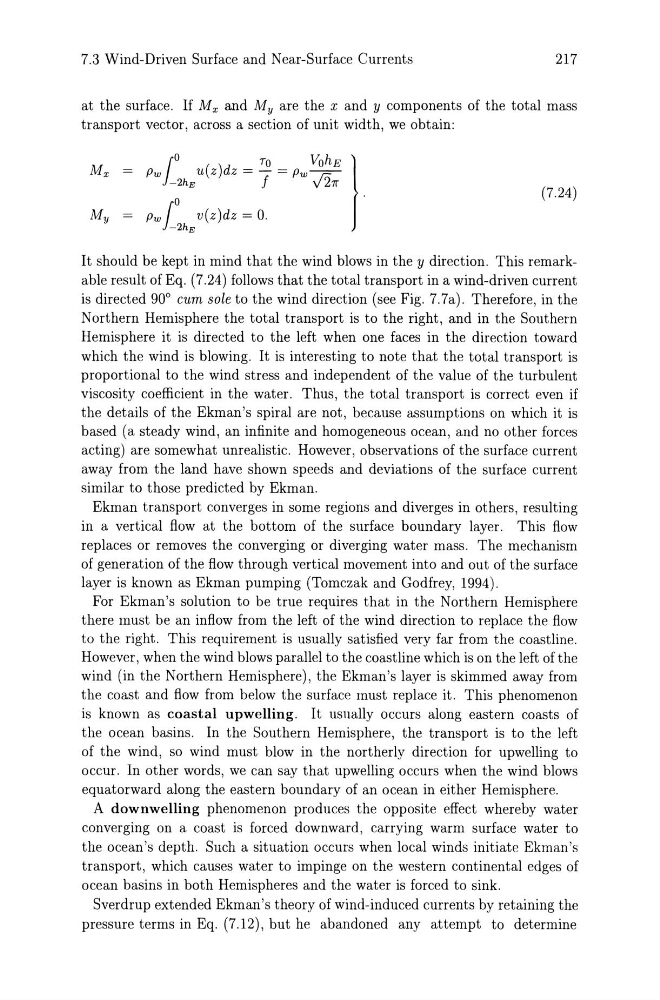
at the surface. If Mx and My are the x and y components of the total mass
transport vector, across a section of unit width, we obtain:
Mx = Pwfo u(z)dz = TO = Pw V~E }
-2hE
f
V 27r
My = PwfO v(z)dz = O.
.
-2hE
(7.24)
It should be kept in mind that the wind blows in the y direction. This remarkable result of Eq. (7.24) follows that the total transport in a wind-driven current
is directed 90° cum sole to the wind direction (see Fig. 7.7a). Therefore, in the
Northern Hemisphere the total transport is to the right, and in the Southern
Hemisphere it is directed to the left when one faces in the direction toward
which the wind is blowing. It is interesting to note that the total transport is
proportional to the wind stress and independent of the value of the turbulent
viscosity coefficient in the water. Thus, the total transport is correct even if
the details of the Ekman's spiral are not, because assumptions on which it is
based (a steady wind, an infinite and homogeneous ocean, and no other forces
acting) are somewhat unrealistic. However, observations of the surface current
away from the land have shown speeds and deviations of the surface current
similar to those predicted by Ekman.
Ekman transport converges in some regions and diverges in others, resulting
in a vertical flow at the bottom of the surface boundary layer. This flow
replaces or removes the converging or diverging water mass. The mechanism
of generation of the flow through vertical movement into and out of the surface
layer is known as Ekman pumping (Tomczak and Godfrey, 1994).
For Ekman's solution to be true requires that in the Northern Hemisphere
there must be an inflow from the left of the wind direction to replace the flow
to the right. This requirement is usually satisfied very far from the coastline.
However, when the wind blows parallel to the coastline which is on the left of the
wind (in the Northern Hemisphere), the Ekman's layer is skimmed away from
the coast and flow from below the surface must replace it. This phenomenon
is known as coastal upwelling. It usually occurs along eastern coasts of
the ocean basins. In the Southern Hemisphere, the transport is to the left
of the wind, so wind must blow in the northerly direction for upwelling to
occur. In other words, we can say that upwelling occurs when the wind blows
equatorward along the eastern boundary of an ocean in either Hemisphere.
A downwelling phenomenon produces the opposite effect whereby water
converging on a coast is forced downward, carrying warm surface water to
the ocean's depth. Such a situation occurs when local winds initiate Ekman's
transport, which causes water to impinge on the western continental edges of
ocean basins in both Hemispheres and the water is forced to sink.
Sverdrup extended Ekman's theory of wind-induced currents by retaining the
pressure terms in Eq. (7.12), but he abandoned any attempt to determine
217
at the surface. If Mx and My are the x and y components of the total mass
transport vector, across a section of unit width, we obtain:
Mx = Pwfo u(z)dz = TO = Pw V~E }
-2hE
f
V 27r
My = PwfO v(z)dz = O.
.
-2hE
(7.24)
It should be kept in mind that the wind blows in the y direction. This remarkable result of Eq. (7.24) follows that the total transport in a wind-driven current
is directed 90° cum sole to the wind direction (see Fig. 7.7a). Therefore, in the
Northern Hemisphere the total transport is to the right, and in the Southern
Hemisphere it is directed to the left when one faces in the direction toward
which the wind is blowing. It is interesting to note that the total transport is
proportional to the wind stress and independent of the value of the turbulent
viscosity coefficient in the water. Thus, the total transport is correct even if
the details of the Ekman's spiral are not, because assumptions on which it is
based (a steady wind, an infinite and homogeneous ocean, and no other forces
acting) are somewhat unrealistic. However, observations of the surface current
away from the land have shown speeds and deviations of the surface current
similar to those predicted by Ekman.
Ekman transport converges in some regions and diverges in others, resulting
in a vertical flow at the bottom of the surface boundary layer. This flow
replaces or removes the converging or diverging water mass. The mechanism
of generation of the flow through vertical movement into and out of the surface
layer is known as Ekman pumping (Tomczak and Godfrey, 1994).
For Ekman's solution to be true requires that in the Northern Hemisphere
there must be an inflow from the left of the wind direction to replace the flow
to the right. This requirement is usually satisfied very far from the coastline.
However, when the wind blows parallel to the coastline which is on the left of the
wind (in the Northern Hemisphere), the Ekman's layer is skimmed away from
the coast and flow from below the surface must replace it. This phenomenon
is known as coastal upwelling. It usually occurs along eastern coasts of
the ocean basins. In the Southern Hemisphere, the transport is to the left
of the wind, so wind must blow in the northerly direction for upwelling to
occur. In other words, we can say that upwelling occurs when the wind blows
equatorward along the eastern boundary of an ocean in either Hemisphere.
A downwelling phenomenon produces the opposite effect whereby water
converging on a coast is forced downward, carrying warm surface water to
the ocean's depth. Such a situation occurs when local winds initiate Ekman's
transport, which causes water to impinge on the western continental edges of
ocean basins in both Hemispheres and the water is forced to sink.
Sverdrup extended Ekman's theory of wind-induced currents by retaining the
pressure terms in Eq. (7.12), but he abandoned any attempt to determine