

6.4 Internal Waves when the Density Varies Continuously with Depth
199
--..c
surface soliton
rip
thermocline
internal soliton
"t'\' ': I ~ isotachs
I
\
I"~
't'. ? : .. :
,
"
' . -
/
I
(, ':=' :i
',.-- '
t '
I
+-=-.
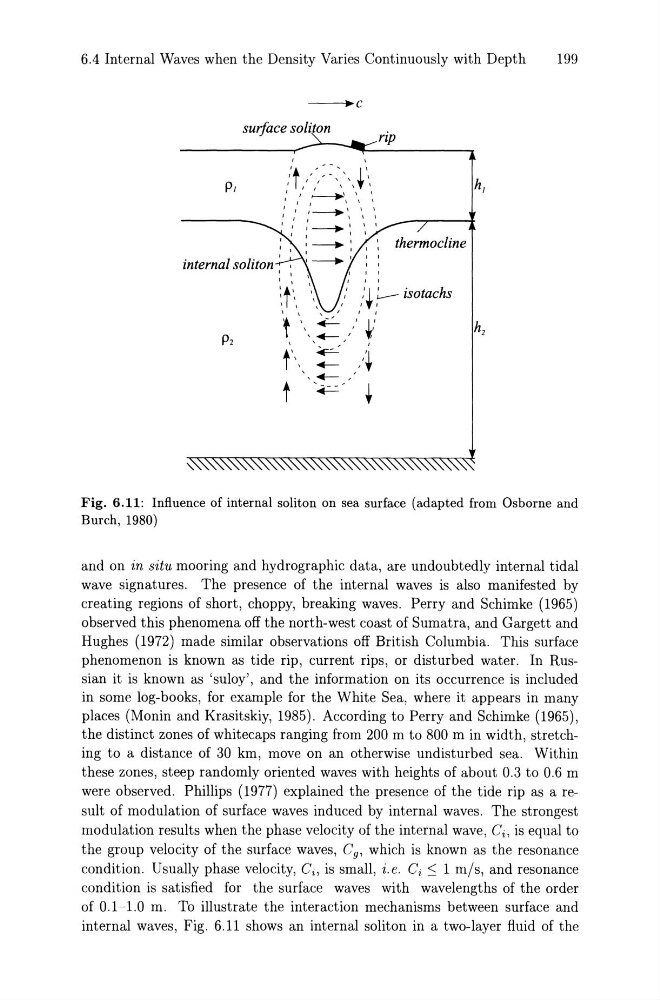
Fig. 6.11: Influence of internal soliton on sea surface (adapted from Osborne and
Burch, 1980)
and on in situ mooring and hydrographic data, are undoubtedly internal tidal
wave signatures. The presence of the internal waves is also manifested by
creating regions of short, choppy, breaking waves. Perry and Schimke (1965)
observed this phenomena off the north-west coast of Sumatra, and Gargett and
Hughes (1972) made similar observations off British Columbia. This surface
phenomenon is known as tide rip, current rips, or disturbed water. In Russian it is known as 'suloy', and the information on its occurrence is included
in some log-books, for example for the White Sea, where it appears in many
places (Monin and Krasitskiy, 1985). According to Perry and Schimke (1965),
the distinct zones of whitecaps ranging from 200 m to 800 m in width, stretching to a distance of 30 km, move on an otherwise undisturbed sea. Within
these zones, steep randomly oriented waves with heights of about 0.3 to 0.6 m
were observed. Phillips (1977) explained the presence of the tide rip as a result of modulation of surface waves induced by internal waves. The strongest
modulation results when the phase velocity of the internal wave, Gi , is equal to
the group velocity of the surface waves, Gg , which is known as the resonance
condition. Usually phase velocity, Gi , is small, i.e. Gi :::; 1 mis, and resonance
condition is satisfied for the surface waves with wavelengths of the order
of 0.1-l.0 m. To illustrate the interaction mechanisms between surface and
internal waves, Fig. 6.11 shows an internal soliton in a two-layer fluid of the
199
--..c
surface soliton
rip
thermocline
internal soliton
"t'\' ': I ~ isotachs
I
\
I"~
't'. ? : .. :
,
"
' . -
/
I
(, ':=' :i
',.-- '
t '
I
+-=-.
Fig. 6.11: Influence of internal soliton on sea surface (adapted from Osborne and
Burch, 1980)
and on in situ mooring and hydrographic data, are undoubtedly internal tidal
wave signatures. The presence of the internal waves is also manifested by
creating regions of short, choppy, breaking waves. Perry and Schimke (1965)
observed this phenomena off the north-west coast of Sumatra, and Gargett and
Hughes (1972) made similar observations off British Columbia. This surface
phenomenon is known as tide rip, current rips, or disturbed water. In Russian it is known as 'suloy', and the information on its occurrence is included
in some log-books, for example for the White Sea, where it appears in many
places (Monin and Krasitskiy, 1985). According to Perry and Schimke (1965),
the distinct zones of whitecaps ranging from 200 m to 800 m in width, stretching to a distance of 30 km, move on an otherwise undisturbed sea. Within
these zones, steep randomly oriented waves with heights of about 0.3 to 0.6 m
were observed. Phillips (1977) explained the presence of the tide rip as a result of modulation of surface waves induced by internal waves. The strongest
modulation results when the phase velocity of the internal wave, Gi , is equal to
the group velocity of the surface waves, Gg , which is known as the resonance
condition. Usually phase velocity, Gi , is small, i.e. Gi :::; 1 mis, and resonance
condition is satisfied for the surface waves with wavelengths of the order
of 0.1-l.0 m. To illustrate the interaction mechanisms between surface and
internal waves, Fig. 6.11 shows an internal soliton in a two-layer fluid of the