

6.4 Internal Waves when the Density Varies Continuously with Depth
197
G
~
~
~ 20r---------*-~---------------i3
S
~
14L--------------------------o
2
3
4
5
6
Time (hours)
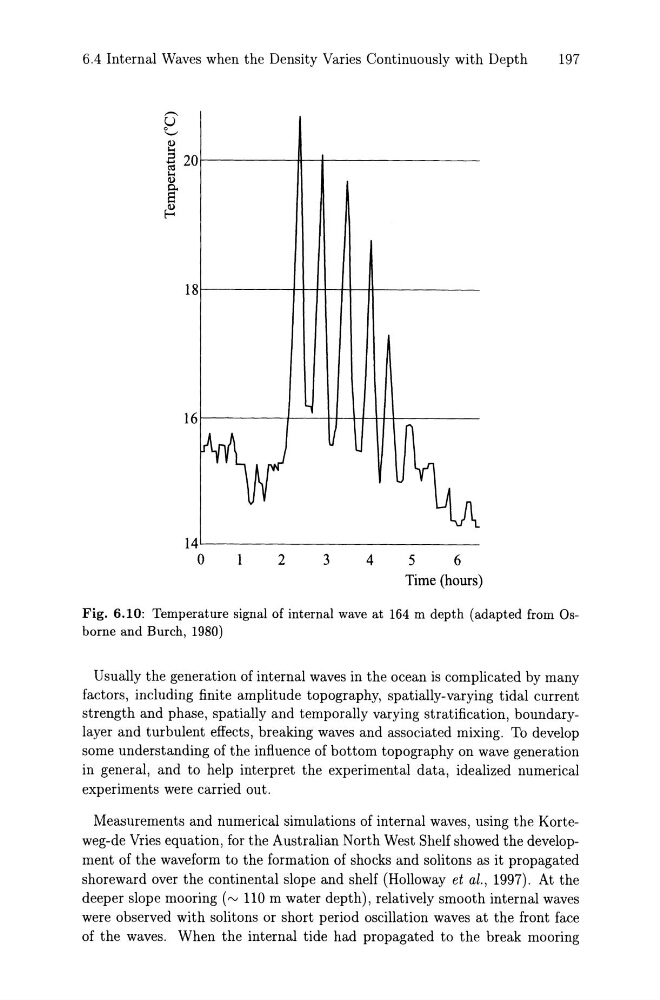
Fig. 6.10: Temperature signal of internal wave at 164 m depth (adapted from Osborne and Burch, 1980)
Usually the generation of internal waves in the ocean is complicated by many
factors, including finite amplitude topography, spatially-varying tidal current
strength and phase, spatially and temporally varying stratification, boundarylayer and turbulent effects, breaking waves and associated mixing. To develop
some understanding of the influence of bottom topography on wave generation
in general, and to help interpret the experimental data, idealized numerical
experiments were carried out.
Measurements and numerical simulations of internal waves, using the Korteweg-de Vries equation, for the Australian North West Shelf showed the development of the waveform to the formation of shocks and solitons as it propagated
shoreward over the continental slope and shelf (Holloway et al., 1997). At the
deeper slope mooring ("-' 110 m water depth), relatively smooth internal waves
were observed with solitons or short period oscillation waves at the front face
of the waves. When the internal tide had propagated to the break mooring
197
G
~
~
~ 20r---------*-~---------------i3
S
~
14L--------------------------o
2
3
4
5
6
Time (hours)
Fig. 6.10: Temperature signal of internal wave at 164 m depth (adapted from Osborne and Burch, 1980)
Usually the generation of internal waves in the ocean is complicated by many
factors, including finite amplitude topography, spatially-varying tidal current
strength and phase, spatially and temporally varying stratification, boundarylayer and turbulent effects, breaking waves and associated mixing. To develop
some understanding of the influence of bottom topography on wave generation
in general, and to help interpret the experimental data, idealized numerical
experiments were carried out.
Measurements and numerical simulations of internal waves, using the Korteweg-de Vries equation, for the Australian North West Shelf showed the development of the waveform to the formation of shocks and solitons as it propagated
shoreward over the continental slope and shelf (Holloway et al., 1997). At the
deeper slope mooring ("-' 110 m water depth), relatively smooth internal waves
were observed with solitons or short period oscillation waves at the front face
of the waves. When the internal tide had propagated to the break mooring