

184
8'
0
'-'
"
.£i
fr
"0
\
....
II)
50
....
~
, ~
~
100
12
14
16
22
23
24
o
~
"
'"
18
20
22
25
26
27
2
-24
28
6 Internal Waves
26
29
T
28
Toe
3
NxJO~S-1
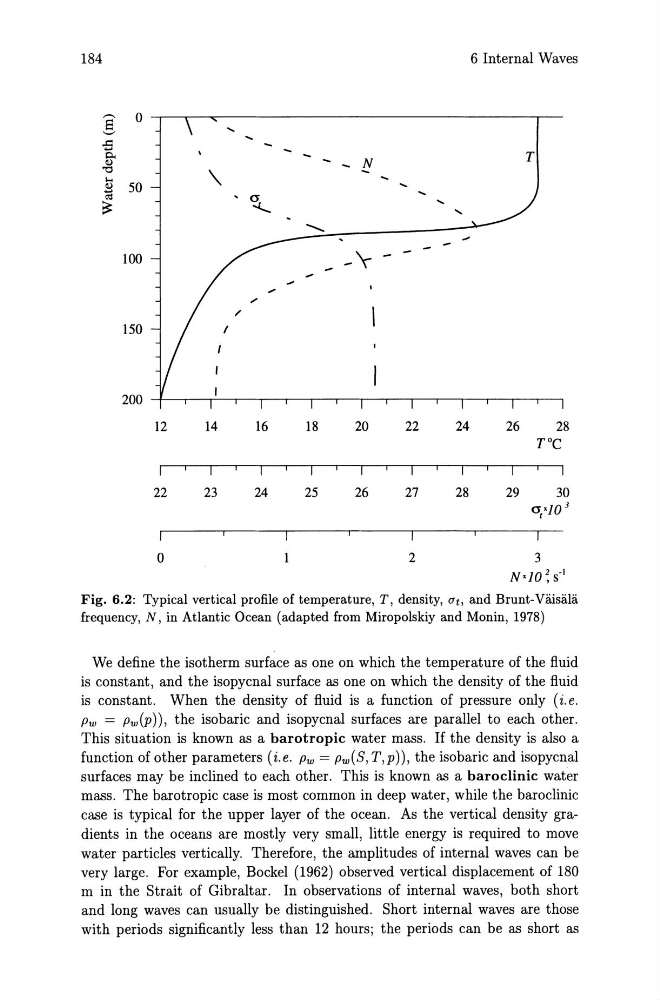
Fig. 6.2: Typical vertical profile of temperature, T, density, at, and Brunt-Viiisiilii
frequency, N, in Atlantic Ocean (adapted from Miropolskiy and Monin, 1978)
We define the isotherm surface as one on which the temperature of the fluid
is constant, and the isopycnal surface as one on which the density of the fluid
is constant. When the density of fluid is a function of pressure only (i.e.
Pw = Pw(p)), the isobaric and isopycnal surfaces are parallel to each other.
This situation is known as a barotropic water mass. If the density is also a
function of other parameters (i.e. Pw = Pw(S, T,p)), the isobaric and isopycnal
surfaces may be inclined to each other. This is known as a baroclinic water
mass. The barotropic case is most common in deep water, while the baroclinic
case is typical for the upper layer of the ocean. As the vertical density gradients in the oceans are mostly very small, little energy is required to move
water particles vertically. Therefore, the amplitudes of internal waves can be
very large. For example, Bockel (1962) observed vertical displacement of 180
m in the Strait of Gibraltar. In observations of internal waves, both short
and long waves can usually be distinguished. Short internal waves are those
with periods significantly less than 12 hours; the periods can be as short as
8'
0
'-'
"
.£i
fr
"0
\
....
II)
50
....
~
, ~
~
100
12
14
16
22
23
24
o
~
"
'"
18
20
22
25
26
27
2
-24
28
6 Internal Waves
26
29
T
28
Toe
3
NxJO~S-1
Fig. 6.2: Typical vertical profile of temperature, T, density, at, and Brunt-Viiisiilii
frequency, N, in Atlantic Ocean (adapted from Miropolskiy and Monin, 1978)
We define the isotherm surface as one on which the temperature of the fluid
is constant, and the isopycnal surface as one on which the density of the fluid
is constant. When the density of fluid is a function of pressure only (i.e.
Pw = Pw(p)), the isobaric and isopycnal surfaces are parallel to each other.
This situation is known as a barotropic water mass. If the density is also a
function of other parameters (i.e. Pw = Pw(S, T,p)), the isobaric and isopycnal
surfaces may be inclined to each other. This is known as a baroclinic water
mass. The barotropic case is most common in deep water, while the baroclinic
case is typical for the upper layer of the ocean. As the vertical density gradients in the oceans are mostly very small, little energy is required to move
water particles vertically. Therefore, the amplitudes of internal waves can be
very large. For example, Bockel (1962) observed vertical displacement of 180
m in the Strait of Gibraltar. In observations of internal waves, both short
and long waves can usually be distinguished. Short internal waves are those
with periods significantly less than 12 hours; the periods can be as short as