

170
~
12
8
'-'
... 11
..Q
I:l.()
'i)
..Q
10
';
'0
9
~
8
7
6
5
4
3
2
0
6
12
18
24
27.07.98
30
36
5. Tides
42
48
29.07.98
Time (hours)
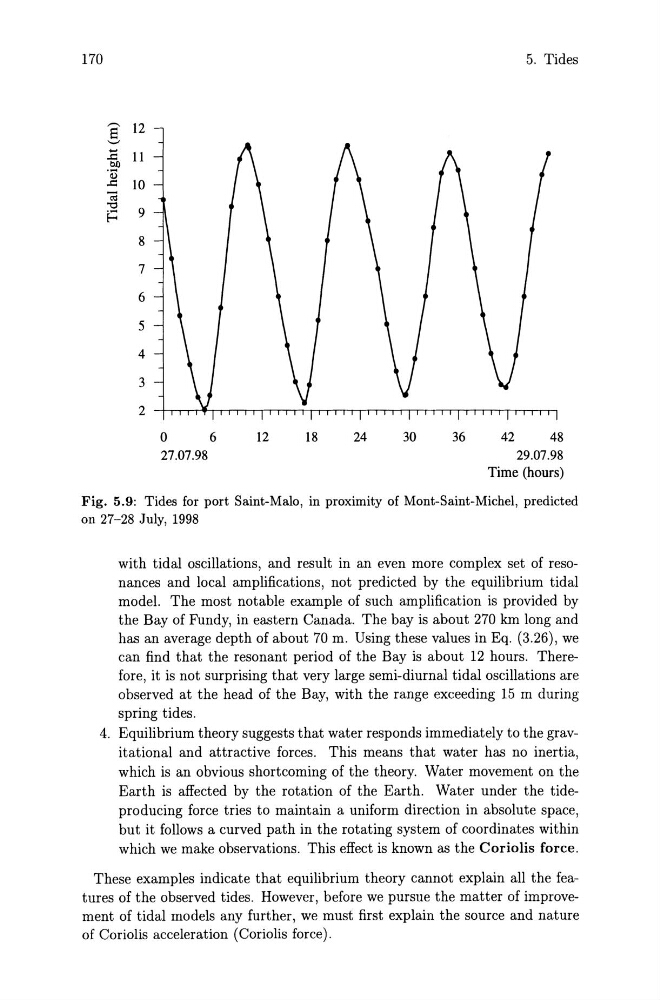
Fig. 5.9: Tides for port Saint-Malo, in proximity of Mont-Saint-Michel, predicted
on 27-28 July, 1998
with tidal oscillations, and result in an even more complex set of resonances and local amplifications, not predicted by the equilibrium tidal
model. The most notable example of such amplification is provided by
the Bay of Fundy, in eastern Canada. The bay is about 270 km long and
has an average depth of about 70 m. Using these values in Eq. (3.26), we
can find that the resonant period of the Bay is about 12 hours. Therefore, it is not surprising that very large semi-diurnal tidal oscillations are
observed at the head of the Bay, with the range exceeding 15 m during
spring tides.
4. Equilibrium theory suggests that water responds immediately to the gravitational and attractive forces. This means that water has no inertia,
which is an obvious shortcoming of the theory. Water movement on the
Earth is affected by the rotation of the Earth. Water under the tideproducing force tries to maintain a uniform direction in absolute space,
but it follows a curved path in the rotating system of coordinates within
which we make observations. This effect is known as the Coriolis force.
These examples indicate that equilibrium theory cannot explain all the features of the observed tides. However, before we pursue the matter of improvement of tidal models any further, we must first explain the source and nature
of Coriolis acceleration (Coriolis force).
~
12
8
'-'
... 11
..Q
I:l.()
'i)
..Q
10
';
'0
9
~
8
7
6
5
4
3
2
0
6
12
18
24
27.07.98
30
36
5. Tides
42
48
29.07.98
Time (hours)
Fig. 5.9: Tides for port Saint-Malo, in proximity of Mont-Saint-Michel, predicted
on 27-28 July, 1998
with tidal oscillations, and result in an even more complex set of resonances and local amplifications, not predicted by the equilibrium tidal
model. The most notable example of such amplification is provided by
the Bay of Fundy, in eastern Canada. The bay is about 270 km long and
has an average depth of about 70 m. Using these values in Eq. (3.26), we
can find that the resonant period of the Bay is about 12 hours. Therefore, it is not surprising that very large semi-diurnal tidal oscillations are
observed at the head of the Bay, with the range exceeding 15 m during
spring tides.
4. Equilibrium theory suggests that water responds immediately to the gravitational and attractive forces. This means that water has no inertia,
which is an obvious shortcoming of the theory. Water movement on the
Earth is affected by the rotation of the Earth. Water under the tideproducing force tries to maintain a uniform direction in absolute space,
but it follows a curved path in the rotating system of coordinates within
which we make observations. This effect is known as the Coriolis force.
These examples indicate that equilibrium theory cannot explain all the features of the observed tides. However, before we pursue the matter of improvement of tidal models any further, we must first explain the source and nature
of Coriolis acceleration (Coriolis force).