

168
5. Tides
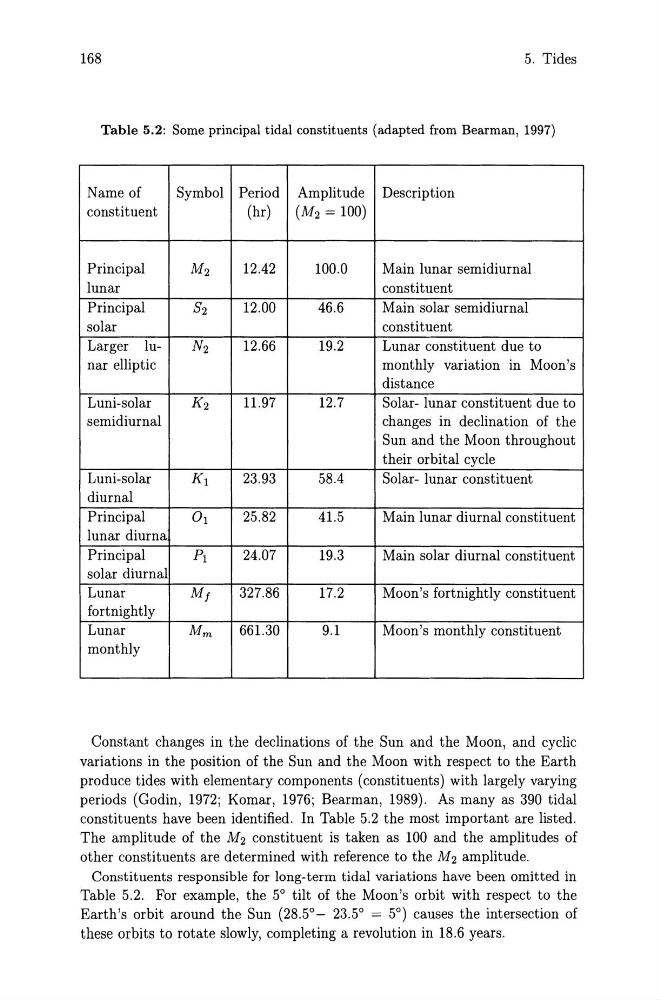
Table 5.2: Some principal tidal constituents (adapted from Bearman, 1997)
Name of
Symbol Period Amplitude Description
constituent
(hr)
(M2 = 100)
Principal
M2
12.42
100.0
Main lunar semi diurnal
lunar
constituent
Principal
52
12.00
46.6
Main solar semidiurnal
solar
constituent
Larger luN2
12.66
19.2
Lunar constituent due to
nar elliptic
monthly variation in Moon's
distance
Luni-solar
K2
11.97
12.7
Solar- lunar constituent due to
semidiurnal
changes in declination of the
Sun and the Moon throughout
their orbital cycle
Luni-solar
Kl
23.93
58.4
Solar- lunar constituent
diurnal
Principal
0 1
25.82
41.5
Main lunar diurnal constituent
lunar diurna
Principal
PI
24.07
19.3
Main solar diurnal constituent
solar diurnal
Lunar
M f
327.86
17.2
Moon's fortnightly constituent
fortnightly
Lunar
Mm
661.30
9.1
Moon's monthly constituent
monthly
Constant changes in the declinations of the Sun and the Moon, and cyclic
variations in the position of the Sun and the Moon with respect to the Earth
produce tides with elementary components (constituents) with largely varying
periods (Godin, 1972; Komar, 1976; Bearman, 1989). As many as 390 tidal
constituents have been identified. In Table 5.2 the most important are listed.
The amplitude of the M2 constituent is taken as 100 and the amplitudes of
other constituents are determined with reference to the M2 amplitude.
Constituents responsible for long-term tidal variations have been omitted in
Table 5.2. For example, the 5° tilt of the Moon's orbit with respect to the
Earth's orbit around the Sun (28.5°- 23.5° = 5°) causes the intersection of
these orbits to rotate slowly, completing a revolution in 18.6 years.
5. Tides
Table 5.2: Some principal tidal constituents (adapted from Bearman, 1997)
Name of
Symbol Period Amplitude Description
constituent
(hr)
(M2 = 100)
Principal
M2
12.42
100.0
Main lunar semi diurnal
lunar
constituent
Principal
52
12.00
46.6
Main solar semidiurnal
solar
constituent
Larger luN2
12.66
19.2
Lunar constituent due to
nar elliptic
monthly variation in Moon's
distance
Luni-solar
K2
11.97
12.7
Solar- lunar constituent due to
semidiurnal
changes in declination of the
Sun and the Moon throughout
their orbital cycle
Luni-solar
Kl
23.93
58.4
Solar- lunar constituent
diurnal
Principal
0 1
25.82
41.5
Main lunar diurnal constituent
lunar diurna
Principal
PI
24.07
19.3
Main solar diurnal constituent
solar diurnal
Lunar
M f
327.86
17.2
Moon's fortnightly constituent
fortnightly
Lunar
Mm
661.30
9.1
Moon's monthly constituent
monthly
Constant changes in the declinations of the Sun and the Moon, and cyclic
variations in the position of the Sun and the Moon with respect to the Earth
produce tides with elementary components (constituents) with largely varying
periods (Godin, 1972; Komar, 1976; Bearman, 1989). As many as 390 tidal
constituents have been identified. In Table 5.2 the most important are listed.
The amplitude of the M2 constituent is taken as 100 and the amplitudes of
other constituents are determined with reference to the M2 amplitude.
Constituents responsible for long-term tidal variations have been omitted in
Table 5.2. For example, the 5° tilt of the Moon's orbit with respect to the
Earth's orbit around the Sun (28.5°- 23.5° = 5°) causes the intersection of
these orbits to rotate slowly, completing a revolution in 18.6 years.