

4.2 Wave Parameters Based on Small Amplitude Wave Theory
117
is similar but now the particle path is elliptical. More discussion on orbital
velocities is given in Appendix C.5.4.
The vertical profiles of orbital velocities u and w, for four phase positions
and for t = 0, are shown in Fig. 4.7. The highest horizontal orbital velocities
are those under the wave crest; they are directed parallel to the direction of
wave propagation. In that part of the wave, when surface displacement is zero,
horizontal orbital velocity is also zero. For the profile at the wave trough, the
direction of orbital velocity is the reverse to the direction of wave propagation
and its magnitude at a given level is the same as for the wave crest profile. At
profiles where surface displacement vanishes, i.e. for x = L/4 and x = 3L/4,
only vertical orbital velocity exists, with values attenuating with submergence;
at the sea bottom, vertical velocity is obviously zero because of zero bottom
permeability. In Appendix D, the computer program D.43 is given to calculate
the velocities at wave crest and wave trough and for arbitrary wave parameters.
Orbital Acceleration Components. The particle acceleration at a given
point (x, z) and time, t, is obtained by differentiation of the particle velocities
with respect to time, i. e.:
au gkH cosh k(z + h) .
ax(x, z, t) = - = - -
( )
sm(kx - wt),
at
2
cosh kh
(4.28)
OW
gkH sinhk(z+h)
az(x, z, t) = - = - - -
() cos(kx - wt),
at
2
cosh kh
(4.29)
or:
gkH sinhk(z+h)
az(x,z,t)=-( )
cos(kx-wt+1l').
2
cosh kh
( 4.30)
Water Particle Displacement. As was shown in Figs. 3.3 and 3.4, water
particles under the influence of wave motion move along closed circular or
closed elliptical paths. The shape and length of these paths can be found by
integrating the particle velocities, u and w, with respect to time. The resulting
path equation take the form (Massel, 1989):
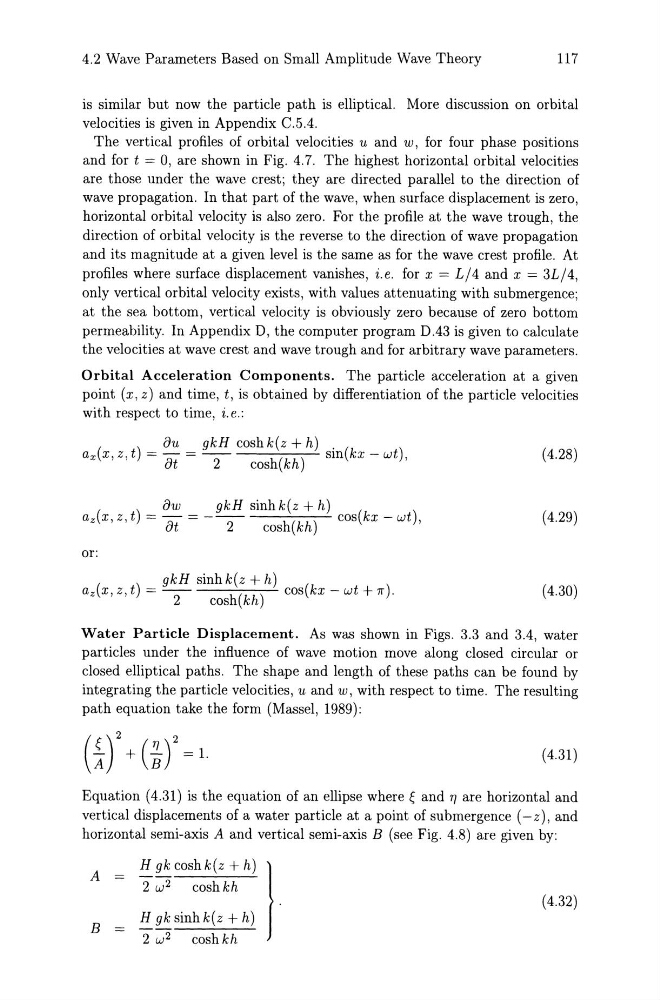
(4.31 )
Equation (4.31) is the equation of an ellipse where ~ and 'f) are horizontal and
vertical displacements of a water particle at a point of submergence (- z ), and
horizontal semi-axis A and vertical semi-axis B (see Fig. 4.8) are given by:
A = H 9 k cosh k (z + h) }
2 w 2 coshkh
.
B
H gk sinhk(z + h)
2 w 2 coshkh
( 4.32)
117
is similar but now the particle path is elliptical. More discussion on orbital
velocities is given in Appendix C.5.4.
The vertical profiles of orbital velocities u and w, for four phase positions
and for t = 0, are shown in Fig. 4.7. The highest horizontal orbital velocities
are those under the wave crest; they are directed parallel to the direction of
wave propagation. In that part of the wave, when surface displacement is zero,
horizontal orbital velocity is also zero. For the profile at the wave trough, the
direction of orbital velocity is the reverse to the direction of wave propagation
and its magnitude at a given level is the same as for the wave crest profile. At
profiles where surface displacement vanishes, i.e. for x = L/4 and x = 3L/4,
only vertical orbital velocity exists, with values attenuating with submergence;
at the sea bottom, vertical velocity is obviously zero because of zero bottom
permeability. In Appendix D, the computer program D.43 is given to calculate
the velocities at wave crest and wave trough and for arbitrary wave parameters.
Orbital Acceleration Components. The particle acceleration at a given
point (x, z) and time, t, is obtained by differentiation of the particle velocities
with respect to time, i. e.:
au gkH cosh k(z + h) .
ax(x, z, t) = - = - -
( )
sm(kx - wt),
at
2
cosh kh
(4.28)
OW
gkH sinhk(z+h)
az(x, z, t) = - = - - -
() cos(kx - wt),
at
2
cosh kh
(4.29)
or:
gkH sinhk(z+h)
az(x,z,t)=-( )
cos(kx-wt+1l').
2
cosh kh
( 4.30)
Water Particle Displacement. As was shown in Figs. 3.3 and 3.4, water
particles under the influence of wave motion move along closed circular or
closed elliptical paths. The shape and length of these paths can be found by
integrating the particle velocities, u and w, with respect to time. The resulting
path equation take the form (Massel, 1989):
(4.31 )
Equation (4.31) is the equation of an ellipse where ~ and 'f) are horizontal and
vertical displacements of a water particle at a point of submergence (- z ), and
horizontal semi-axis A and vertical semi-axis B (see Fig. 4.8) are given by:
A = H 9 k cosh k (z + h) }
2 w 2 coshkh
.
B
H gk sinhk(z + h)
2 w 2 coshkh
( 4.32)