

4.2 Wave Parameters Based on Small Amplitude Wave Theory
113
The wave crest appears when the argument of the cos function is equal to zero;
when x - Ct = 0 or when xlt = C. This means that the wave crest and any
other point on the wave surface propagate with the phase velocity, C. The
surface displacement (4.13) is illustrated in Fig. 4.2. A computer program for
calculating wave surface displacement is given in Appendix D (see program
D.42).
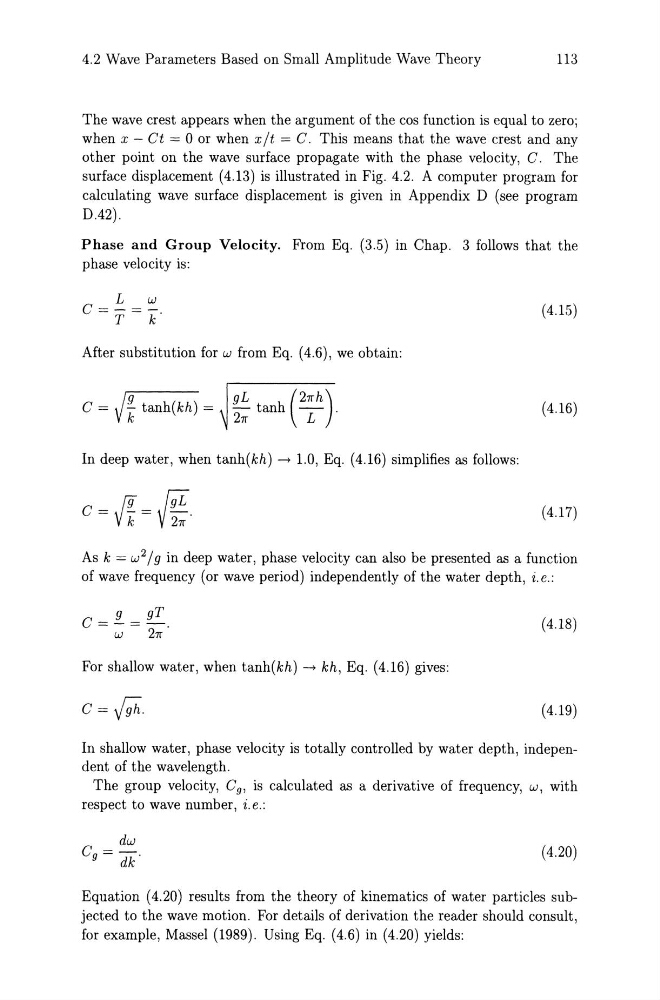
Phase and Group Velocity. From Eq. (3.5) in Chap. 3 follows that the
phase velocity is:
L w
C = - =-.
T
k
After substitution for w from Eq. (4.6), we obtain:
C = Jf tanh(kh) = gL tanh (27rh).
27r
L
In deep water, when tanh(kh) -> 1.0, Eq. (4.16) simplifies as follows:
( 4.15)
(4.16)
( 4.17)
As k = w 2 I 9 in deep water, phase velocity can also be presented as a function
of wave frequency (or wave period) independently of the water depth, i.e.:
(4.18)
For shallow water, when tanh(kh) -> kh, Eq. (4.16) gives:
C = f;h.
(4.19)
In shallow water, phase velocity is totally controlled by water depth, independent of the wavelength.
The group velocity, C 91 is calculated as a derivative of frequency, w, with
respect to wave number, i.e.:
dw
C 9 = - ·
dk
(4.20)
Equation (4.20) results from the theory of kinematics of water particles subjected to the wave motion. For details of derivation the reader should consult,
for example, Massel (1989). Using Eq. (4.6) in (4.20) yields:
113
The wave crest appears when the argument of the cos function is equal to zero;
when x - Ct = 0 or when xlt = C. This means that the wave crest and any
other point on the wave surface propagate with the phase velocity, C. The
surface displacement (4.13) is illustrated in Fig. 4.2. A computer program for
calculating wave surface displacement is given in Appendix D (see program
D.42).
Phase and Group Velocity. From Eq. (3.5) in Chap. 3 follows that the
phase velocity is:
L w
C = - =-.
T
k
After substitution for w from Eq. (4.6), we obtain:
C = Jf tanh(kh) = gL tanh (27rh).
27r
L
In deep water, when tanh(kh) -> 1.0, Eq. (4.16) simplifies as follows:
( 4.15)
(4.16)
( 4.17)
As k = w 2 I 9 in deep water, phase velocity can also be presented as a function
of wave frequency (or wave period) independently of the water depth, i.e.:
(4.18)
For shallow water, when tanh(kh) -> kh, Eq. (4.16) gives:
C = f;h.
(4.19)
In shallow water, phase velocity is totally controlled by water depth, independent of the wavelength.
The group velocity, C 91 is calculated as a derivative of frequency, w, with
respect to wave number, i.e.:
dw
C 9 = - ·
dk
(4.20)
Equation (4.20) results from the theory of kinematics of water particles subjected to the wave motion. For details of derivation the reader should consult,
for example, Massel (1989). Using Eq. (4.6) in (4.20) yields: