

3.8 Storm Surges
105
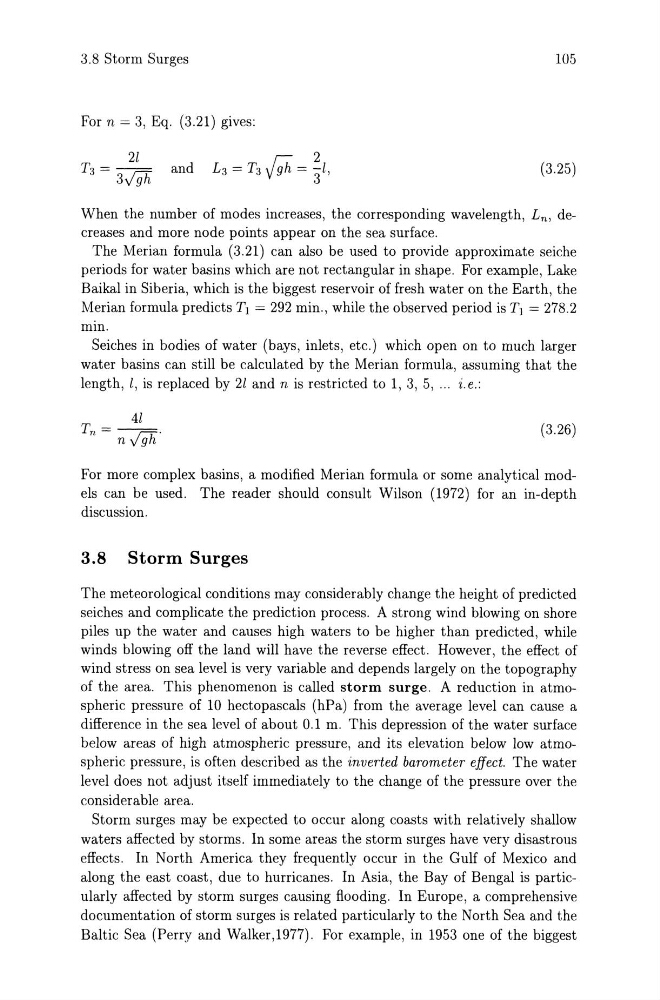
For n = 3, Eq. (3.21) gives:
(3.25)
When the number of modes increases, the corresponding wavelength, L n , decreases and more node points appear on the sea surface.
The Merian formula (3.21) can also be used to provide approximate seiche
periods for water basins which are not rectangular in shape. For example, Lake
Baikal in Siberia, which is the biggest reservoir of fresh water on the Earth, the
Merian formula predicts Tl = 292 min., while the observed period is Tl = 278.2
min.
Seiches in bodies of water (bays, inlets, etc.) which open on to much larger
water basins can still be calculated by the Merian formula, assuming that the
length, I, is replaced by 21 and n is restricted to 1, 3, 5, ... z.e.:
(3.26)
For more complex basins, a modified Merian formula or some analytical models can be used. The reader should consult Wilson (1972) for an in-depth
discussion.
3.8 Storm Surges
The meteorological conditions may considerably change the height of predicted
seiches and complicate the prediction process. A strong wind blowing on shore
piles up the water and causes high waters to be higher than predicted, while
winds blowing off the land will have the reverse effect. However, the effect of
wind stress on sea level is very variable and depends largely on the topography
of the area. This phenomenon is called storm surge. A reduction in atmospheric pressure of 10 hectopascals (hPa) from the average level can cause a
difference in the sea level of about 0.1 m. This depression of the water surface
below areas of high atmospheric pressure, and its elevation below low atmospheric pressure, is often described as the inverted barometer effect. The water
level does not adjust itself immediately to the change of the pressure over the
considerable area.
Storm surges may be expected to occur along coasts with relatively shallow
waters affected by storms. In some areas the storm surges have very disastrous
effects. In North America they frequently occur in the Gulf of Mexico and
along the east coast, due to hurricanes. In Asia, the Bay of Bengal is particularly affected by storm surges causing flooding. In Europe, a comprehensive
documentation of storm surges is related particularly to the North Sea and the
Baltic Sea (Perry and Walker,1977). For example, in 1953 one of the biggest
105
For n = 3, Eq. (3.21) gives:
(3.25)
When the number of modes increases, the corresponding wavelength, L n , decreases and more node points appear on the sea surface.
The Merian formula (3.21) can also be used to provide approximate seiche
periods for water basins which are not rectangular in shape. For example, Lake
Baikal in Siberia, which is the biggest reservoir of fresh water on the Earth, the
Merian formula predicts Tl = 292 min., while the observed period is Tl = 278.2
min.
Seiches in bodies of water (bays, inlets, etc.) which open on to much larger
water basins can still be calculated by the Merian formula, assuming that the
length, I, is replaced by 21 and n is restricted to 1, 3, 5, ... z.e.:
(3.26)
For more complex basins, a modified Merian formula or some analytical models can be used. The reader should consult Wilson (1972) for an in-depth
discussion.
3.8 Storm Surges
The meteorological conditions may considerably change the height of predicted
seiches and complicate the prediction process. A strong wind blowing on shore
piles up the water and causes high waters to be higher than predicted, while
winds blowing off the land will have the reverse effect. However, the effect of
wind stress on sea level is very variable and depends largely on the topography
of the area. This phenomenon is called storm surge. A reduction in atmospheric pressure of 10 hectopascals (hPa) from the average level can cause a
difference in the sea level of about 0.1 m. This depression of the water surface
below areas of high atmospheric pressure, and its elevation below low atmospheric pressure, is often described as the inverted barometer effect. The water
level does not adjust itself immediately to the change of the pressure over the
considerable area.
Storm surges may be expected to occur along coasts with relatively shallow
waters affected by storms. In some areas the storm surges have very disastrous
effects. In North America they frequently occur in the Gulf of Mexico and
along the east coast, due to hurricanes. In Asia, the Bay of Bengal is particularly affected by storm surges causing flooding. In Europe, a comprehensive
documentation of storm surges is related particularly to the North Sea and the
Baltic Sea (Perry and Walker,1977). For example, in 1953 one of the biggest