

98
6
1
-90
-70
22
19
13
-50
-30
-10
3 An Introduction to Surface Waves
Percentage of total energy (%)
22
19
13
6
1
10
30
50
70
90
Angle flo) with respect to wind direction
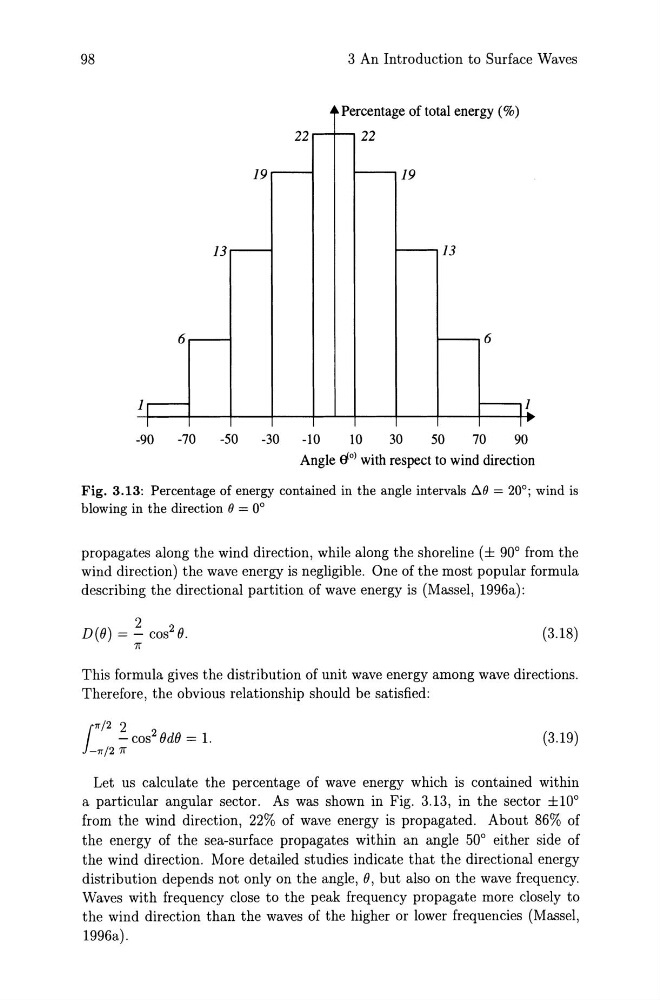
Fig. 3.13: Percentage of energy contained in the angle intervals 6..(} = 20°; wind is
blowing in the direction () = 0°
propagates along the wind direction, while along the shoreline (± 90° from the
wind direction) the wave energy is negligible. One of the most popular formula
describing the directional partition of wave energy is (Massel, 1996a):
2
D(e) = - cos 2 e.
7r
(3.18)
This formula gives the distribution of unit wave energy among wave directions.
Therefore, the obvious relationship should be satisfied:
(3.19)
Let us calculate the percentage of wave energy which is contained within
a particular angular sector. As was shown in Fig. 3.13, in the sector ±10 0
from the wind direction, 22% of wave energy is propagated. About 86% of
the energy of the sea-surface propagates within an angle 50° either side of
the wind direction. More detailed studies indicate that the directional energy
distribution depends not only on the angle, e, but also on the wave frequency.
Waves with frequency close to the peak frequency propagate more closely to
the wind direction than the waves of the higher or lower frequencies (Massel,
1996a).
6
1
-90
-70
22
19
13
-50
-30
-10
3 An Introduction to Surface Waves
Percentage of total energy (%)
22
19
13
6
1
10
30
50
70
90
Angle flo) with respect to wind direction
Fig. 3.13: Percentage of energy contained in the angle intervals 6..(} = 20°; wind is
blowing in the direction () = 0°
propagates along the wind direction, while along the shoreline (± 90° from the
wind direction) the wave energy is negligible. One of the most popular formula
describing the directional partition of wave energy is (Massel, 1996a):
2
D(e) = - cos 2 e.
7r
(3.18)
This formula gives the distribution of unit wave energy among wave directions.
Therefore, the obvious relationship should be satisfied:
(3.19)
Let us calculate the percentage of wave energy which is contained within
a particular angular sector. As was shown in Fig. 3.13, in the sector ±10 0
from the wind direction, 22% of wave energy is propagated. About 86% of
the energy of the sea-surface propagates within an angle 50° either side of
the wind direction. More detailed studies indicate that the directional energy
distribution depends not only on the angle, e, but also on the wave frequency.
Waves with frequency close to the peak frequency propagate more closely to
the wind direction than the waves of the higher or lower frequencies (Massel,
1996a).