

88
3 An Introduction to Surface Waves
\ ,
b
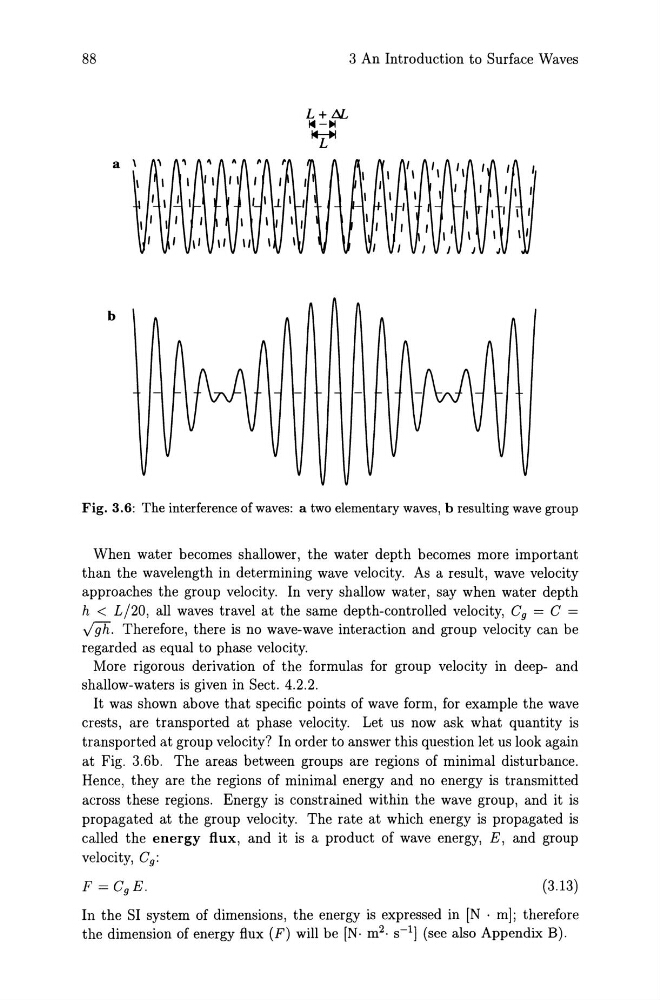
Fig. 3.6: The interference of waves: a two elementary waves, b resulting wave group
When water becomes shallower, the water depth becomes more important
than the wavelength in determining wave velocity. As a result, wave velocity
approaches the group velocity. In very shallow water, say when water depth
h < L/20, all waves travel at the same depth-controlled velocity, Cg = C =
ygh. Therefore, there is no wave-wave interaction and group velocity can be
regarded as equal to phase velocity.
More rigorous derivation of the formulas for group velocity in deep- and
shallow-waters is given in Sect. 4.2.2.
It was shown above that specific points of wave form, for example the wave
crests, are transported at phase velocity. Let us now ask what quantity is
transported at group velocity? In order to answer this question let us look again
at Fig. 3.6b. The areas between groups are regions of minimal disturbance.
Hence, they are the regions of minimal energy and no energy is transmitted
across these regions. Energy is constrained within the wave group, and it is
propagated at the group velocity. The rate at which energy is propagated is
called the energy flux, and it is a product of wave energy, E, and group
velocity, Cg :
(3.13)
In the SI system of dimensions, the energy is expressed in [N . m]; therefore
the dimension of energy flux (F) will be [N· m 2 . s-l] (see also Appendix B).
3 An Introduction to Surface Waves
\ ,
b
Fig. 3.6: The interference of waves: a two elementary waves, b resulting wave group
When water becomes shallower, the water depth becomes more important
than the wavelength in determining wave velocity. As a result, wave velocity
approaches the group velocity. In very shallow water, say when water depth
h < L/20, all waves travel at the same depth-controlled velocity, Cg = C =
ygh. Therefore, there is no wave-wave interaction and group velocity can be
regarded as equal to phase velocity.
More rigorous derivation of the formulas for group velocity in deep- and
shallow-waters is given in Sect. 4.2.2.
It was shown above that specific points of wave form, for example the wave
crests, are transported at phase velocity. Let us now ask what quantity is
transported at group velocity? In order to answer this question let us look again
at Fig. 3.6b. The areas between groups are regions of minimal disturbance.
Hence, they are the regions of minimal energy and no energy is transmitted
across these regions. Energy is constrained within the wave group, and it is
propagated at the group velocity. The rate at which energy is propagated is
called the energy flux, and it is a product of wave energy, E, and group
velocity, Cg :
(3.13)
In the SI system of dimensions, the energy is expressed in [N . m]; therefore
the dimension of energy flux (F) will be [N· m 2 . s-l] (see also Appendix B).