

78
Marine Mammal Physiology: Requisites for Ocean Living
greater fluidity and rapid expansion capabilities to cope with repeated collapse and reinflation has been reported in pinnipeds. These functional adaptations appear to be supported by
molecular modifications in key protein and lipid compositional changes, as well as adaptations in the secretory mechanisms of the cells (Foot et al. 2006). Thus, the surfactant compositions in pinnipeds may have been selected to help recruitment of closed alveoli following
deep dives. Surfactant production may also be triggered by diving, supporting the idea that
pressure is the driving force behind observed differences in surfactant levels (Foot et al. 2006).
While selection at the molecular level has been investigated between different marine mammal groups, analysis of surfactant composition has been primarily conducted on samples
from pinnipeds and much less is known about cetacean surfactants. Preliminary data suggest
that the fluidizing phospholipids are not increased in odontocetes (Gutierrez et al. 2015).
4.2.6 Diving diseases
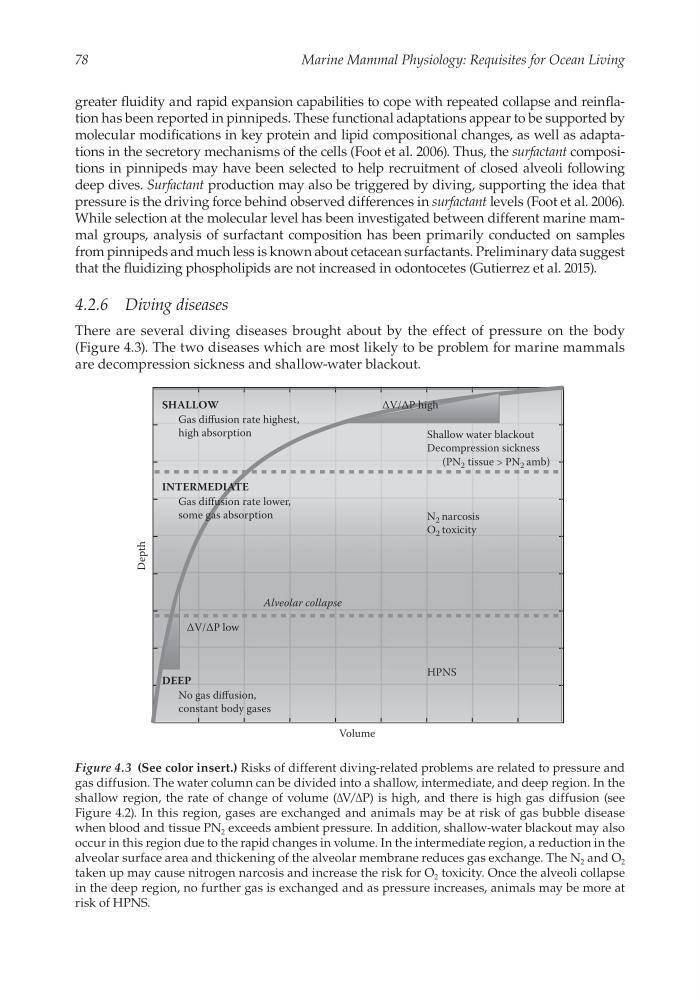
There are several diving diseases brought about by the effect of pressure on the body
(Figure 4.3). The two diseases which are most likely to be problem for marine mammals
are decompression sickness and shallow-water blackout.
SHALLOW
Gas diiusion rate highest,
high absorption
Alveolar collapse
Depth
INTERMEDIATE
Gas diffusion rate lower,
some gas absorption
DEEP
No gas diusion,
constant body gases
ΔV/ΔP low
Shallow water blackout
Decompression sickness
HPNS
N 2 narcosis
O 2 toxicity
Volume
(PN 2 tissue > PN 2 amb)
ΔV/ΔP high
Figure 4.3 (See color insert.) Risks of different diving-related problems are related to pressure and
gas diffusion. The water column can be divided into a shallow, intermediate, and deep region. In the
shallow region, the rate of change of volume (ΔV/ΔP) is high, and there is high gas diffusion (see
Figure 4.2). In this region, gases are exchanged and animals may be at risk of gas bubble disease
when blood and tissue PN 2 exceeds ambient pressure. In addition, shallow-water blackout may also
occur in this region due to the rapid changes in volume. In the intermediate region, a reduction in the
alveolar surface area and thickening of the alveolar membrane reduces gas exchange. The N 2 and O 2
taken up may cause nitrogen narcosis and increase the risk for O 2 toxicity. Once the alveoli collapse
in the deep region, no further gas is exchanged and as pressure increases, animals may be more at
risk of HPNS.
Marine Mammal Physiology: Requisites for Ocean Living
greater fluidity and rapid expansion capabilities to cope with repeated collapse and reinflation has been reported in pinnipeds. These functional adaptations appear to be supported by
molecular modifications in key protein and lipid compositional changes, as well as adaptations in the secretory mechanisms of the cells (Foot et al. 2006). Thus, the surfactant compositions in pinnipeds may have been selected to help recruitment of closed alveoli following
deep dives. Surfactant production may also be triggered by diving, supporting the idea that
pressure is the driving force behind observed differences in surfactant levels (Foot et al. 2006).
While selection at the molecular level has been investigated between different marine mammal groups, analysis of surfactant composition has been primarily conducted on samples
from pinnipeds and much less is known about cetacean surfactants. Preliminary data suggest
that the fluidizing phospholipids are not increased in odontocetes (Gutierrez et al. 2015).
4.2.6 Diving diseases
There are several diving diseases brought about by the effect of pressure on the body
(Figure 4.3). The two diseases which are most likely to be problem for marine mammals
are decompression sickness and shallow-water blackout.
SHALLOW
Gas diiusion rate highest,
high absorption
Alveolar collapse
Depth
INTERMEDIATE
Gas diffusion rate lower,
some gas absorption
DEEP
No gas diusion,
constant body gases
ΔV/ΔP low
Shallow water blackout
Decompression sickness
HPNS
N 2 narcosis
O 2 toxicity
Volume
(PN 2 tissue > PN 2 amb)
ΔV/ΔP high
Figure 4.3 (See color insert.) Risks of different diving-related problems are related to pressure and
gas diffusion. The water column can be divided into a shallow, intermediate, and deep region. In the
shallow region, the rate of change of volume (ΔV/ΔP) is high, and there is high gas diffusion (see
Figure 4.2). In this region, gases are exchanged and animals may be at risk of gas bubble disease
when blood and tissue PN 2 exceeds ambient pressure. In addition, shallow-water blackout may also
occur in this region due to the rapid changes in volume. In the intermediate region, a reduction in the
alveolar surface area and thickening of the alveolar membrane reduces gas exchange. The N 2 and O 2
taken up may cause nitrogen narcosis and increase the risk for O 2 toxicity. Once the alveoli collapse
in the deep region, no further gas is exchanged and as pressure increases, animals may be more at
risk of HPNS.