

73
Chapter four: Pressure regulation
corresponding partial pressure of that gas in gas phase, referred to as the gas tension.
However, a variation in solubility can have a significant effect on this. Some gases, such as
N 2 and O 2 have relatively low solubility, while CO 2 dissociates into carbonic acid and has
high solubility. Consequently, the molar concentration dissolved will be related to both the
partial pressure and the solubility, and the molar concentration of a given change in gas
tension will differ considerably for different gases.
During descent, the partial pressure of the gases in the lung increases in proportion
with the pressure (Dalton’s law). As long as the alveoli are open and there is gas exchange,
the gas tension in the arterial blood increases as gas diffuses from high to low pressure. It
is this increased partial pressure of different gases which leads to many of the gas diseases
discussed in Section 4.2.6.
4.2.3 Pressure, biochemistry, and blood flow
The effects of pressure on the body can be caused via its effect on gas spaces and solubility, or can be caused directly in terms of biochemical reactions and cellular structure.
The deepest point in the ocean lies at a depth of 11.8 km (i.e., pressures of >1000 ATA).
However, most marine mammals live within the upper waters of the ocean at pressures
of 1–300 ATA. Although protein denaturation is only caused at extremely high pressures
(>4000 ATA) beyond those found in the ocean, pressures in the ocean can nevertheless
have an effect at the biochemical and cellular level. During any reaction, pressure can have
an effect via the changes in volume caused by the reaction. When a process occurs with
an increase in volume, pressure inhibits that process; and when a process occurs with a
decrease in volume, pressure enhances that process (Somero 1992).
Comparative studies have shown that the pressure sensitivities of enzymes, structural
proteins, and membrane-based systems differ markedly between shallow- and deep-living
species. Some fish that live as shallow as 500 m show biochemical adaptations that allow
their enzymatic reactions to be pressure-tolerant (Siebenaller and Garrett 2002; Somero 1992).
Although many marine mammal species stay in relatively shallow waters for much of
the time, others visit depths well beyond these (Table 4.1). What is perhaps most remarkable is that whereas many marine species have a relatively narrow range of pressure at
which they function, marine mammals must function over a remarkable range of diving
depths. There have been only a few studies of the biochemical tolerance to pressure found
in marine mammals. In general, these have shown that marine mammal tissue enzymes
and living red blood cells appear to be adapted to pressure, either showing no reaction
to pressure changes, or even functioning better under pressure conditions (Castellini
et al. 2001, 2002; Croll et al. 1992; Williams et al. 2001). Recent work has looked at immune
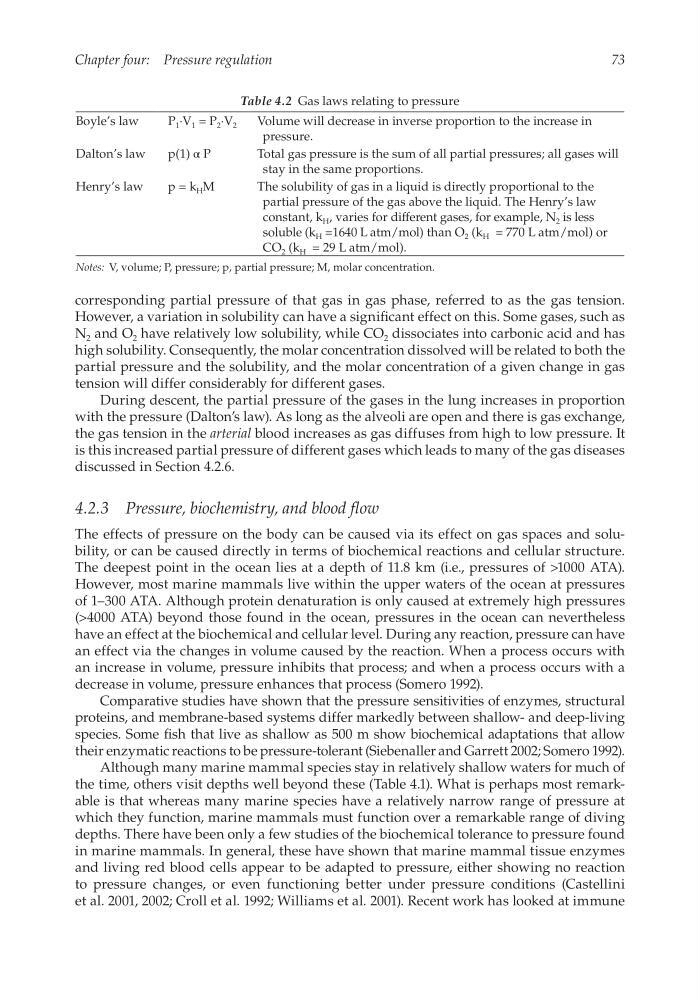
Table 4.2 Gas laws relating to pressure
Boyle’s law
P 1 ·V 1 = P 2 ·V 2
Volume will decrease in inverse proportion to the increase in
pressure.
Dalton’s law
p(1) α P
Total gas pressure is the sum of all partial pressures; all gases will
stay in the same proportions.
Henry’s law
p = k H M
The solubility of gas in a liquid is directly proportional to the
partial pressure of the gas above the liquid. The Henry’s law
constant, k H , varies for different gases, for example, N 2 is less
soluble (k H =1640 L atm/mol) than O 2 (k H = 770 L atm/mol) or
CO 2 (k H = 29 L atm/mol).
Notes: V, volume; P, pressure; p, partial pressure; M, molar concentration.
Chapter four: Pressure regulation
corresponding partial pressure of that gas in gas phase, referred to as the gas tension.
However, a variation in solubility can have a significant effect on this. Some gases, such as
N 2 and O 2 have relatively low solubility, while CO 2 dissociates into carbonic acid and has
high solubility. Consequently, the molar concentration dissolved will be related to both the
partial pressure and the solubility, and the molar concentration of a given change in gas
tension will differ considerably for different gases.
During descent, the partial pressure of the gases in the lung increases in proportion
with the pressure (Dalton’s law). As long as the alveoli are open and there is gas exchange,
the gas tension in the arterial blood increases as gas diffuses from high to low pressure. It
is this increased partial pressure of different gases which leads to many of the gas diseases
discussed in Section 4.2.6.
4.2.3 Pressure, biochemistry, and blood flow
The effects of pressure on the body can be caused via its effect on gas spaces and solubility, or can be caused directly in terms of biochemical reactions and cellular structure.
The deepest point in the ocean lies at a depth of 11.8 km (i.e., pressures of >1000 ATA).
However, most marine mammals live within the upper waters of the ocean at pressures
of 1–300 ATA. Although protein denaturation is only caused at extremely high pressures
(>4000 ATA) beyond those found in the ocean, pressures in the ocean can nevertheless
have an effect at the biochemical and cellular level. During any reaction, pressure can have
an effect via the changes in volume caused by the reaction. When a process occurs with
an increase in volume, pressure inhibits that process; and when a process occurs with a
decrease in volume, pressure enhances that process (Somero 1992).
Comparative studies have shown that the pressure sensitivities of enzymes, structural
proteins, and membrane-based systems differ markedly between shallow- and deep-living
species. Some fish that live as shallow as 500 m show biochemical adaptations that allow
their enzymatic reactions to be pressure-tolerant (Siebenaller and Garrett 2002; Somero 1992).
Although many marine mammal species stay in relatively shallow waters for much of
the time, others visit depths well beyond these (Table 4.1). What is perhaps most remarkable is that whereas many marine species have a relatively narrow range of pressure at
which they function, marine mammals must function over a remarkable range of diving
depths. There have been only a few studies of the biochemical tolerance to pressure found
in marine mammals. In general, these have shown that marine mammal tissue enzymes
and living red blood cells appear to be adapted to pressure, either showing no reaction
to pressure changes, or even functioning better under pressure conditions (Castellini
et al. 2001, 2002; Croll et al. 1992; Williams et al. 2001). Recent work has looked at immune
Table 4.2 Gas laws relating to pressure
Boyle’s law
P 1 ·V 1 = P 2 ·V 2
Volume will decrease in inverse proportion to the increase in
pressure.
Dalton’s law
p(1) α P
Total gas pressure is the sum of all partial pressures; all gases will
stay in the same proportions.
Henry’s law
p = k H M
The solubility of gas in a liquid is directly proportional to the
partial pressure of the gas above the liquid. The Henry’s law
constant, k H , varies for different gases, for example, N 2 is less
soluble (k H =1640 L atm/mol) than O 2 (k H = 770 L atm/mol) or
CO 2 (k H = 29 L atm/mol).
Notes: V, volume; P, pressure; p, partial pressure; M, molar concentration.